
Summary:
- 100,000 people in Margibi and Montserrado counties miss out on promised access to safe water as $US11 million USAID project ends
- Cancellation comes as communities see increase in water-borne diseases, according to local health officials
- Government Water, Sanitation and Hygiene Commission holds talks with partners for intervention
By Grace Joshua with New Narratives
YARNWEILLE, Margibi county —Beatrice Paye has a firsthand experience of the impact of waterborne diseases. In April, the community leader’s eight-year-old daughter was hospitalized for a week with a dangerous case of diarrhea. Paye blames the illness on water her daughter drank from the creek here.
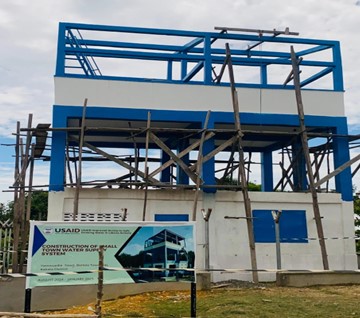
Paye and the community of 700 people thought they would be free of these threats by now. They were one of 14 communities that would have access to clean drinking water as a result of a $US11 million U.S.A.I.D-funded project. But that was before Donald Trump, in his second term as U.S. president, shut down America’s international development agency leaving millions of people around the world without the lifesaving interventions the U.S. had promised.
“I felt bad that we have a water facility standing here, and still I had to give my daughter creek water to drink,” says Paye. “If U.S.A.I.D. had finished the project, this wouldn’t be happening.”
Access to safe drinking water remains a major challenge across Liberia, with only about 10 percent of the population served by safely managed systems, according to a 2022 report by the World Health Organization and UNICEF. Experts consider clean water and sanitation be one of the most impactful investments that can be made, with every dollar of aid leading to more than $4 in value created by the health and education opportunities people are able to take part in when they’re not sickened by dirty water or working hard to find it.
More than 100,000 residents across Margibi and Montserrado counties have been left disappointed by the project’s sudden halt. As the population here grows and climate change has delayed the start of the rainy season, the impact of a lack of clean water is getting worse by the year.
“We use the nearby creek for washing, bathing, and cooking,” says Irene Dalowor, chairwoman of the nearby Baypolu community. One hand pump and well now serves more than 1,000 residents. “During the dry season, it becomes almost impossible to get water from the pump.”
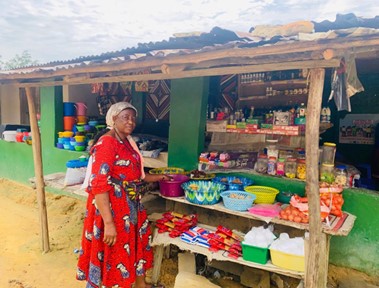
Paye’s daughter isn’t the only one who has been sickened this year. The case intake at the only clinic in Yarnweillie is reaching a crisis level according to Gbolu U. Morris, a registered nurse, who says she “treats up to seven patients daily for waterborne illnesses.”
The water improvement project was one of 27 of 29 U.S.A.I.D. projects shut down in Liberia. Before the aid cuts, the U.S. was Liberia’s largest country donor. In coming years, the country expects to lose as much as $300 million in funding for badly needed projects, according to Augustine Ngafuan, the country’s Finance Minister.

The Liberia Project Dashboard, which tracks development assistance to the country, said 55 percent of the $11 million in funding for the project was disbursed to Winrock and Water Aid, the implementing partners, as of January 2025.
In an interview, Luis Grimes, former monitoring and evaluation officer at Winrock, claimed that the project had been 95 percent completed in four communities: Sarah Johnson in Montserrado county and Dolo Town, Baypolu, and Yarnweillie in Margibi county.
But in a visit Frontpage Africa/New Narratives found that only one of 14 planned water facilities in Dolo Town had reached 95 percent completion. Others remained in early stages, with bags of cement, crushed rock, plumbing supplies, and sand still on-site. That has fueled anger and disappointment.
“If the government doesn’t have the means to complete the project, they should give the community the go-ahead to seek help and finish it,” says Afalh Peters of Baypolu. “We cannot afford to let this project go to waste. We want to use this water. We want people to graduate from using shallow wells. We are still suffering.”
Grimes says he hopes the government will step in to finish the work.
“I can imagine how frustrated they are that these facilities could not be completed and handover to them for the purpose that it was intended,” says Grimes.
According to George Yarngo, chief executive officer of Liberia’s Water, Sanitation, and Hygiene Commission, the Commission does not have funds to complete the project but has contracted World Hope International, an international NGO, for help.
In a Facebook post, World Hope International Liberia called on the public to help fund the completion. But in an interview Richeleau A. Nance, country coordinator of the organization, confirmed they had raised some of the money and was waiting for the government through the Ministry of Internal Affairs to sign a memorandum of understanding.
Teron S.Y. Bartuah, program manager for water, sanitation and hygiene at World Hope said they had also discussed with the ministry “to assign one of the three vehicles turned over to the ministry by U.S.A.I.D. before its shutdown to World Hope International, to help with logistics.”
But in an interview, Francis Sakila Nyumalin, Liberia’s minister of internal affairs, rejected those claims.
“How do I get into an M.O.U. (memorandum of understanding)? To do what?” asked Nyumalin in an interview. “I will just get up from the clear blue sky and sign an M.O.U. with somebody? The only body that could advise me to give these three vehicles to anybody will be U.S.A.I.D., which wrote this communication and transferred the vehicles. I told them to the General Services Agency, (G.S.A.). If G.S.A. gives them a car, fine.”

For people here the challenge goes on with no help in sight. Every morning, before dawn, Ma Kumba Borley, 64, wakes and walks on dusty footpaths in her community with a yellow jerry can in hand in search of safe drinking water from the only creek here. It’s a three hour walk. She had hoped the project would bring an end to this daily toil freeing them to do other things and kids to go to school.
“The creek is very far,” says Ma Boley. “We walk to go to the farm, our children walk to go to the nearby high school, and then we have to walk again to get water from the creek. The water is not even clean or safe. We are not asking the government to feed us, we are praying that they complete this project to end our suffering.”
This story was a collaboration with New Narratives as part of the Investigating Liberia project. Funding was provided by the Swedish embassy in Liberia which had no say in the story’s content.