
Summary
- The Environmental Protection Agency warnsLiberia’s normally dry season has been disrupted by rainfall, flooding, and strong winds, showing the country’s growing vulnerability to climate change.
- Subsistence farmers report sharply reduced harvests due to unpredictable rainfall and soil disease, increasing food insecurity and prompting some to consider migration.
By Aria Deemie, climate change reporter with New Narratives
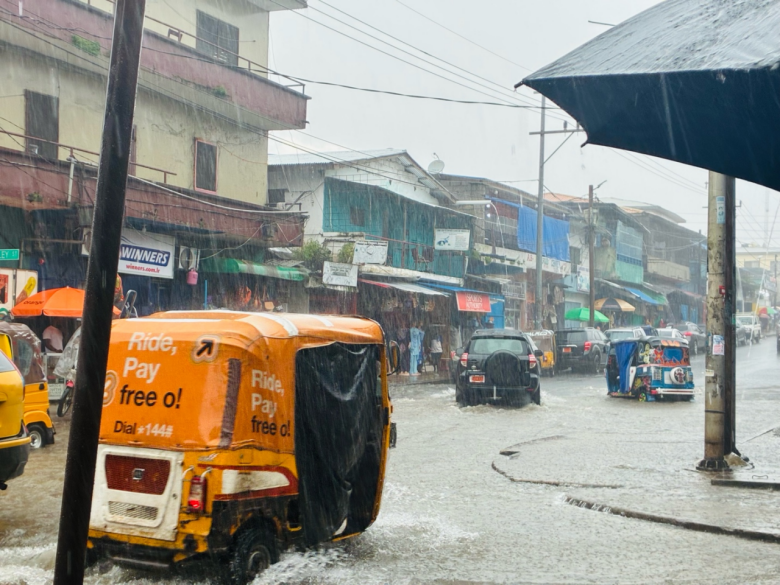
Liberia’s normally dry season has been disrupted by rainfall, flooding, and strong winds, raising fresh concerns about the country’s vulnerability to climate change and the growing risks to agriculture, infrastructure, and coastal communities.
For generations, Liberia’s weather followed a predictable pattern, with rains beginning in mid-April and ending by mid-October. Farmers, engineers, and planners relied on this rhythm to guide planting seasons, construction, and development projects. But that predictability has ended according to the Environmental Protection Agency. Heavy rains have continued well into what should be the peak of the dry season.
“This is not normal weather variability. It is climate change unfolding before our eyes,” said Emmanuel K. Urey Yarkpawolo, Executive Director of the Environmental Protection Agency of Liberia, during a press briefing Thursday in Monrovia. “Liberia is already experiencing heavier rainfall, storms outside traditional seasons, and more frequent flooding, and these events are becoming more destructive.”

Climate data supports the warning from environmental authorities. Reports from the World Bank and the United Nations Environment Programme show that Liberia is experiencing more intense and unpredictable rainfall, alongside rising flood risks linked to global warming. Scientific projections indicate that sea levels are rising and heavy rainfall events are becoming more frequent, threatening coastal communities where nearly 60 percent of the population lives. Together, the evidence suggests the unusual January rains are not isolated incidents but part of a broader climate shift already reshaping daily life and development planning across the country.
The consequences are already visible on farms across Liberia. Previous FrontPage Africa and New Narratives reporting found that erratic rainfall, flooding, and prolonged dry spells are devastating subsistence farmers, forcing many to abandon traditional agriculture altogether. A 2024 national survey of farmers in River Cess, Nimba, Bong, Montserrado, and Grand Bassa counties found that nearly all respondents said climate change had made farming increasingly unviable, with nine in ten considering migration to cities, mining areas, or even abroad.
In Margibi County, cassava farmer Gleekeh Peters said that unpredictable rains and soil disease had slashed her harvests by more than half. “I used to sell 100, sometimes 150 bags of cassava,” she said in an earlier interview. “Now, I can’t even sell 50 bags. The heavy rain and soil disease spoil the cassava—now nothing to eat or sell.”

As traditional farming systems falter, some innovators are experimenting with climate-resilient alternatives. A recent FrontPage Africa and New Narratives investigation revealed that Liberia’s first private commercial greenhouse farm, operated by entrepreneur Paul Wungko in Bong County, is helping shield crops from extreme rainfall and heat by using controlled environments, drip irrigation, and temperature monitoring.

“We can’t change the weather,” Wungko said during that reporting. “But we can adapt to it. The only way is smart agriculture.”
Experts say greenhouses could become a key adaptation tool as climate shocks intensify. But they warned that high costs—around ten thousand United States dollars per structure—and the withdrawal of international aid threaten to limit how widely such solutions can be scaled.
Beyond agriculture, the Environmental Protection Agency warned that Liberia faces two major climate threats: rising sea levels and increasingly erratic rainfall. Global sea levels are projected to rise up to one meter by the end of the century, putting Liberia’s 560‑kilometer coastline at serious risk of flooding, according to the Intergovernmental Panel on Climate Change and the World Bank’s climate risk reports.
Coastal erosion is already accelerating. Reporting has documented shoreline losses of up to three meters per year in parts of Montserrado, Grand Bassa, and Sinoe counties, displacing families and damaging roads, schools, and businesses.
While climate change is caused by the emission of so-called “greenhouse gases” resulting from burning fossil fuels primarily in heavily industrialized rich countries, Liberian authorities say local practices are intensifying its impacts. Heavy dependence on charcoal and firewood, deforestation, wetland destruction, poor waste management, and pollution from mining activities are weakening Liberia’s natural defenses against flooding and storms.
As subsistence farming collapses under climate stress, many rural families are turning to charcoal production to survive—fueling deforestation and undermining the country’s climate commitments. In Bomi County, one farmer told reporters: “If they really want us to stop burning coal, they have to give us another way to live.”
In response to the growing crisis, the government says it is scaling up climate adaptation efforts, including securing international funding for climate-resilient agriculture, water management, and early warning systems. Liberia has also renewed its push for climate justice and loss-and-damage support on the global stage, arguing that the country contributes little to global emissions but suffers disproportionately from climate impacts.
Civil society groups, however, say progress on the ground remains slow. At the National People’s Climate Justice Summit in December, advocates warned that while policies and consultations have increased, early warning systems, climate finance access, and support for frontline communities remain limited.
“Climate justice is not optional for Liberia,” said Loretta Pop-Kai, head of the National Civil Society Council of Liberia, during the summit. “We need policies and funding that reach the village level and protect our most vulnerable communities.”
Yarkpawolo echoed that call Thursday, urging Liberians to protect forests and wetlands, stop unnecessary deforestation, avoid blocking drainage systems, and adopt sustainable farming practices.
“Climate change is real, and it is already affecting our daily lives,” he said. “With science, strong partnerships, and responsible environmental stewardship, Liberia can adapt and build resilience.”
As Liberia enters a year marked by growing climate uncertainty, officials and experts warn that the cost of inaction is rising, measured not only in damaged roads and flooded homes, but in lost livelihoods and deepening food insecurity across the country.
This story was produced in collaboration with New Narratives with funding from the American Jewish World Service. The donor had no say in the story’s content.