
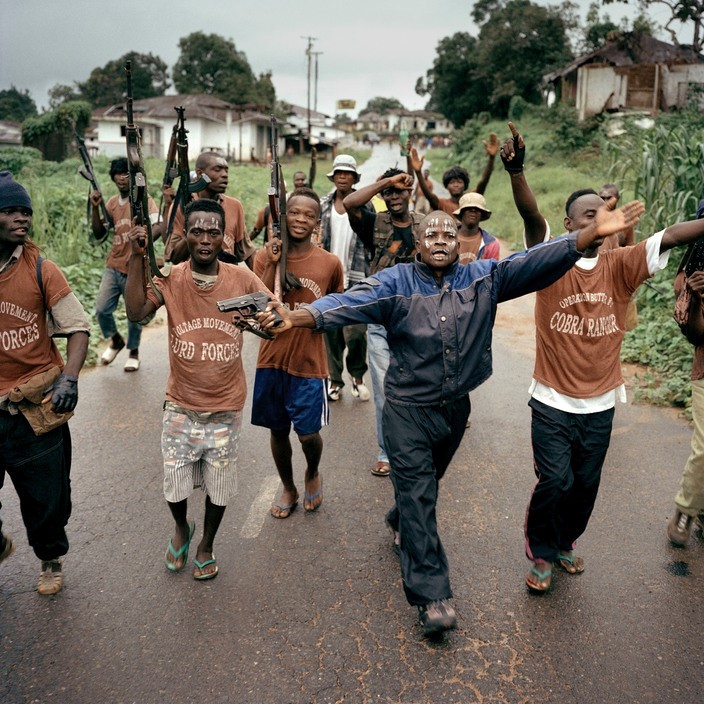
By Nemenlah Cyrus Harmon with New Narratives
MONROVIA, Liberia — They were among 17 witnesses who overcame more than two decades of fear to travel to the United States city of Philadelphia in January to testify against Laye Sekou Camara, the once dreaded general with the Lurd rebel faction. One after the other witnesses told the court that Camara, known by the war name K1, had committed horrific acts of murder, torture, rape and forced labor.
After last week’s news that the sentencing phase of Camara’s trial had been delayed until September some told Front Page Africa that though they had no regrets about testifying, the delay has left them with more months living in fear.
“I don’t even want him to be out to communicate with anybody, I want him to be imprisoned now,” said one 39-year-old witness who traveled to Philadelphia, in an interview in Monrovia. “For him being outside communicating is a threat to us, if he is in jail, I believe that he will not communicate with any family member.”
The January hearing in Philadelphia was not to determine Camara’s guilt. A week before the hearing, in a surprise move, Camara admitted to the four counts with which he had been charged, conceding he had lied to US immigration authorities when he applied for asylum in Senegal in the 2000s. He had told them that he had not taken part in the wars that left 250,000 Liberians dead, and more than one million people displaced.
Once Camara pleaded guilty January’s court session became a sentencing hearing where the victims told the judge of the horrors they said they had suffered at Camara’s hands. The judge was then to take that into consideration in deciding if he would follow prosecutors’ recommendation that Camara serve 40 years in prison. Camara hoped that pleading guilty would encourage the judge to impose a lesser sentence, which could include no prison time at all. Camara – like Mohammed Jabbateh, the Ulimo commander serving 30 years in prison after his 2017 conviction in this same court – will be deported to Liberia after he has served his prison time. Still, news of delayed sentence prompted some of the victims to tell Front Page Africa that they are living in fear as Camara and his allies continued to harass and threaten them.
“Since we left from Philadelphia, I am in not Monrovia because I was living in Jacob Town with my family and he has many family and friends there,” said the 39-year-old witness who told the Philadelphia court that he first met Camara in Lofa when he was a young teenager. He said Camara brutally beat his uncle when the man would not give the boy up, and then forced the witness to travel with him for many months to carry loads and do other duties. The witness said he saw Camara commit dozens of murders, torture, rape and recruitment of children.
“So my fear is if I live there and he is not sentenced and he is still outside and he has a telephone; he has friends, brother and other people who were in the court; they know me and they know my family. So it made me to leave Jacob town. I was forced to go in the bush.”
Camara is not in detention as he awaits sentencing. He is in home detention, monitored by an ankle bracelet, at his residence in the state of New Jersey. At January’s hearing Camara was not given a chance to speak to the court. He appeared agitated and repeatedly told journalists that “God knows the truth”. Two Liberian men who came to court with Camara tried to intimidate journalists outside the courtroom.
Another witness who testified in Philadelphia, a man aged 49, said he had been living in hiding since his return. He claimed his uncle was killed by Camara during the war at a frozen food importer store in Logan Town.
“We are still frightened,” the witness said. He now avoids his usual activities and doesn’t tell people where he lives. “We are not safe with people of his ethnic group. We are still frightened.”
The witness alleged that one of Camara’s relatives attempted to take photographs of witnesses outside the courthouse in Philadelphia in an attempt to intimidate them. But the witness said, even as he waited to hear of the sentence, he had no regret for taking the stand in America.
“I was happy because I am sure justice has been served,” he said. “The justice we are seeking for is for everybody, not only for my uncle alone, because he did lots of things. People died under him.”
The witness had a message for the judge. “I beg and appeal that the only thing that will satisfy me, when K1 is sentenced to 40 years or above in prison.”
Even without the sentence Camara’s guilty verdict represented a rare moment of accountability for victims in a country still struggling with the legacy of its brutal civil wars.
Camara is now the sixth Liberian to be held criminally or civilly liable for war related crimes committed in Liberia’s conflicts in Europe and the United States.
“Chuckie” Taylor, Charles’s son, was tried in the US as an American citizen for his crimes in Liberia and is serving a 97-year sentence. Taylor is serving a 50-year sentence in a UK prison for crimes committed in neighboring Sierra Leone. Experts said it is unlikely he will ever face justice for alleged crimes in Liberia. Just one accused perpetrator charged in relation to Liberia’s civil wars has been acquitted in a trial – Sierra Leonean Gibril Massaquoi.

Some of Camara’s victims who testified in Philadelphia, and some who did not, said his prosecution represented both hope and frustration. While they celebrated the fact that he had been held accountable, some feared reprisals from his associates still living freely in Liberia.
Osman O. Nyei, who said his brother was killed by Camara in 2003, expressed similar sentiments. Nyei was willing to have his name published saying he did not fear retaliation.
“I feel great,” Nyei said about Camara’s guilty plea. “Despite his indictment and guilty plea will not bring my brother back but let him face the consequences of his doing.”
Nyei said he hoped for a sentence of “at least 30 years” and said the case should serve as “a deterrent to other people” in a country he described as having “a culture of impunity.”

Camara’s guilty plea followed earlier trials by the same prosecutors in the Eastern District of Pennsylvania, of Jabbateh and Tom Woewiyu, right hand man to Charles Taylor during his rebel assault on the country in 1989. Both were convicted of criminal immigration fraud for lying about their war time activities during immigration interviews and on forms.
The year after Jabbateh was found guilty for lying to immigration authorities about his 1993 crimes in Lofa county Woewiyu was found guilty for lying about crimes committed in several counties in 1990-1994. He was facing 70 years in prison when he died of Covid before sentencing.
Camara is the first commander of the rebel group Liberians United for Reconciliation and Democracy (Lurd) to go to trial. Jancuba Fofana, another Lurd leader, was charged in the United Kingdom in 2020, but his case has never been taken to court.

Lurd was formed late in Liberia’s 14 years of civil conflict, but it quickly became one of the most violent factions. It was accused of committing 12 per cent of all civil war atrocities reported to Liberia’s Truth and Reconciliation Commission, second only to Taylor’s NPFL, which committed 39 per cent. Lurd’s violent assault on Monrovia in July and August in 2003 helped force Taylor to resign, ending the conflict.
Camara’s trial was the first to go ahead since the Liberian Legislature passed a resolution to establish a war and economics crimes court and President Boakai has issued consecutive executive orders to operate an office for the court. All the victims and witnesses who spoke to Front Page Africa said their experiences in the Camara trial had fueled their conviction that the court must come urgently in Liberia.
“We are appealing to the government of Liberia to speed up with the war crime issue,” the 39-year-old witness said. “We need justice in this country. If he can bring the war crime, at least everybody who fought, committed a crime, and committed atrocity in this country to pay for their doing, every human being needs to pay for their doing.”
“We need justice in this country,” he said. “If we cannot get justice in this country, there will be many things going on that will be very wrong. There will a chaos, because if you come and hurt me, destroyed my family, if I see you on the street, myself will jump on you to do something to you.”
This story was a collaboration with New Narratives as part of the Investigating Liberia Project. Funding was provided by the Swedish Embassy in Liberia. The funder had no say in the story’s content.