
By Tetee Gebro, gender correspondent with New Narratives
Summary:
- Sexual health advocates say just one in 10 Liberian students receive formal sex education, leaving many young people at risk of teenage pregnancy and sexually transmitted infections.
- One in three Liberian girls become pregnant before 19, one of the highest rates of teen pregnancy in the world. High teen pregnancy is strongly linked to high rates of poverty.
- Many Liberian parents avoid talking about sex, leaving young people to learn from unreliable sources.
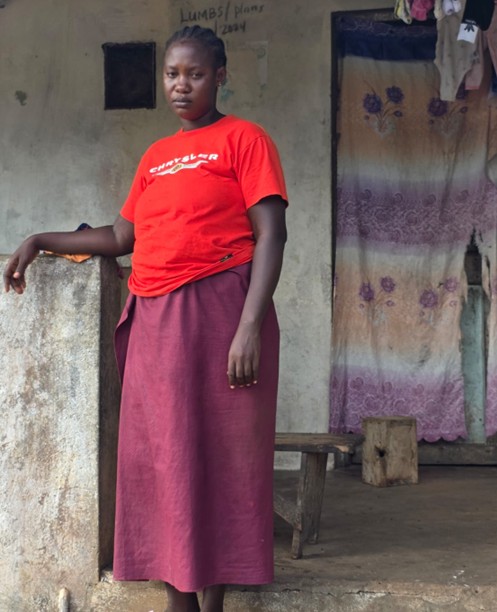
BENSONVILLE, Montserrado — Benetta was 17 when she first became pregnant. No one had ever explained sex, contraception, or how pregnancy happens to her. People in her community started talking and urged her to visit a clinic. A nurse told her she would be a mother in a few months.
“The thing surprised me I na even know,” she said speaking in Liberian English at her home here. “Until I was in my five months.”
Now 27 and a mother of two, Benetta says that moment set off a chain of consequences she is still living with. She gave up on returning to school and has found herself trapped in the same life her mother had – growing food and struggling to survive extreme poverty. (Last names are being withheld to protect women and children from stigma.)
Across Liberia, nine in every 10 young people are growing up without basic information about sex and their bodies, according to the United Nations Population Fund. Interviews with girls, parents, students, and health workers detailed a pattern of silence — where families avoid difficult conversations, schools provide little education, and young people are left to learn from friends or guesswork.
“Sex is still a huge taboo,” said Aminata Kamara Sneh, country focal person for the Swedish Association for Sexuality Education. “Young people depend on their peers, and the information they get is often wrong.”
National data from the 2020 Liberia Demographic and Health Survey showed one in three girls under 19 in Liberia are already mothers or pregnant, one of the highest rates in the world. Teenage pregnancy is both a cause and a consequence of poverty — cutting short girls’ education, limiting their economic prospects, and perpetuating cycles of deprivation.
Countries with high teenage pregnancy rates face compounding development costs — overburdened health systems, reduced female labor force participation, and slower economic growth — as each generation of girls forced out of school by early motherhood passes the same vulnerabilities on to the next.
Experts say that makes the lack of sex education a problem for all Liberians. Low levels of sex education contribute to teenage pregnancy, unsafe abortions, sexually transmitted infections, and school dropouts — problems that place additional pressure on Liberia’s struggling health system and trap many young people in poverty. Many young people’s first sexual experiences are forced, which Kamara Sneh linked in part to the lack of places where the idea of consent is openly taught.
Without information, she said, “the majority of young people are making decisions about relationships, pregnancy, and disease without understanding the risks — and the consequences are affecting the entire country.”
Girls unprepared for motherhood often means their children are trapped in poverty
Benetta grew up here in Tolbert Camp, 30 miles from the capital Monrovia, where survival depended on hard labor in nearby farms and forests. “Every other day if you not go in the bush you will not make it,” she said.
When she first got her period, Benetta’s mother gave her sanitary pads but did not explain what was happening to her body. Now, she wonders how different her life could have been if she had prepared. “If somebody was going to tell me… I was going to prevent myself,” she said.
Just as Benetta’s mother struggled to provide opportunities for her to escape poverty, she is struggling to do the same for her children. Benetta didn’t know how to care for babies. She never knew her own father and relied heavily on her mother for help until she died suddenly from high blood pressure three years ago, when the oldest child was six years.
Benetta said the second time she became pregnant, she knew the risks. She was using a three-month contraceptive injection to avoid another pregnancy. But the man she was with insisted she stop, saying he wanted a child and making it a condition for staying in the relationship. With no financial support, limited access to contraceptives, and hoping he would remain and provide for the family, she agreed. When she became pregnant, he left.
Benetta was alone, with nothing but a little money here and there from the father of her first child. Food was often scarce — some nights, she said, the family survived on gari. Getting clothes and basic supplies for her babies was a constant struggle.
At one point, overwhelmed and frightened, she considered ending the second pregnancy. “The tension was too much,” she said. “I wanted to take it out.” But the pregnancy was already too advanced and there are no safe or legal options for girls in rural communities to end pregnancies.
Today, she farms cassava and corn to get by. She wants to continue her education but says she has had to make sacrifices.
“I can’t send my children to school and send myself.”
Teenage mothers like Benetta find it almost impossible to escape poverty said Lelia Precious-Dolo, executive director of Help a Mother and Newborn Initiative, a Liberian nonprofit. Some are abandoned by families when they become pregnant. Many cannot afford childcare and so cannot return to school. Health facilities, even when they are reachable, often do not have the contraceptives they need. Stigma from teachers and communities can further isolate them, making help harder to seek, even where services exist.
“You will see a 17-year-old girl having two or three children,” Dolo said. “Because she has the first one, nobody corrects her or supports her. She must depend on a man. She goes back again.”
For many young people, that silence starts at home. David Kpandeh, a father in Johnsonville, said his children were born before he was ready because no one taught him how babies were made.
Now, raising teenage daughters of his own, he wants a different life for them. He can see they are exposed to misinformation on social media so he talks openly with his daughters about sex, condoms, and early pregnancy.
“Our children are very small and they go to school with big phones,” he said. “They can see a lot of things.”
But not all parents agree. Some in the community here said it was not parents’ job to educate children on the subject that they found uncomfortable.
“I don’t like it,” said James Kamara, another parent in the community. “If they want to learn, that’s their business.”
Experts say that is a dangerous position, leaving children powerless to make good choices. The consequences are visible in homes and clinics across the country.

At nearby Johnsonville Community clinic girls as young as 14 come pregnant. The clinic records about 30 to 40 teenage pregnancies each month.
“A lot of our patients are not informed about sex,” said Larwuo Walker, a midwife. “A lot of them get into it with no knowledge.”
Like Benetta, Mamia grew up here in Tolbert Camp. Now 21, she also dropped out of school after becoming pregnant at 17. Mamia says her mother warned her to stay away from boys but didn’t give her the information she needed. “She’s supposed to set me down and advise me about it,” Mamia said. Now she blames the lack of communication for changing the direction of her life.“I was going to finish my education.”
Instead of being in school with dreams of being a nurse, she watches her children and farms with her parents. “I’m supposed to be out of high school,” she said. “But now I’m in the bush hauling palm before I can get a living.”
The consequences reach beyond Mamia herself. One of her children died after being sick since birth. With neither of the children’s fathers supporting her financially, little money for treatment, and little understanding of how to properly care for a constantly sick child she was powerless. The family relied mostly on herbs and home remedies as the child’s health failed.
Her mother, Bendu, said she regrets what happened.“I wanted her to finish school first.” She said she was a strict parent and thought she could protect her daughter from pregnancy simply by keeping her at home. Now she admits that was a mistake. “Some children can be afraid… but some will still do it.”
For many young women in Liberia, silence is not protection — it is the problem. Comprehensive sex education has been on the policy agenda for years — the Ministry of Education began integrating reproductive health into the national curriculum in 2018, with funding from international donors — but implementation has lagged, particularly outside urban centres. Legal barriers compound the access gap: parental consent requirements still prevent adolescents from obtaining contraceptives, and entrenched gender norms continue to limit uptake of available services.
The Boakai administration, in office since January 2024, has signalled ambition on gender but sex education has not been a visible priority.
After initially agreeing to an interview, Maxim Bleeten, director of communications for the education ministry, did not respond to calls or text messages seeking comment. But in an interview with Frontpage Africa/New Narratives in June 2025, Jarso Maley Jallah, education minister, said expanding sex education was important and on her agenda. But with reduced international funding for schools, and a limited national budget, the ministry is still struggling to get enough paid teachers in schools to teach anything.
The United Nations Population Fund launched a five-year initiative with Irish support, targeting adolescent girls across Grand Gedeh, Montserrado, and Rivercess counties, and a Swedish-funded network of local organizations led by the Swedish Association for Sexuality Education has delivered sex education in schools and communities in other counties for four years. Together, they have carried the load that government has yet to pick up. But some of that support looks set to end with the Swedish embassies plans to close its embassy by August 31.
As donor support dries up and government fails to fill the gap, many experts warn that the gap between policy and classroom is not abstract — it is women like Benetta and Mamia, their children and another lost generation.
The story was a collaboration with New Narratives as part of the “Investigating Liberia” project. Funding was provided by a private donor and the Swedish International Development Cooperation Agency. The donors had no say in the story’s content.