
By Joyclyn Wea, gender correspondent with New Narratives
- As domestic violence continues to devastate victims across the country, many children are left traumatized and orphaned when the crime takes both parents out of the home. In most cases, no government services are provided, and children are left destitute.
- Liberia’s Ministry of Gender has no data on how many children are left behind when domestic violence ends in death and imprisonment. The county coordinator for Montserrado knew about both cases in this story and had not followed up on either one.
- Liberia recorded 3,381 sexual and gender-based violence cases in 2024, a 20 percent rise from the year before. No agency is counting how many children are left behind.
MISSION-THIRD, Montserrado County – Esther was 39 years old when she died in her friend’s arms here late last year. Family and neighbors say she had survived years of abuse by her husband. But no help ever came.
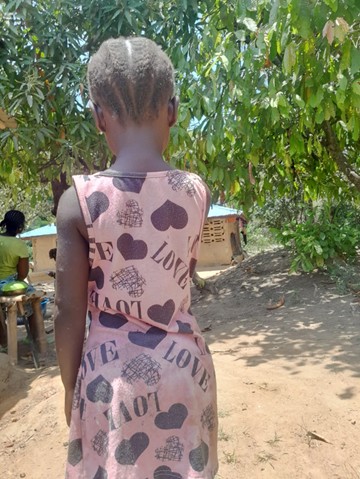
Her husband is now detained and facing a murder charge. Though her murder made the front page of newspapers, her six children, including a newborn baby, were left alone to survive with no mother or father.
Esther’s elderly father was in no position to take them so Kolu Sengbeh, her best friend, took them in. But Sengbeh already had six children of her own. In the weeks that followed, Kolu tried to keep Esther’s two-month-old baby girl, still breastfeeding, alive, giving her milk and paying for medical care. But the infant grew weaker and, after a month she died.
“Nobody came to me to say they wanted to take the baby,” Sengbeh said. “She stayed with me until she died.”
The baby’s death was not a crime scene. But it was a second death resulting from devastation that domestic violence brought to this family. Experts say with if Liberia had a better functioning system to care for these victims, the entire tragedy should not have occurred. As it is, when a spouse kills their partner, the arrest becomes the headlines, but the children are left with a second tragedy.
Domestic violence continues to plague families across the country. In the first two quarters of 2025 alone, there were 339 domestic violence cases. The GBV unit also counted 1,033 physical violence cases in 2025. None of those numbers includes a count of children left behind. Experts say the low presence of police in rural areas, stigma, and family pressure mean that the real number is likely far higher.
“Globally, 140 women and girls are killed every day by an intimate partner or family member, or one woman every ten minutes.”
…2023 report by UN Women and the UN Office on Drugs and Crime.
In theory, children in Esther’s situation should not be in this situation. Isaac George, who leads the Sexual and Gender-Based Crimes Unit at the Ministry of Justice, said children caught in these situations should be treated as “survivor victims,” especially when they were present during the violence. When a mother is killed and a father is jailed, he said, the first option is family placement. If no family can take the children, the government looks for safe homes run by the Ministry of Gender. Safe homes are meant to be short-term—about three months. When children stay longer, schooling becomes difficult because safe home locations are kept secret. The ministry sometimes helps with school fees or emergency needs, but George said, this is not routine policy support.
The Ministry of Gender told New Narratives/FrontPage Africa that Liberia has 12 safe homes: three in Montserrado and one each in Grand Cape Mount, Maryland, Grand Kru, Grand Bassa, Nimba, Bong, Lofa, Grand Gedeh, and Margibi but those in Grand Gedeh, Grand Bassa, Margibi, Grand Kru, and Maryland are not operating and one in Montserrado was destroyed by fire last year. The ministry said children are typically referred or brought to safe homes from SGBV One-Stop centers, police stations, or directly from communities when authorities are called to intervene. But Bennietta Jarto, director of the ministry’s GBV unit, said the ministry has no data on how many children are left behind when domestic violence ends in death and imprisonment.
Esther’s case suggests the system is not working in rural Montserrado at least. Though the husband was arrested, Sengbeh said no one approached her for emergency help or safe care after Esther died.
Jarto said the Montserrado County coordinator knew about both cases documented in this story and had not followed up on either one when queried about it.
A friendship that became a lifeline
Sengbeh said her bond with Esther was both family and friendship: the pair were childhood friends who happened to marry into the same family. They supported each other as mothers raising large families in poverty in a rural town. Before she died, Esther sometimes teased her: “Kolu, these children are for you.” She meant it as a joke. Now it is Sengbeh’s life.
Sengbeh, who survives on small farming and charcoal burning, said some of the children are in school and some are not, including Esther’s five-year-old who witnessed the murder. Before Esther’s children arrived, Sengbeh said she was already paying school fees for her six children—about $L6,000 (about $US33) per child at a nearby community school.
The five-year-old is not in school. She still cries when other children remind her that her father is in jail for killing her mother. No counselor has visited. Sengbeh said the child has grown quieter and falls sick often.
“So I really worry about her,” Sengbeh said. “I want somebody to hear me and help with that little girl. She tells me, ‘Mama, I want to go back to school.’”
Esther’s elderly father, Yarlo Gbarnah, said he is also devastated. He is barely able to grow enough rice to feed himself and can’t help Sengbeh. “I don’t even want to go see the house, and I don’t see my daughter.”
The boy who hauls water for his siblings
About forty kilometers away, in the heart of Monrovia, a 12-year-old boy is living the same reality. The address is different, but the devastation is the same.
He said the violence began in the middle of the night at his home in Bassa Town, on Du Port Road. He woke up and saw blood rolling toward the door. When he walked closer, he saw his mother on the floor, badly hurt. He started shouting. Neighbors came running. His stepfather ran. People chased him. Police took him away.
The boy and his two sisters—ages 9 and 4—were left to fend for themselves until their grandmother, Ma Korpu, was able to get to the house days later from her home in Lofa County. The grandmother said two government women came to the house weeks later, wrote down names, and promised to call back. No one ever did.
Unable to pay rent, the family moved to a rundown building in another part of Du Port Road, where a caretaker offered them temporary shelter. The caretaker left for a family engagement in Lofa County. The family does not know when he will return, and they have to find somewhere else to stay.
The boy had been in third grade. Now he is out of school.
“No money,” he said. “We hardly eat.”
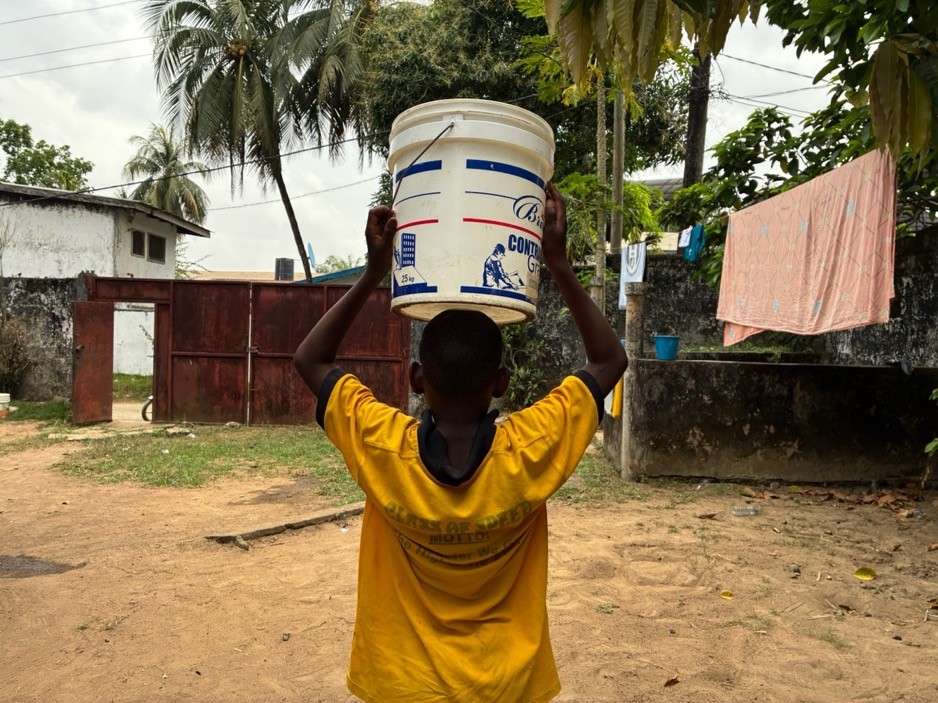
The family are doing whatever they can to make money. Ma Korpu picks breadnut to sell; the girls sell cold water packets late into the evening; the boy hauls water for neighbors. Each bucket earns them $L20 (US11 cents). He makes many trips a day and watches sadly as other children go to school.
Ma Korpu said life has become “suffering” since her daughter was killed. Some days, grief and injustice take her appetite: “When I think about it sometimes, my heart can be burning,” she said in Liberian English. And they are hungry. “We buy two cups of rice, cook and eat, that’s how we just here.”
Her anger is tied to how distant the justice process still feels. “They say case business there, but they (the court) nah call us yet.”
What the government says it does—and what families say isn’t happening
The Justice Ministry’s Isaac George confirmed both cases are pending trial. Domestic violence incidents that result in murder are handled through the Montserrado County Attorney and prosecuted in Criminal Court “A,” beyond the GBV unit’s mandate. George said prosecutors are now preparing indictments for the grand jury, which will determine whether there is probable cause to proceed. If so, the cases will be placed on the court’s docket and trial dates will be scheduled.
As with other cases covered by FrontPage Africa/New Narratives, the cases have imposed extra financial costs on the families even though George said domestic violence victims should never be asked for fees. Esther’s brother, Ezekiel Gbarnah, said a court officer asked him to pay to transport the accused from Monrovia City Court to South Beach. Siatta Paul Hidden, clan chief of Mehn Clans, Todee District, said she had earlier paid $L10,000 to transport the accused from the village to the police station in Nyahn, and that additional money was provided as compensation to the community watch forum that helped carry out the arrest.
Such demands are common. FrontPage Africa/New Narratives has followed the case of a 57-year-old grandmother who said she was asked for money at every step to move her case through the justice system, including jailing the accused offender. Another Monrovia-based mother reported the rape of her 8-year-old daughter and said she was repeatedly asked to pay fees before the suspect could be jailed and tried.
How it is supposed to work—and how it falls apart
Jarto said a new Gender-Based Violence Information Management System is planned under “Spotlight 2.0.”, a $US13.6 million EU-funded program that is expected to strengthen how cases are recorded and shared across the system. The system is meant to function as a secure national database: when a survivor reports abuse at a clinic, police station, one-stop center, or safe home, trained staff enter basic case details and the services provided, helping the government see where cases cluster, where services are missing, and whether survivors—including children—are being followed up.
But advocates say they have cause for skepticism. Spotlight 2.0 is a new phase of an earlier EU-UN initiative that had similar goals. An independent audit by the European Court of Auditors found the original Spotlight Initiative had limited impact—delivering some outputs while struggling to show lasting results or enforcement.
The new Spotlight 2.0 Liberia program is planned to run from 2025 to 2029 and is intended to improve coordination, services, and data systems with the Ministry of Gender in a central role.
In Mission-Third, Esther’s children still ask about school; the children cry for their parents and Sengbeh struggles alone. In Monrovia, the 12-year-old measures his days in buckets of water —each one another hour away from a classroom. For now, both families have been lost in a system that leaves children to pay the price for a tragedy they had no part in.
This story was produced in collaboration with New Narratives as part of the Investigating Liberia project. Funding was provided by a private donor and the Swedish International Development Cooperation Agency. The donors had no say in the story’s content.