
By Anthony Stephens, senior justice correspondent and New Narratives editors
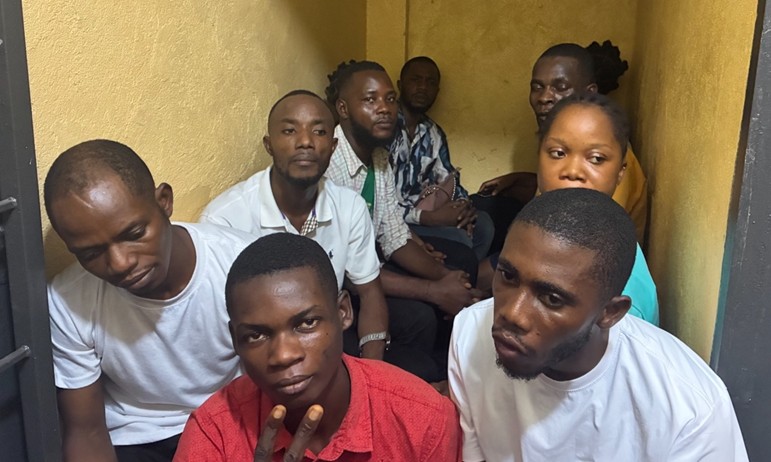
- Ten of 11 defendants in what prosecutors call Liberia’s largest human trafficking case are set to go on trial Wednesday, weeks after a grand jury indicted them over the alleged trafficking of 57 people from seven counties.
- Prosecutors say the defendants lured the poor victims with promises of jobs in Canada and Australia before allegedly confining, abusing and extorting them at a compound near the residence of Vice President Jeremiah Koung.
- The trial comesmonths after aFrontPage Africa/New Narratives investigation exposed bribery and interference allegationsthat looked set to derail the case.
Ten of the 11 people accused in what prosecutors and anti-trafficking experts describe as
Liberia’s largest human trafficking case are scheduled to go on trial Wednesday, weeks after a
Montserrado County grand jury indicted them over the alleged trafficking and exploitation of
57 poor people from seven of Liberia’s 15 counties.
The trial comes nine months after the victims filed complaints with authorities and three
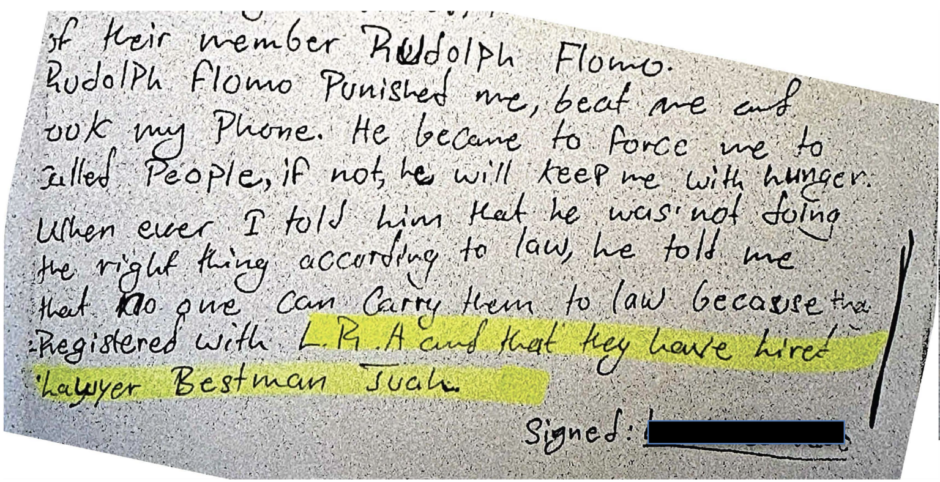
months after FrontPage Africa/New Narratives exposed victims’ allegations that Bestman Juah,
a public defender, was paying bribes to police and prosecutors on behalf of the accused
traffickers to protect them. “Noone can carry us to the law” victims said the defendants told
them. “We own the government.”
Delays and a reduction in charges looked likely to give the accused perpetrators the right to
apply for bail after which they were expected to vanish as accused trafficker Cephus Selebay did
in a similar case in 2022.
Juah and Enoch Dunbar, a senior police investigator accused of taking a bribe to reduce the
charges, denied they had taken any bribes.
The case is the largest human trafficking prosecution in Liberia’s history. The investigation
shone a rare spotlight on the alleged corruption that plagues Liberia’s justice system and
undermines confidence in the rule of law. It gave credence to victims’ claims that justice is only
available to those who can pay.
The trial comes as researchers at the U.S. State Department are finalizing their annual
Trafficking in Persons Report. Liberia has spent the last two consecutive years on the Tier-2
watchlist. One more year would see it risk a ban on U.S. aid.
Prosecutors allege that the defendants lured 22 women and 35 men with promises of high-
paying jobs in Canada and Australia before confining them in a compound near the residence of
Vice President Jeremiah Koung along the Roberts International Airport highway, where
prosecutors say they were denied food and water, sexually assaulted and forced to extort
money from their own relatives and friends.
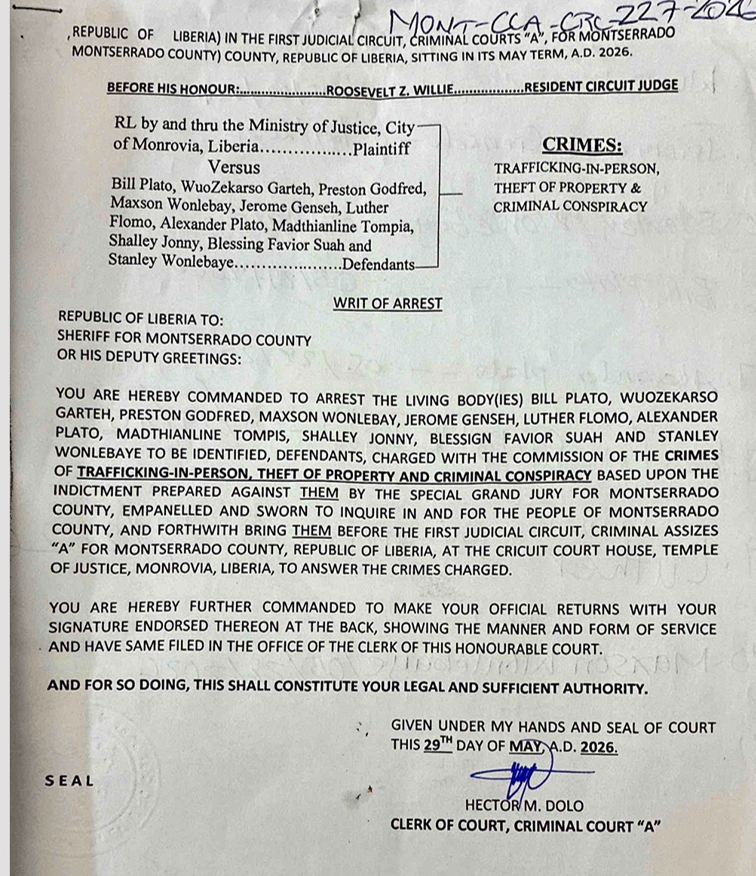
Court records show that 10 of the defendants have been served with a writ of arrest — a formal
legal document placing them under the jurisdiction of the court and informing them of the
charges against them. Only one defendant, Blessing Favor Suah, has not been served.
Prosecutors say they will seek her arrest and prosecution through the court.
The case is being heard before Criminal Court “A” at the Temple of Justice, the seat of Liberia’s
judiciary, in Monrovia.
Last month, a grand jury unanimously found it “more probable than not” that the defendants committed first-degree human trafficking. The indictment alleges that the accused lured victims to the compound, denied them food and water, raped and sexually assaulted some of them, and coerced them into contacting relatives for additional money—acts the indictment described as “slavery-like practice/labor exploitation.”
The grand jury also found that the defendants “willfully, knowingly, intentionally and purposely agreed and conspired” to extort $125,000 from the victims between 2024 and 2025. Human trafficking carries a minimum 20-year sentence.
For victims, the trial is the first sign that the justice system may finally be listening.
“I am happy,” said a victim identified only as “G.” for her protection. “I am proud of that because I never knew they will spend this kind of time in jail. People told us they couldn’t go anywhere because they had the court and police in their pockets. But I am surprised they have spent this much time in jail and are now before a judge.”
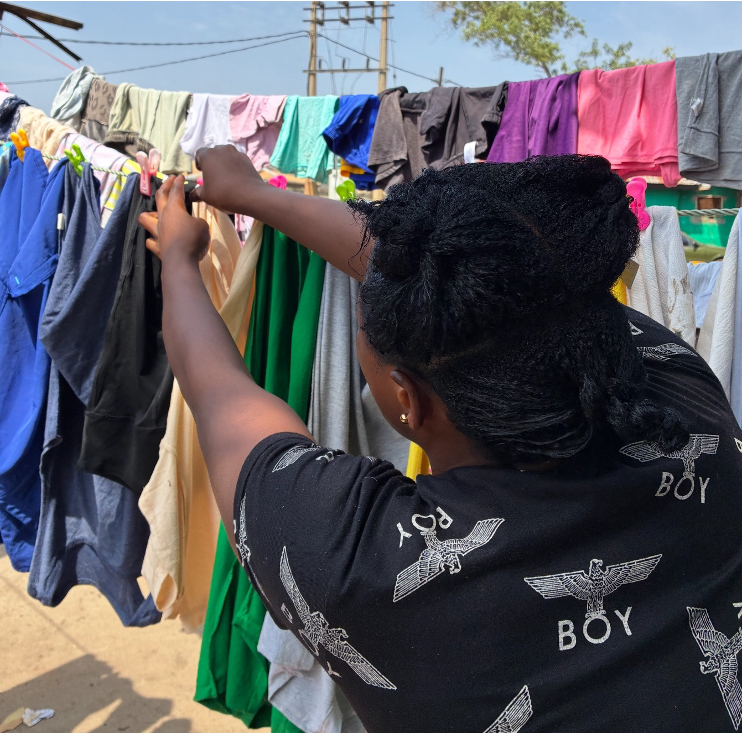
The trial marks the first time a trafficking case of this scale has reached a Liberian courtroom. Human trafficking advocates welcomed the news but said it should have happened much sooner.
“I am excited that they will go on trial because it has been long overdue and their actions have caused a lot of atrocities for Liberians,” said Princess Taire, project manager for World Hope International, which has worked with trafficking victims. “It will serve as a deterrent for other would-be perpetrators. Everywhere you turn, the radio, the social media, you will find these people.”
Despite the indictment, many victims and advocates remain worried that delays and jury tampering could still undermine the case.
Victims in trafficking cases previously investigated by FrontPage Africa/New Narratives have reported intimidation by relatives and associates of accused traffickers. Victims in the current case have expressed similar concerns and are calling on the government to ensure their protection throughout the proceedings.
The defendants named in the indictment are Bill Plato, Wuo Zekarso Garteh, Preston Godfred, Maxson Wonlebaye, Jerome Genseh, Luther Flomo, Alexander Plato, Marthaline Tompia, Shelley Jonny, Blessing Favor Suah and Stanley Wonlebaye.
Because Liberian law does not permit trials in absentia, prosecutors say they will ask the court to try any defendants who remain at large either separately or with other defendantsonce they are arrested.
The trial comes at a critical moment for Liberia’s international reputation. Prior to this year, Liberia had secured just five convictions since 2020. For comparison, Uganda secured 230 convictions in the two years to 2024 alone.
This will be the third major trafficking prosecution by the government in recent months. Last month, prosecutors secured a 10-year prison sentence against a Nigerian woman who admitted trafficking three Nigerian teenage girls into Liberia. Liberia’s Labor Ministry said the court cited her “lack of prior criminal record, support from members of the community, willingness to rehabilitate and her current pregnancy,” when determining the sentence. In March, authorities won convictions against five women for trafficking 14 children.
Adolphus Satiah, a former head of Liberia’s anti-human trafficking secretariat, said the trial offered an important measure of relief for victims.
“They are seeing their perpetrators being handcuffed, prosecuted and put into prison,” Satiah said. “Even if the case has not ended, it means, to some extent, justice is being served.”
But Satiah also condemned the failure of the government to act until the FrontPage Africa investigation.
“Cases of trafficking in persons are a national emergency,” he said. “Government should not be allowed to go under pressure before they can move. The fact that the government has to be under pressure from the international partners, is not a good sign for the government.”
In addition to securing the indictment, prosecutors persuaded the grand jury to seek nearly $US200,000 in restitution under Liberia’s revised anti-trafficking law for victims’ medical and psychological treatment, rehabilitation expenses incurred by victims and their families, and emotional distress and suffering that prosecutors said continued long after the victims escaped the compound.
If granted, it would mark the largest restitution award ever made in a Liberian trafficking case. The money is badly needed. Victims said they have suffered tremendous hardship as a result of the fraud perpetrated against them. One woman sold her farm and everything she owned to raise $16,500 for the traffickers. She and her six children are now destitute. Another said her mother is now bedridden and hounded by lenders demanding their loans be returned.
But there are concerns victims will not see that money. In 2023, Criminal Court “A” ordered Arthur Chan-Chan, a former National Security Agency agent convicted of trafficking two Liberian women to Oman, to pay $11,500 in restitution after sentencing him to 25 years in prison. But the order has never been enforced, and the victims are still waiting to receive the money.
Experts say the outcome of the current case could test not only Liberia’s willingness to prosecute traffickers, but also its ability to deliver compensation promised to victims under the law.
“It sends a signal that nobody is above the law,” Satiah said. “For years, people claimed they were ‘untouchable.’ Now they have been arrested, investigated and brought before the court.”
This story was a collaboration with New Narratives as part of the Investigating Liberia project. Funding was provided by the Swedish International Cooperation Development Agency. The funder had no say in the story’s content.