
By Anthony Stephens, senior justice correspondent and New Narratives editors
Summary:
- A key prosecution witness broke down in tears as she identified defendant Daniel Davis as her alleged rapist during Liberia’s largest human trafficking trial.
- Jurors at Criminal Court “A” will be kept in protected housing to protect them from intimidation or bribery, known as “sequestered”, throughout the trial, the first such decision by the state in years.
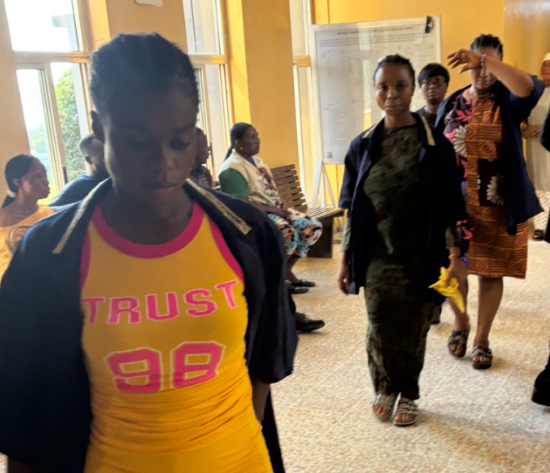
One of 57 alleged victims in the country’s largest human-trafficking case broke down during her testimony in open court, crying as she described how the man she identified—Daniel Davis—raped her after putting a drug in her drink in one of the trial’s most dramatic opening moments.
After drinking the beverage, S. said, she immediately felt unwell.
I got weak,” said a weeping S. “I didn’t have strength. That’s how Daniel Davis took me in the room and took advantage on me. It was my first time for man to advantage on me.”
She then pointed Davis out in court in the dock at the request of Sumo Kutu Akoi, the lead prosecutor in the case.
“The man that down there. The man that knocked his chest,” she said. “Is that him?” asked Roosevelt Wille, the judge. “Yes,” S. responded loudly and firmly and pointed her hand at Davis, also known as “Wuzo Jekarso Carter”, sitting with 11 other defendants in an orange jumpsuit.
The woman, whom FrontPage Africa/New Narratives is identifying only by the initial S. to protect her from possible retaliation, told Criminal Court “A” in the first victim testimony of the trial that Davis had promised to help her travel to Canada and extorted US$950 from her.
The courtroom fell silent as Davis looked directly at her and smiled. The exchange was brief but charged with emotion. Maintaining her composure, the witness identified him as the same man she and other victims said had presented himself as “Law Unto Himself”.
Four women have alleged they were raped and, along with another 53 victims, say they were trafficked and had $100,00 in total stolen from them by the 12 defendants and 15 others who have yet to be arrested. The defendants are facing charges of trafficking in persons, theft of property, and criminal conspiracy. Three are facing rape charges. They will face a minimum of 20 years in prison if convicted of human trafficking.
It is the largest human trafficking case to make it to trial in Liberia’s history and comes after Front Page Africa/New Narratives reporting revealed allegations by victims that Bestman Juah, a public defender and current president of the Public Defenders Association of Liberia, offered a US$7,000 bribe to a public prosecutor to drop the rape and trafficking charges. After most of the charges were dropped, the victims accused Enoch Dunbar, head of the Liberia National Police’s anti-trafficking desk, of accepting the money. The case had appeared likely to be delayed long enough that the accused would become eligible for bail.
In a WhatsApp message to FrontPage Africa/New Narratives in March, Dunbar and Juah denied the allegations.
Criminal Court “A” has jurisdiction over serious offenses, including human trafficking, murder, manslaughter and kidnapping. Defense lawyers—Sennay Carlor and Mamae Gongbah—contested the court’s authority to prosecute rape, arguing that rape is not listed as a standalone charge in the indictment.
Prosecutors countered that rape was included in the allegations. “Sexual exploitation is in the narrative,” said Adolphus Karnuah, a prosecutor. “We believe that that sort of drink was spiked to make her stupid.”
After a heated exchange between prosecution and defense counsels lasting about 10 minutes, Wille ruled for the prosecution.
“Human trafficking has several elements. You have transportation, you have deception and many others among which you have sexual exploration… So your objection is overruled.”
S. also testified that she paid Davis a total of $2,300 after he recruited her from Bomi County, adding that her mother—a widow—struggled to raise the money.
“My mother said, ‘I don’t have anybody in life, but I will try because that will be opportunity for life,’” S. said, continuing to cry as she described her mother’s efforts to raise funds for her travel.
She testified that after she and other victims were held hostage at a compound in Gbankpa Town—near the residence of Vice President Jeremiah Koung along the Roberts International Airport highway—they were tortured and denied access to food. “[Marthaline] Tompia made me to kneel down on the ground to call my mother to send US$300,” S. said. “The punishment was hard on me. I called my mother to send $300.”
She also said Luther Flomo, another indicted defendant, tortured them.
Before the close of direct examination, prosecutors asked the witness to identify the statement she had made to police. The defense objected, arguing they did not have her police statement—only the grand jury materials.
That prompted a quarrel between Akoi and Gongbah. Akoi accused the defense of “wasting time,” saying the statement and the names of prosecution witnesses were not hidden and had not been shared with the defense before trial as required by law.
Wille ruled for the prosecution.
“In the interest of justice and fair play, that objection is denied,” he said as he knocked his gavel. “Because this statement is part of the charge that was made by the Liberia National Police.”
Through cross-examination, which lasted nearly three hours, the defense sought to undermine the witness’s credibility by trying to make her contradict herself, reframing questions she had already answered, something that annoyed the prosecution. But S. maintained her testimony and said she paid money to Davis to travel to Canada.
The defense also asked her to identify Davis’s signature, but prosecutors objected, arguing she was not the author of the signature. Wille ruled in favor of the prosecution’s objection and said the key element of human trafficking is deception and that the best evidence would come from the person who could directly identify it. Over prosecutors’ objection, Judge Wille allowed defense lawyers to question S. about her literacy after she testified that she could not read or write but had learned the meaning of the word “opportunity” from a classmate. She later told the court that she had dropped out of school.
Earlier in the day, prosecution also requested the sequestration of the jurors, a decision the defense did not object to. Experts said it reflects the seriousness the state attaches to the case following intense public criticism over how similar cases were previously handled. In 2023, prosecutors claimed they lost two cases because jurors were not sequestered.
Trial jurors have come under heightened scrutiny in recent years, particularly after the acquittal of Samuel Tweah, the finance minister under former President George Weah, and Moses P. Copper, the ministry’s comptroller, in a $6.2 million corruption case. An investigation into allegations of jury tampering in that case remains underway.
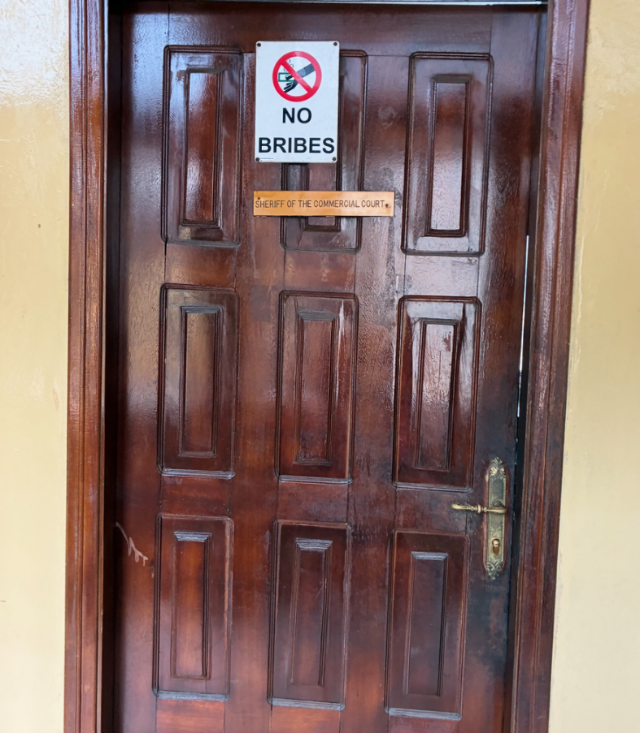
Judge Wille cautioned jurors in the trafficking trial to remain professional.
“Nothing will be done by you jurors without the consent of the court,” Wille warned. “In case of anything that will bring dispute to this court, we will take the appropriate action.”
The trial resumes Wednesday, when the three other alleged rape victims are scheduled to testify.
This story was a collaboration with New Narratives. Funding was provided by the Swedish embassy in Liberia. The funder had no say in the story’s content.