
By Joyce Gyekye
For years, communities across Africa have been treated as recipients of aid rather than as the people who should determine what development looks like. Now, a coalition of civil society organizations from across the continent is coming together to change that.
Two hundred organizations gathered this week in Accra, Ghana, to confront what they describe as a development system that is no longer fit for purpose — and to build, collectively, a new model in which Africans have a greater say over their own futures.
The ambition goes beyond another declaration or conference outcome. Organizers want to document what works, build practical models, and — over the next five to ten years — see those approaches adopted more widely across the continent.
Rewriting an Old Script
For decades, development in Africa has largely followed a familiar pattern: international governments and foundations decide what they want to fund and invite local organizations to apply. Projects designed in global capitals are then implemented in African communities.
Now, African civil society organizations want to flip that script. They argue that the old aid dynamics are broken — creating dependence, undermining economic development, and failing to produce lasting change.
This week in Accra, more than 200 organizations from across the continent gathered for the Africa at the Center convening to chart a different path.
Charles Kojo Vandyck of the West Africa Civil Society Institute, the conference’s organizer, says the answer lies in fundamentally changing who holds the power to shape development. He points to an organization in Zambia as a model of what that shift can look like.
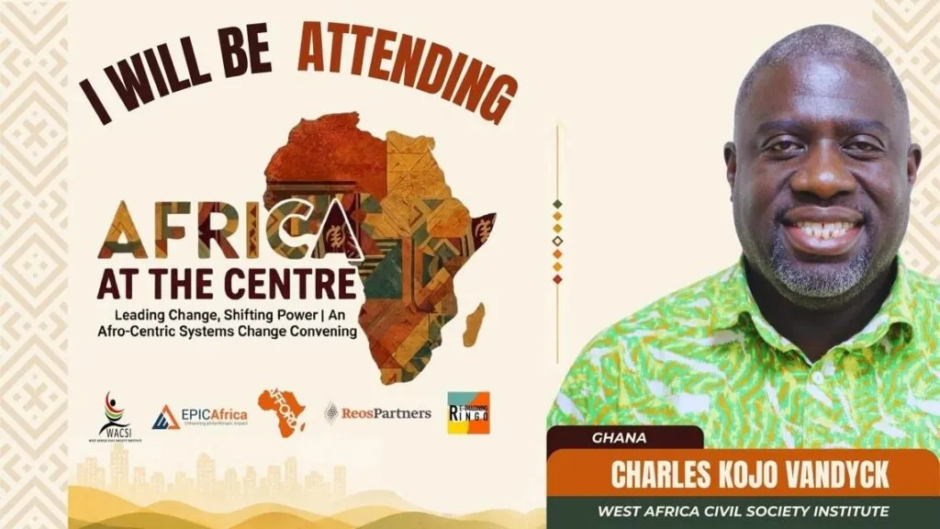
“Already, beyond the actual outcomes — even the power dynamic, even the mindset shift — that is success. When I talk to the guys in Zambia, they talk about that more than the outcomes. It is the way it has empowered the committee members to feel that they are in charge of the project.”
Mr. Vandyck who is also the Co-Founder of the African Centre for Philanthropic and Social Investment(ACPSI) said decades of development interventions had created a transactional system that described African communities as beneficiaries rather than active partners in shaping their own development.
He said the prevailing model focused excessively on communities’ problems and needs while overlooking their assets, capabilities and local knowledge. ”The development system has always been about people somewhere coming to rescue people who need help. Communities have been treated as beneficiaries and recipients instead of partners with solutions and resources of the own,” he said in an interview ahead of the Africa at the Center Conference scheduled for September 1-3 in Accra.
The Global Fund in Ghana: Progress and Cracks
Ghana’s experience with the Global Fund illustrates both the promise and the limits of the current system. The Global Fund is a five-billion-dollar-a-year global health effort; since 2002, Ghana has received more than $1.18 billion from it to fight HIV, tuberculosis, and malaria.
The money has worked — in places. Malaria cases dropped 40 percent between 2015 and 2020, and HIV infections fell by a third.
But a 2023 audit found cracks in the system. TB treatment coverage has been stuck at just 30 percent for 15 years, and auditors flagged gaps in the underlying data, raising questions about how reliable the reported results really are.
Critics go further, arguing that the aid has let Ghana’s own government off the hook. Since 2018, health spending has averaged just 7 percent of the national budget — far short of the 15 percent African leaders promised in the 2001 Abuja Declaration.
Communities Setting Their Own Terms
For years, a growing chorus of groups has demanded greater African control over the continent’s development agenda.
Vandyck spotlights one example: NOORSAC, a Ghanaian civil society organization based in the country’s northern region. Rather than applying for donor funding on donors’ terms, NOORSAC is part of a growing number of African civil society organizations that have flipped the model — putting out their own calls for proposals and inviting international donors to apply for the right to fund them. That is called Reverse Call for Proposal, (RCFP)
NOORSAC has now begun experimenting with RCFP. In three communities- Garjio, Shiu and Singa, all in Ghana’s Sanarigu Municipal Assembly. Instead of approaching communities with predetermined projects, NOORSAC asks them to articulate their priorities. The intention is to eventually extend the model across more than 55 districts where the organization works
Alhassan Mohammed Awal, NOORSAC’s Executive Director, described how one community identified and shaped its own priorities: “The community went through a process and came out with water and sanitation as a major challenge to their survival.”
“We facilitated the process for the Assembly to be part of it, then, they prioritized and costed some of the items. If you’re to do the intervention — looking at their own energy, their own contribution — it will cost around 880,000 cedis. That was how the community picked up the issue; that was how they costed the issue.” He explained,
A Pivotal Moment
Organizers say this power shift needs to be replicated across the continent — and they see the timing as critical. Donor aid is being slashed globally, and governments including Ghana’s have rejected what they describe as predatory aid deals offered by the Trump administration in the United States.
This week’s convening in Accra is expected to produce new plans for remaking development in Africa, on African terms. Organizers are calling on African governments and international donors alike to adapt to that shift.
This story was a collaboration with New Narratives,