

By Joyclyn Wea, senior correspondent with New Narratives with photography by Allison Hunter
- Liberia’s Boakai administration revives a stalled $26 million coastal defense project to protect Monrovia’s West Point community, where more than 6,500 have already been displaced by sea erosion.
- Construction of the long-awaited sea wall is set to begin by the end of 2025, with government co-financing now secured after delays under former President George Weah.
- As many as 1,000 residents face demolition of their homes to make way for construction, but leaders say the community has yet to hear details from government.
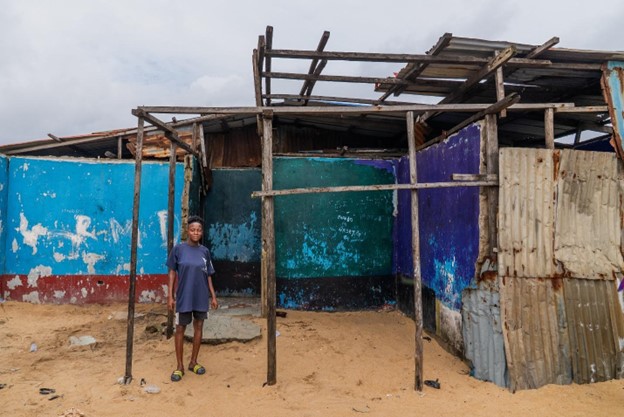
WEST POINT, Monrovia — As heavy rains batter the coast, fear thickens in West Point. Five years ago a storm surge took the home Sarah Gary’s father built when she was a child. Now Gary lives in a house just feet from the Atlantic’s rage. Every rainy season more than a dozen homes in this low-lying informal settlement are swept away. When Gary goes to sleep she fears she’ll be wakened by crashing waves taking this home too.
But this may be the last rainy season families here live in fear. After years of broken promises under the administration of President George Weah, the long-stalled sea wall – part of the $26 million Monrovia Metropolitan Climate Resilience Project – is set to begin construction by year end.
“I’ve been hearing about this project long time,” said Gary. “Every time the people say people will come to help us put rock here, since CDC time, nobody wants to do it. So we will be happy.”
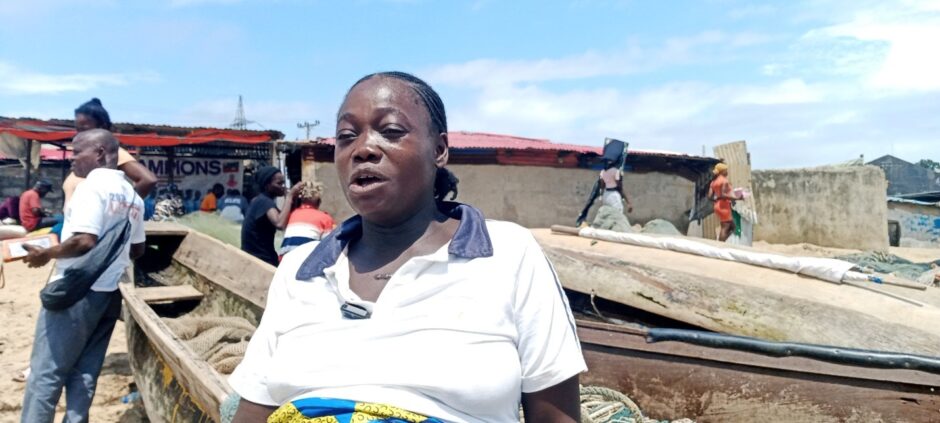
The announcement represents a turning point for the project which was launched to much fanfare by then-Mayor Jefferson Koijee in 2021. In the years after, the failure of the Weah administration to put up the $US2.4 million co-financing and $4 million in large boulders it had agreed to, meant the project ground to a crawl. The government contributed just $50,000.
In part one of this series Wilson Tarpeh, Weah administration Environmental Protection Agency chief, said he had found it impossible to get the money from the Finance Ministry and admitted that his administration had failed the people of West Point.
In the years since more than 67 homes have disappeared beneath rising seas, and 403 residents have been displaced, according to township leadership. Many more have lost their livelihoods, as boats, nets, and storefronts are regularly swept away during high seas.
Christina Toe, a lifelong West Point resident and mother of two, exemplifies the economic vulnerability: “If God is not on your side when the sea gets vexed, your canoe will go, your machine will go. Your net will go. And if it goes, you don’t have anything like you are depending on, meaning you just have to sit down.”
Now the community is celebrating news that the 18-month-old Boakai administration has met the co-financing requirements, and the project is back on track.
“This time next year, West Point should be protected from sea level rise for 40-plus years,” said Louise Kuukpen, deputy resident representative at the United Nations Development Programme in Liberia, which is implementing the project on behalf of the Green Climate Fund, a global pool of funds from rich countries designed to help low-income countries adapt to climate change.
Construction Challenges and Community Sacrifice
But construction of the sea wall will not come without pain for this community. Homes where approximately 1,000 people live will need to be demolished to make way for a road connectd the south end of the beach with the mainland. Community leaders say the people understand this is a sacrifice they must make for long-term security.
“We will embrace it,” said Swen. “This place where we are is government land. So if they come and give you something for you to find a place, so be it.”
But this aspect of the project is causing some concerns. The UN’s Kuukpen says the relocation of residents is not funded under the overall project. The government must find funding and a solution separately. Community leaders say they have not been given enough information about this, and it’s making people nervous.
Project manager Zienu Kanneh said specific responses to resettlement questions await completion of a resettlement action plan and livelihood restoration plan, which are currently in progress.
“These two instruments are essential in ensuring that project-affected persons, particularly those whose livelihoods and access to resources may be disrupted, are adequately identified, engaged, and supported through tailored mitigation and compensation measures,” Kanneh said.
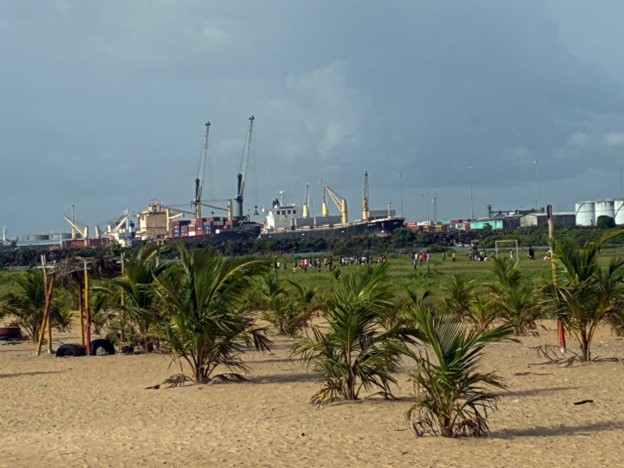
While waiting for the funds to come, the West Point community has done its best to slow the sea, planting 430 mangroves and 4,000 coconut seedlings along vulnerable shorelines.
While policy makers and environmentalists will breath a sigh of relief to see this heavily populated community saved from the waves, it is just one of many communities along the coast facing the same fate in coming years.
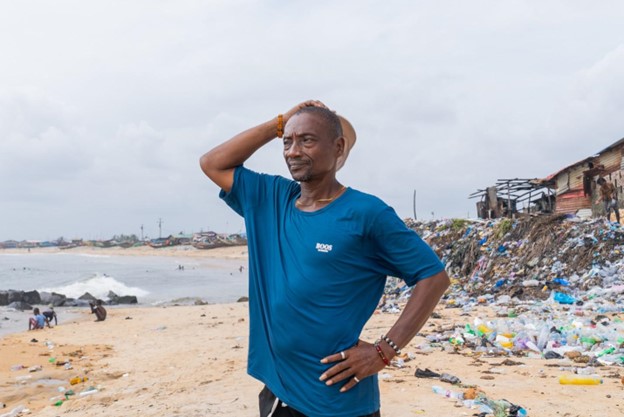
The country’s shoreline has retreated by an average of 30 meters over the past two decades, with some areas experiencing much more dramatic losses. As many as 230,000 Liberians are set to lose their homes by 2100 with current levels of sea level rise.
Experts say the project has become a test case for international climate finance mechanisms established under the Paris Agreement. The Green Climate Fund’s $17.2 million contribution was contingent on Liberia meeting its share of the total project cost—a requirement that had proved nearly impossible under the previous administration. Another Green Climate Fund project to create a weather hazard warning system had also been delayed for years by Weah government failures.
“A climate-vulnerable country like Liberia is a priority for GCF as Liberia counts among those most impacted by climate change despite contributing little in the way of greenhouse gas emissions,” said Andrew McElroy, a Green Climate Fund spokesperson.
But just being a priority country isn’t enough if the government won’t meet requirements to unlock funding. Experts say the funds will just move to another country that will, leaving millions of Liberians to fight climate change impacts on their own.
For a project originally set to run from 2021 to 2027, the road ahead may now stretch to 2028 or 2029, as Liberia seeks a no-cost extension to finish the work. But for a government eager to restore public trust, and for families like Sarah Gray’s who can’t afford another rainy season without protection, the countdown has begun.
The Boakai administration has distinguished itself from its predecessor with transparency about the project’s challenges and timelines. Unlike the previous government, which often portrayed the project as proceeding on schedule, current officials have acknowledged delays while providing specific timelines and funding figures.
It was not just funding that was missing according to the new administration. Scientific and environmental studies were also not done.
“We inherited a situation where these critical studies hadn’t even been commissioned,” Yarkpawolo said. “We’ve fast-tracked procurement for the engineering studies, but proper engineering takes time.”
For now the township braces for the worst of the rainy season to kick in. The township typically experiences its highest seas between July and September. This year has been relatively calm, but residents know that provides no guarantee for the rest of the season.
This story was a collaboration with New Narratives as part of the “Investigating Liberia” project. The Swedish Embassy provided funding, but the founder had no say in the story’s content.