

Summary:
- A lack of market price information is keeping Liberia’s farmers trapped in poverty, experts say, as predatory middlemen exploit their ignorance and reap most of the profits from their crops.
- With no national pricing system or access to reliable information, rural farmers—many of them women—are forced to sell harvests far below market value while imported goods dominate local markets.
- Analysts and advocates are calling for basic information tools such as SMS alerts and radio price bulletins to level the playing field, even as government pledges for agricultural reform have yet to deliver results.
By King Brown with New Narratives
TAYE TOWN, Grand Bassa County — The weeds have returned, thick and stubborn. But so has Patience Kpan. After a disastrous harvest in 2024, the 37-year-old mother of five is back on her knees weeding grass from her young rice plants. Her youngest child, a barefoot toddler, tugs at her skirt as she works. She has no choice.
Farming is the main source of income for her family and the only livelihood she has ever known. But now she has fallen prey to predatory middleman she is growing desperate.
“I nearly leave this farm,” she mutters, sweat sliding down her cheek. “Last year, I lost everything.”
Kpan’s story reflects a brutal reality across rural Liberia. According to 2024 Liberia Agriculture Census Household Report, the country has more than 1.3 million farmers; women comprise 80 per cent of smallhold farmers. But most operate blind. They plant and grow their crops with one market value in mind, but when it comes to selling the crop the price they get is often drastically less.
Experts say hundreds of thousands of smallholder farmers across the country are trapped in a broken market system where middlemen, known as “Gobachop”, set prices, and the government provides no regulation. Middlemen leave with harvests worth double or triple what they paid, sinking families who feed the nation deeper into poverty.
“There is no pricing system in rural Liberia,” says Williams Vonyeegar, dean of the College of Agriculture and Food Sciences at the Grand Bassa University. “Farmers don’t know what their crops are worth in Buchanan, Ganta, or Monrovia. So, the buyers name the price, and that’s the end.”
Farmers are already dealing with the devastating impacts of climate change – with no irrigation and no access to information about rainfall and temperatures. But the lack of market prices is making things even worse driving more and more farmers off the land and into even more precarious and environmentally destructive livelihoods such as charcoal making, illegal mining and drug dealing.
“We are seeing the systematic impoverishment of people who feed the nation,” said Williams Vonyeegar, dean of the College of Agriculture and Food Sciences at the Grand Bassa University. “Farmers are selling their crops for pennies while consumers in Monrovia pay market rates. The difference goes straight into middlemen’s pockets.”
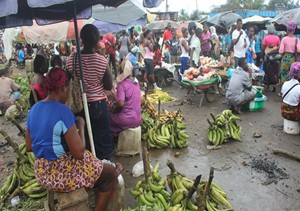
In 2024 Kpan borrowed $US280 from a local group called the “Help Yourself Organization” – more money than most families in her village see in a year – to plant rice across two acres of land here, outside the port town of Buchanan. She calculated everything carefully – seeds, fertilizer and labor costs. If she could sell 30 bags of rice at what she believed was the fair market price of $US15 per bag, she could get a decent profit, with enough to repay the loan, feed her children, and keep them in school.
Instead, Kpan says, a Gobachopnamed Otis Doue arrived in her village with cash in hand, and named his price at just $5 a bag. With no transport to take the crop elsewhere and no information to challenge Doue’s offer she received just $150 – less than what it cost her to grow the rice. She is now $130 deeper in debt.
“The people who buy from me call their own price. I’m forced to take it,” says Kpan. A 2023 survey found that 84 percent of rural farmers like her rely on buyers to tell them prices. “I have no other buyer, so I have no choice but to sell it cheap before it spoils or leave in my hand.”
Joseph Gbaryou, a longtime farmer here described it as farming blind. “No price board. No text alerts. No radio updates. Nothing. The traders know the prices in Monrovia, Buchanan, and other big cities,” says Gbaryou. “But we farmers don’t know anything. They tell us the price is low everywhere, so we believe them and sell cheap. Later, we find out they made big profits.”
David Kpagbo, head of the Garbamu Multipurpose Cooperative in Samsumer Town, says he put $LD20,000 into his farm. He hired ten men who cleared and planted his cassava and okra. He was expecting $35000. But he made back only $4,000 not even enough for next year’s seeds.
“The Gobachop people take advantage of us while we waste our time and resources,” Kpagbo says. “If I knew cassava was going for a good price in Ganta or Monrovia, I will find a way to get it there. Instead, I have to sell to the first buyer who comes.”
Vonyeegar, who mentors dozens of local growers, says says he has seen entire harvests rot while farmers wait for buyers who never come. Farmers sell okra, peppers, and cassava for next to nothing, just to survive the day. While Liberian farmers struggle to sell crops, fresh produce from Ghana, Burkina Faso, and Côte d’Ivoire floods local markets – fresher, and better packaged and out-competing local goods.
Ruth Johnson is a what’s known as a “Gobachop” woman. She defends her practices. “We not stealing. We and them talk price before we pay. We don’t force them,” she says. “We self buy it and put it on car to Buchanan or Monrovia, and we take risk on bad roads. We too pay plenty car pay. We lose goods.” The consequences ripple far beyond individual farms. World Bank 2024 report estimated that 2.5 million Liberians live in poverty, with nearly 80 percent of rural population below the poverty line. For most, farming is their only source of income. When farming families remain poor, children are pulled from school to help with fieldwork or sent to urban areas seeking wage labor, and communities remain trapped in a cycle of poverty. Food insecurity and malnutrition stalk the country. Liberians are the second most undernourished population in West Africa behind Niger, according to a 2024 Global Hunger Index report.

in Grand Bassa County
Women bear the brunt of the problem. They are largely excluded from market information networks because they stay closer to home and farm, juggling childcare, cooking, and household duties. Kpan says school fees alone cost her $30 per child each year. Sometimes she skips meals to cover school expenses. This year, she says it’s likely she’ll have to keep some out of school.
The solution, experts agree, is basic information. They say a simple SMS system from the Ministry of Agriculture broadcasting weekly price updates and crops demand trends could transform rural livelihoods overnight. Community radio programs in local languages listing market prices could reach farmers without smartphones. Even district-level price bulletin boards at local markets could level the playing field.
Across Africa, digital technology is transforming the agricultural sector. Farmers are benefiting from the Kenya’s M-Farm, Ghana’s Farmerline and Esoko, Ethiopia’s ECX, Nigeria’s FarmCrowdy, and Uganda’s radio price bulletins. These services connect farmers to markets, cut out middlemen, and ensure fairer trade. Liberian farmers are being left behind.

Comfort Whitfield, spokeswoman for the Ministry of Agriculture, acknowledged the problem, admitting that there is currently no market information platform, “though plans are under discussion with partners” to create one.
Responding to follow-up questions from this reporter via WhatsApp, Whitfield said, “We are too busy right now. Later on, please.” She did not respond to subsequent requests for comment. Agriculture Minister Alexander Nuetah also did not respond to requests for comment on the ministry’s plans.
The Boakai administration has said agriculture is a key priority. Liberia used the stage of the Africa Food Systems Forum in September to launch its most ambitious agricultural plan in decades: the US$900 million Legacy Investment Program. Nuetah told delegates the initiative will push the country beyond policy statements toward real projects, calling on investors, researchers, and development partners to help shape implementation.
In an interview on the ministry’s website, Nuetah said the focus of the program is five crops—rice, maize, cassava, coffee, and oil palm. The government says boosting production across these staples will feed Liberia’s people and open new avenues for exports and processing. If successful, rice and cassava yields could rise, post-harvest losses could fall, and reliable price information could give producers a fairer share of value chains. International partners including AGRA and the Gates Foundation have signaled interest, but much will depend on whether funds translate into storage facilities, extension services, and transparent market systems. More seeds are worthless if farmers are being driven into debt.
It’s not the first major investment in the space. A $55 million World Bank–funded agriculture project, approved in 2021, was meant to improve smallholder farmers’ market access in 11 counties. Its main components include improving farm-to-market roads, modernizing rural markets, providing technical assistance, and strengthening links between farmers and buyers.
The project, arming about 12,000 farmers with tools and support to boost their crop production by 30 percent in five years, was rolled out but rural farming communities like Taye Town say they have yet to see any real change.
Of the new plans Kpagbo remains skeptical. “We heard promises before,” “Let us see results.”
In the meantime he says he is watching the next generation of farmers desert their parents’ fields. He worries what will come of their future.
“We’re losing the next generation of farmers. Young people don’t want to farm. They see their parents suffer. We are farming,” he says, “but we are not living.”
This story was a collaboration with New Narratives as part of the Investigating Liberia project. Funding was provided by the Swedish Embassy in Liberia. The funder had no say in the story’s content.