
By Augusta S. Lafalay with New Narratives
Summary:
· Liberian mothers face a hidden postpartum depression crisis, with cultural stigma, spiritual beliefs, and lack of diagnosis leaving many to suffer in silence.
· Experts warn that inadequate screening and minimal funding are undermining maternal mental health, destabilizing families and worsening outcomes for children.
· Survivors are breaking the silence, urging compassion, public education, and systemic reforms to ensure women get treatment without shame.
For Sharon, the birth of her daughter was one of the happiest days of her life. The 35-year-old had sailed through her first pregnancy and childbirth 4-years earlier with a baby girl. But after this second birth, as the weeks passed, an invisible weight began to press down on her. As the congratulations faded and visitors stopped coming Sharon found herself drowning in a darkness that had no name in her native Kpelle language.
Sharon had led the choir at Mount Sinai Baptist Church for eight years, her voice soaring the congregation each Sunday. But now, cradling her newborn daughter in the humid Monrovia night, she could barely summon the strength to hum a lullaby.
“I began to resent the sound of her cry,” she says in an interview at her Monrovia home. “I wondered if this was God’s punishment for some sin I couldn’t remember committing.” “I became two people. The Sharon everyone saw, and the Sharon who was slowly disappearing inside.”
No one keeps data on how many Liberian women suffer from what’s known as postpartum depression, but a ministry of health survey estimated that in at least one in every five births mothers suffer from the illness in the sub-Saharan Africa region.
Health officials suspect the true number is far higher in a resource-constrained nation like Liberia, where mental illness carries the weight of ancestral shame, spiritual suspicion, lack of diagnoses and support systems, and deep stigma. Women suffer in silence while their families interpret their anguish as ingratitude to God.
Dr. Nowiah Gorpu-Dolo Dennis, director of the Family Health Program at Liberia’s Ministry of Health, says she has witnessed this crisis unfold in examination rooms across the country. After more than a decade treating women in Liberia’s fragile healthcare system, she describes postpartum depression as “very common and often underdiagnosed.”
“I have personally diagnosed women years after delivery who did not realize they had postpartum depression,” Dr. Dennis said. “Many, many are suffering in silence.”
The symptoms—sleep disturbances beyond normal newborn schedules, anxiety that transforms routine tasks into undefeatable obstacles, mood swings that feel like emotional whiplash—are often dismissed as typical adjustment struggles. But for women like Sharon, the experience goes far beyond normal fatigue.
At Mount Sinai Baptist Church, Sharon became a Master of Performance. She would dress in her finest wrapper, fix her hair in elaborate braids, carry her daughter proudly in a colorful baby sling—all while feeling like she was suffocating.
“I smiled in public and died in private,” she said.

The congregation saw blessed motherhood. They had no idea that some mornings, Sharon sat on the edge of her bed for twenty minutes, summoning the energy to face another day of pretending to be whole.
Perhaps nowhere is Liberia’s mental health crisis more evident than in how families interpret severe postpartum episodes. Cultural beliefs, passed down through generations, often override medical understanding—sometimes with fatal consequences.
“Many people associate postpartum psychosis with witchcraft,” Dr. Dennis said. “Instead of seeking medical help, families often take affected women to traditional healers or prayer camps. This delay in getting proper treatment can worsen the condition significantly.”
For Sharon’s husband—a taxi driver working long hours to support their growing family—the transformation of his wife was incomprehensible. “He’d come home exhausted and ask, ‘What’s wrong with you? The baby is healthy. We have food. Why are you acting like this?” Sharon recalls.
“I wanted to explain, but I didn’t understand it myself. How do you describe drowning to someone standing on dry land?”
The emotional distance between them grew like a chasm. “He would reach for me at night, and I would turn away—not from lack of love, but from lack of everything. I felt empty.”
Some nights, Sharon found herself contemplating thoughts that terrified her. “I wonder if my family would be better off without me. The thoughts scared me, but they also felt like the only logical solution to the pain.”
A second sufferer, aged 25, did not have the support of her boyfriend which made things even more difficult. When she became pregnant, she was pursuing her dreams to be a journalist when she was abandoned by her child’s father and ostracized by friends who viewed her situation as cautionary. Unlike Sharon, the second sufferer asked not to be identified for fear of stigma.
“People think pregnancy is just about money and medical care, but it is mental,” she said. “You need emotional support. I didn’t get much from the child’s father, and that broke something inside me.”

When delivery complications left her arm numb for weeks and required multiple procedures to control bleeding, Hawa’s mental state crumbled. She struggled to bond with her baby. She says the community response was merciless.
“People judged me harshly. As if my pain was entertainment,” she says.
Dr. Dennis paints a sobering picture of how untreated postpartum depression impacts entire families in a society where mothers usually serve as emotional and practical centers of households.
“The impact is devastating,” she says. “Most families in Liberia revolve around mothers. When a mother is affected by depression, it doesn’t just destabilize her—it destabilizes the entire home. It affects childcare, disrupts family dynamics, and can lead to serious marital problems.”
Experts says the absence of systematic screening makes the crisis worse. Liberia has very few psychiatrists and psychosocial therapists available in urban and rural areas, and routine screening for postpartum depression is inconsistent.
“Screening is usually done based on obvious risk factors,” Dr. Dennis says. “If a woman has documented mental health history, we probe further. But routine screening for everyone? That’s not common practice.”
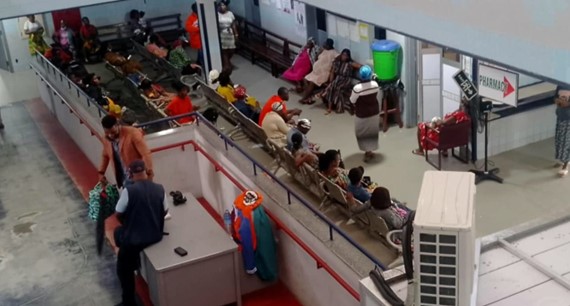
For Sharon, salvation came unexpectedly in a busy corridor at Redemption Hospital during her daughter’s vaccination appointment. Comfort Mulbah, a midwife, noticed what everyone else had missed.
“Sister, you don’t look fine to me,” Comfort said. “You look like you’re carrying something very heavy.”
The words, spoken with simple compassion, broke something open in Sharon that had been sealed tight for months. “Right there in that busy corridor, I started crying and couldn’t stop. It was like a dam burst.”
Instead of offering usual platitudes about counting blessings, Comfort offered something revelatory: validation without judgment.
“What you’re experiencing has a name,” the midwife told her gently. “It’s called postpartum depression, and it’s not your fault. It’s not punishment. It’s a medical condition, and medical conditions can be treated.”
For the first time in months, Sharon felt hope. She received six months counseling in addition to prescribed medication.
For most women the biggest barrier to treatment isn’t lack of medication or facilities—it’s cultural stigma. “Many people equate any mental health struggle with being ‘crazy’ or possessed, so women hide symptoms and suffer in absolute silence,” says Dr. Dennis. “This leads to massive underreporting and prevents women from seeking treatment that could save their lives.”
Experts say the solution requires comprehensive change: systematic healthcare screening for all new mothers, cultural education campaigns, efforts to reduce mental health stigma, increased funding for services, and recognition that maternal mental health is a public health priority.
“We must talk about it in newspapers, on radio programs, in churches and community meetings,” Dr. Dennis recommends. “Many women are suffering right now. It is not witchcraft. It is not spiritual punishment. It is medical, and it can be treated.”
Sharon’s healing process has been neither linear nor easy, marked by good days and bad days. But gradually, she began recognizing herself again.
“Now, when I hold my daughter, I feel love without crushing fear,” she says. “I look at her beautiful face and see hope instead of obligation. I am still healing—I think I always will be. But I am no longer ashamed of my journey.”
She is taking the brave decision to speak out to help other women.
“I share my story not to frighten expecting mothers, but to let them know they are not alone. Seeking help is not weakness—it’s strength and love for yourself and your family.”
“I dream of communities where women can speak honestly about struggles without fear,” Sharon says. “Where seeking help is seen as responsible rather than shameful.”
Her eyes light up: “This dream isn’t impossible. It’s already beginning, one honest conversation at a time, one brave woman at a time.”
This story was a collaboration with New Narratives as part of the “Investigating Liberia” project. The Swedish Embassy provided funding, but the funder had no say in the story’s content.