

By Aria Deemie, environmental reporter with New Narratives
At 3 a.m. Richedna Kpanneh Tobii finally opened her books. The 21-year-old university student had learned that her densely populated neighborhood of Lakpazee, with more than 160,000 people, was only quiet enough for her to study in the middle of the night. Video clubs blasted matches past midnight. Vendors shouted into megaphones and food sellers clanged pans and coal fires right outside her window
Richedna’s struggle was not unusual. Across Monrovia, residents endure relentless noise pollution day and night, from churches that shake neighborhoods with all-night worship, to roadside sellers whose loudspeakers and generators that hum over entire blocks.
“Even at 3 a.m. I could hear drunk lovers fighting in the street,” Richedna says. “Sometimes I stayed on campus late just to escape the noise.”
As Monrovia’s population has swelled in recent years, so has the city’s noise. Experts warn the nonstop noise is more than just annoying, it harms health, disturbs sleep, and makes it hard for students to learn. Though Liberia has laws to limit noise, enforcement has been rare, until now. The new Boakai administration and the Environmental Protection Agency says it will finally crack down.
The Agency recently tested its authority in a high-profile case. In May, it fined telecommunications company Lonestar Cell MTN $15,000 after residents of Congo Town complained for years about the company’s generator. Officials said noise levels far exceeded World Health Organization limits. Lonestar is contesting the penalty in court.
Emmanuel Yarkpawolo, head of the Agency, said at a recent press conference and in a Facebook post, that the agency will soon begin regulating loudspeakers in public spaces.
“School kids need to study. Working people need to sleep. Market women’s ears need protection from loud sounds. Sick people need rest and peace of mind,” he wrote. “Say no to excess noise pollution which is against the Environmental Protection and Management Law and the Public Health Law of Liberia.”

Heath experts are backing the government’s actions, warning that the health impact of noise pollution can be severe but are often ignored.
“Excessive noise can damage the inner ear, commonly known as the eardrum,” said Nick Benito Goll, a Liberian environmental health expert. “It affects people with hypertension, can lead to sleep deprivation, and interferes with concentration and learning.”
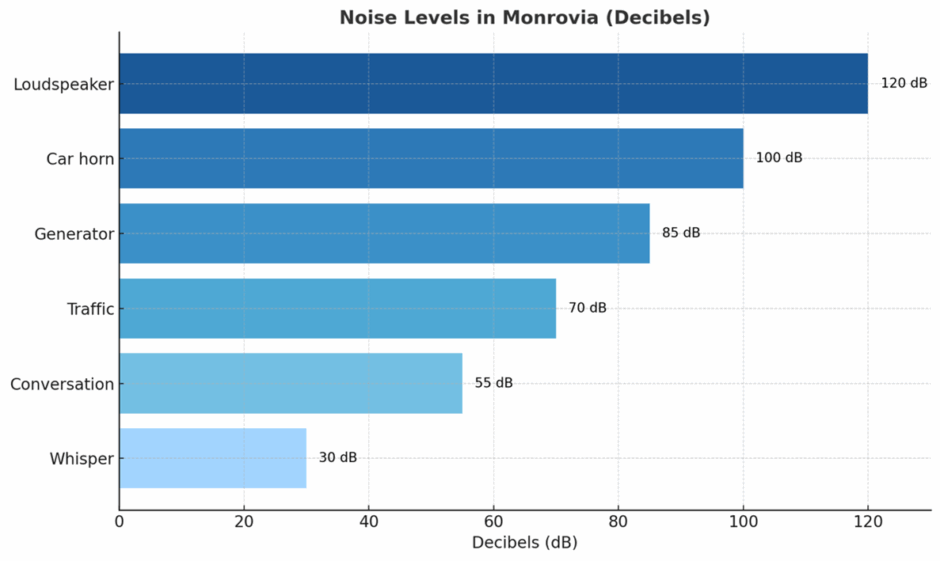
Yarkpawolo explained that noise is measured in decibels. A whisper is about 30 decibels, normal conversation is 50–60, and traffic in Monrovia easily climbs to 70. The steady hum of a generator or the whine of a power saw pushes closer to 85, a level that can start damaging hearing if exposure is long. At 100–120 decibels, the blast of a car horn or music from a giant loudspeaker can cause pain and permanent hearing loss almost immediately.
Noise pollution doesn’t just impact hearing or grate on nerves; it reverberates through the body in ways scientists are only beginning to fully understand. A growing body of research links chronic exposure to traffic, construction and industrial noise with elevated stress hormones that disrupt sleep, raise blood pressure and strain the cardiovascular system. Doctors say the constant thrum of city life can increase the risk of heart disease, stroke and metabolic disorders, while sleep disruption itself has cascading effects on mental health, immunity and cognition.
For children, the impact may be profound: studies suggest that sustained noise in schools can impair concentration and slow learning, making noise pollution not just an environmental nuisance but a significant public health challenge.

Five months ago, after years of sleepless nights, Richedna’s family relocated to Dixville, a northern suburb under Caldwell Township with less than one-third the population of Greater Monrovia’s most densely populated neighborhoods. The quieter streets and less crowded environment provided immediate relief. The move lengthened her commute to classes at the university, but she says the trade-off is worth it.
“My peace of mind matters more than the distance. I can have a long day at school and work, but when I come home to a peaceful environment, that’s okay by me,” Richedna said. “I did not know the value of peace of mind until I moved here. My mind is more productive, I think clearly, and I barely get irritated anymore.”

Enforcement was rare under previous administrations but they are increasing now. In September the Monrovia City Police responded to a complaint about loud music at a wedding in the Sinkor area. Officers said they initially persuaded hosts to turn the volume down, but when the music blared again, they confiscated the PA system. A crowd resisted, assaulting two officers who sustained minor injuries before backup units dispersed the gathering.
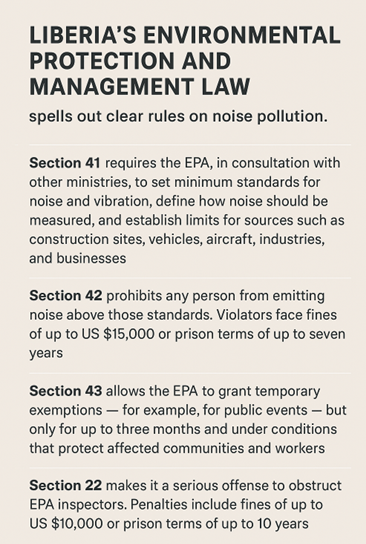
The Monrovia City Police’s authority comes from Liberia’s Environmental Protection and Management Law, which empowers them to seize or impound noise-making equipment to restore peace. That law, overseen by the Environmental Protection Agency, spells out clear rules on noise pollution.
Liberia is not alone in grappling with urban noise. Across Africa, cities are tightening rules to curb excessive sound. In Rwanda, the government enforces strict night-time noise bans, with police shutting down churches and bars that exceed limits. In Nigeria, Lagos State has a dedicated Environmental Protection Agency that regularly seizes loudspeakers and fines offenders. Ghana has also passed guidelines aligning with World Health Organization standards, although enforcement varies between cities.

“We cannot allow companies or individuals to disturb communities without consequences,” Yarkpawolo said.
For Richedna, sleepless nights are no longer part of life in Monrovia. She cherishes the quiet at her new home in Dixville. “I cherish this peace and quiet so much right now,” she said. “No one should have to set an alarm for 3 a.m. just to study.”
This story was a collaboration with New Narratives. Funding was provided by the American Jewish World Service. The donor had no say in the story’s content.