

The challenge of building financially viable businesses to support independent news in low and lower-middle income countries has long vexed the industry. An innovative project in the West African nation of Liberia shows that AI and other new digital tools present promising new options.
By Manon Verchot, Sanshey Biswas, Gardeh Garteh and Prue Clarke.
While newsmedia in rich countries have spent two decades scrambling to find new revenue streams to replace advertising revenue lost to internet platforms, news media in emerging democracies of West Africa have had a different challenge. The authoritarian regimes from which they emerged bequeathed a business model that has been hard to shake: newsrooms pay journalists little or nothing in salaries and expenses for reporting. Instead, newsmakers pay journalists for slanted, single sourced, propaganda.
Persuading news owners and newsmakers – including, sadly, the development world – to give up that model has been hard. In a damaging, self-enforcing cycle, news is seen as a mouthpiece for politicians and business leaders. It’s not trusted by audiences. Journalists see the profession as a steppingstone to more respected, dependable jobs in government or public relations.
New Narratives has been helping West Africa’s leading newsrooms break from that model with reliable donor funding for journalism since 2010. But this year we took a critical step further. With the enlightened support of the Swedish Embassy in Liberia we brought Manon and Sanshey, experts in audience engagement and news product development in LMICs, to embed for six months at a leading newsroom, Front Page Africa.
By better understanding audiences and creating new products to serve them, they have been able to revolutionize Front Page’s operations, taking the publication from being the key source of news for the country’s elite to be the major player in Liberia’s social media and digital information ecosystem. They’ve also put the newsroom on the path to financial sustainability.
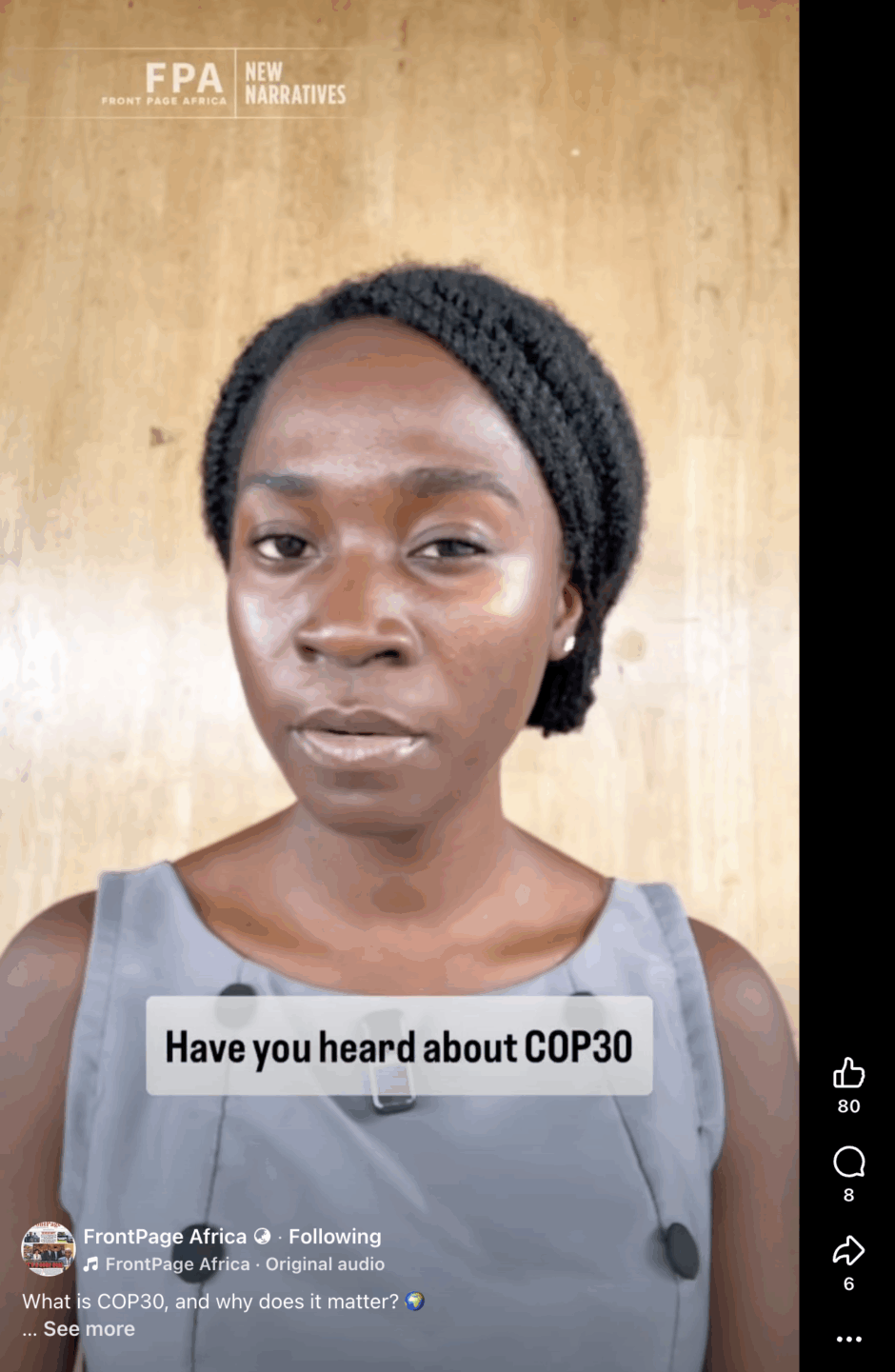
Between May-October 2025, Front Page saw dramatic growth across key platforms:
- Increased views of Facebook posts including videos, photos and links by 60 percent.
- Increased 1-minute views on Facebook videos by 238 percent, illustrating a leap in audience engagement.
- Increased content interactions by 63 percent on Facebook.
- Increase watch time by 150 percent. Which means people spend more time watching videos about the news – no small feat considering all the engaging content on the platform vying for our audience’s attention.
Platforms like Facebook, YouTube and TikTok don’t offer monetization in Liberia, so the team worked on setting up systems for more direct advertising through selling space on Front Page’s social media platforms. In order to future-proof the business team, the media kit for print was updated to add digital formats like videos, photos and social media posts.
Importantly – in a region with a growing youth population consuming antidemocratic disinformation and threatening political instability – they have grown youth audiences with young reporters and youth-friendly formats in video and social media and explanatory reporting that better meets young people’s interests. And they did it without the newsroom having to spend much on additional resources. Sanshey and Manon assessed the resources the newsroom had available and developed processes and workflows based on those resources, like using reporters’ own phones to record vertical video optimized for social videos. Reporters were trained to use free apps to edit the videos on their phones. And free tools that would improve audio recorded in noisy surroundings without high-end microphones.
Journalists at Front Page Africa and New Narratives are now promoting their stories with social video and photo formats that are popular with younger audiences on Tiktok and Facebook. These videos and photos are helping them grow an audience base between the ages of 18-35 in a country where 63 percent of the population is under the age of 25.
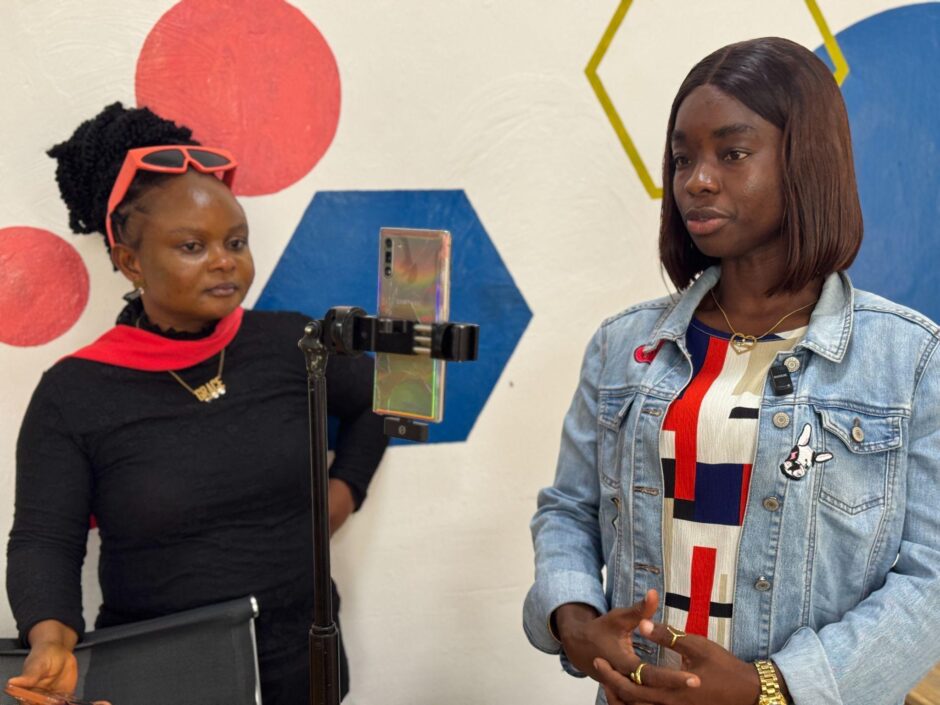
“This has been game changing for FrontPage. Facebook has been the main place where our audience saw our journalism for a long time. But we were losing audience to Reels and Tik Tok and Instagram,” said Rodney Sieh, Front Page publisher and managing editor and co-founder of New Narratives. Sieh has long been critical of donor-supported initiatives in Liberia that failed to give independent newsrooms the support they were asking for. “We didn’t have the in-person knowledge and skills to understand the audiences, the platforms and the tools. Having Manon and Sanshey embedded for six months has been the support we needed. We now have many more revenue options.“
Front Page/New Narratives journalists are loving a chance to get creative and build relationships with their audiences.
“It has been really exciting to hear from friends and family and audiences everywhere who have seen my videos. They are really engaging with the stories in a way they did not before. That’s really motivating,” says Aria Deemie, a youth and climate change reporter with New Narratives and Front Page Africa. Aria has used Facebook videos to educate audiences about climate change, deforestation and pollution and to expose failures by Liberia’s leaders in securing climate finance. “The stories still have the same hard-hitting facts and information but it’s more accessible. That’s really important in a country like ours where only half the population is literate.”
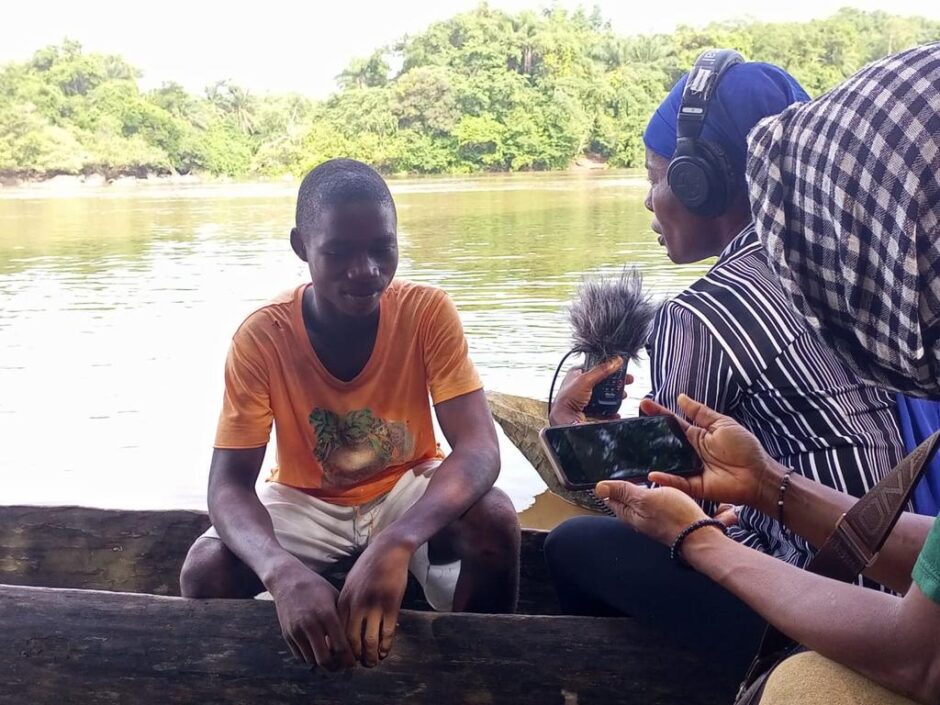
For New Narratives the project has realized a long-term goal of the organization since co-founder Prue Clarke first embedded in Ghanaian newsrooms as a journalist in 2004. The practice of paying for coverage was so entrenched that a United Nations staffer gave Clarke an envelope stuffed with cash at a news conference. Clarke had trained at Columbia University’s Journalism School and worked in the New York bureau of the Financial Times where such ethical violations would lead to instant dismissal.
“This is what works to build viable independent media,” says Clarke who has now been working with West African newsrooms for 21 years. “Journalists don’t want or need more training in how to do journalism. They just need the funding to do it. Having the experts, Manon and Sanshey, spend six months understanding the newsroom and passing on their skills and knowledge in a long apprentice-style approach is what these newsrooms need to grow audiences and build financial independence.”
“Front Page Africa is a standard setter in the Liberian market and we already see other newsrooms emulating what they have done,” she says.
“We are excited to have created a blueprint that newsrooms and donors and media development organizations can learn from in their efforts to support media independence elsewhere. Thanks to the Swedish embassy team for seeing the opportunity and giving us this chance.”
The team also knew that over-reliance on social media for reaching audiences can pose challenges — something that newsrooms have been learning the hard way for a while. So building a product that allowed Front Page to directly reach their audience was a priority for the team. They have created new revenue sources including a PDF newsletter version of the paper that is already on track to pay for Gardeh, the digital creator trained as Front Page’s new audience engagement editor, to run audience engagement projects.
“We keep hearing that younger audiences are gravitating towards short videos because of decreasing attention spans but not enough about how social media platforms promote shorter videos by design,” says Sanshey. “So, it is kind of a loop where newsrooms are stuck between user behavior and algorithm bias. It’s no surprise that even older generations are also feeling the draw to shorter videos. This is something we have noticed happen across geographies through our work on social video platforms.”
Donation campaigns have been created, including for the end of year Newsmatch program in the United States, where tax-deductible donations are triple matched by American foundations.
Front Page holds a special place in the Liberian media space. Launched in 2005 after the end of the civil war, it became a place where Liberians, including the diaspora, and the large expat community turned for news. Twenty years later, it has more than double the audience of its nearest rival. Stories covered in FrontPage force leaders to act on a near-daily basis. It is cited constantly by the administration, lawmakers and everyday Liberians. Hop into a cab in the capital city, Monrovia, and you’ll hear radio hosts debate stories from the paper on your way to work. Front Page’s Facebook posts generate millions of views and tens of thousands of interactions every month.
One of the oft-cited barriers to viability in low-income countries is inability of poor audiences to pay. But Front Page’s analytics showed it had a large audience in the diaspora. In the United States and Europe diaspora audiences are more steeped in information about the importance of a free press and democracy than those in their homeland, and thus more likely to see the need to invest in it. And Front Page’s labor costs are low. It takes a lot less to run a vibrant newspaper there.
Diaspora audiences do not receive the print newspaper and the advertising in it. The team decided that distributing the paper online for this audience via a paid subscription was a top priority.
In addition to the paying-subscriber-only ePaper, the team also launched a free newsletter on weekends that summarizes the top stories in Liberia from that week, and directs readers to the website for more information. Since its launch, the newsletter has brought FPA an additional 125,000 views within four months of starting from scratch. Prior to this, the only direct access to the readers FPA had was the print subscription. Adding a digital offering like ePaper not only improves their ability to reach nearly 6,000 subscribers directly, but also add the diaspora as a source of revenue.
The team has also set up a new channel on TikTok which has grown quickly and added over 1.3 million views in less than 6 months. The account reaches a large number of younger users who look to the platform for news and entertainment. Along with shortform videos on Facebook, TikTok allows FPA to offer premium digital real estate that can be offered to potential advertisers. The team has also built Liberia’s first podcast – Democracy in Focus, a collaboration with newsrooms across the country that repurposes reporting – into a sponsorship and advertising opportunity. There are plans to adapt it for You Tube.
“Journalism in the digital era has seen the line between business strategy and editorial blur more than ever before,” says Manon. “But what we’ve seen is that there are ways to develop business strategies that allow newsrooms to maintain their journalistic principals.”
The successes of the ePaper and new social media formats for FPA show that audiences are still hungry for the journalistic perspective. And that newsrooms still play an important role in sparking conversations and civic engagement.
However, the most important outcome of this project has been FPA’s ability to continue to adapt to the constantly changing media landscape so that they continue wading through the next big thing in journalism.
For more information please email [email protected]