

By Nemenlah Cyrus Harmon, senior reporter with New Narratives
- Boakai’s Anti-Drug Drive Stalls: President Boakai declared drugs a national emergency and pledged more than $3 million, but frontline workers say there is minimal support on the ground.
- Untrained Groups Running Rehab Centers: In the absence of government-run facilities, unregulated organizations—some headed by former warlords—are stepping in, sparking fears over patient safety, abuse, and ineffective treatment.
- Liberia’s Youth at Risk: With one in five young people battling addiction, experts warn Liberia risks losing an entire generation without a stronger national response.
Mount Barclay, Johnsonville —Inside a fenced compound lined with barbed wire Jakuba Kamara sits quietly among dozens of recovering youths once gripped by drug addiction. After six months at this rehabilitation center Kamara reflects on the harrowing life he left behind.
The 42-year-old remembers the stench of the dumpsite where he lived in Zono Town on Bushrod Island – packed with more than a hundred users, many of them barely clinging to life, with no appetite for food, but thirsty for drugs every hour.
Kamara says he saw many friends die —sometimes as many as seven a week. “We’d put them in bags and throw them in the river,” he says.
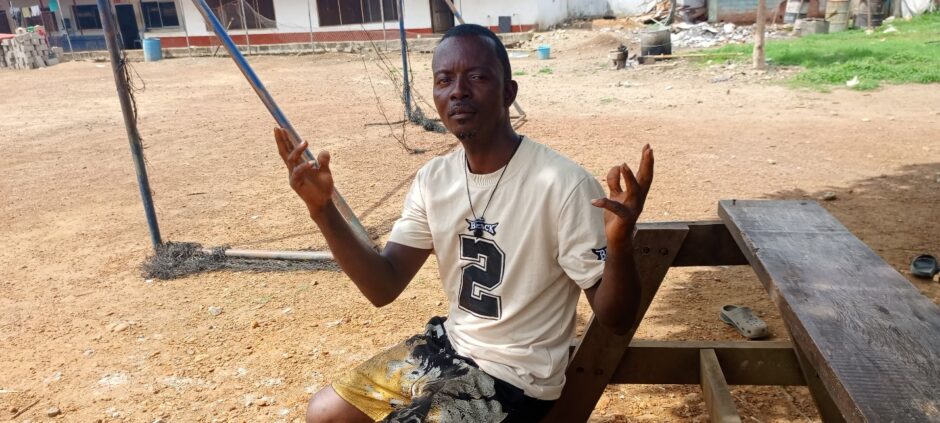
Kamara says he has been sober for six months. He is learning to drive a tractor and bake bread here at the Journey Against Violence rehabilitation center, run by Joshua Milton Blahyi, the once-brutal warlord “General Butt Naked” turned pastor. It’s one of a growing number of unregulated rehabilitation centers across the country charging big fees to desperate families.
Kamara’s latest bid for sobriety began after his teenage daughter waited three days at a busy junction to find Blahyi and plead with him to take her father. This is his fourth attempt at recovery.
“I can’t go back,” Kamara says, as if willing himself to be strong.
A Crisis Unfolds
Liberia’s substance abuse crisis is clear to anyone who lives here. Drug dens, known here as “ghettos” are appearing in towns and cities all over the country. A 2023 study by the United Nations Population Fund found that one in five Liberian youth use narcotics – most often a synthetic mix of dangerous chemical like fentanyl and methamphetamine called “kush”. In 2023 civil society groups report over 866 drug dens operating in Monrovia alone. Estimates are that one in every five Liberian youth is now using drugs.
“This is the second biggest threat to our youth after unemployment,” said Samuel James Kpartor, national program manager at the Federation of Liberian Youth. Civil society leaders like Kpartor warn that the drug epidemic is not only destroying lives, it’s eroding our national conscience. “People are dying, and we’ve adapted to it.We know where they are, and we walk past them every day. That’s not normal. That’s failure.”
Liberia is suffering along with the rest of the region as the drug trade’s reach is expanding. According to the United Nations Office on Drugs and Crime, West Africa has become a major transit route for South American cocaine bound for Europe. Seizures in the Sahel region rose from 13 kilograms a year to 1,466 in 2022.
When President Joseph Boakai entered office in January last year he declared the growing use of drugs was a national public health emergency. A multi-sectoral committee including the Ministries of Health, Justice, Youth and Sports, Gender, and Finance lead the national response with nearly $US3.5 million put aside in the 2024 and 2025 budgets for at-risk youth programs including “Kush Must Go”.
But those working on the frontlines say they have seen little of it. Just 163 people are currently receiving government funded treatment – 37 as inpatients at a facility in Grand Bassa, and 126 in outpatient care in Congo Town, according to Dr. Moses Ziah II, director of Mental Health at the Ministry of Health and chair of the government’s technical working group on drug abuse.

Dr. Ziah II insists progress is being made. He cites stepped-up law enforcement –1,000 copies of the amended drug law have been distributed to law enforcement agencies to create awareness among security institutions about the law and its applicability.
He says there has also been an increase in the number of Liberia Drug Enforcement Agency officers at international borders and across the 15 counties. That has resulted in the destruction of cannabis farms in Lofa, Nimba, and Grand Gedeh. There have been seizures of imported cocaine, heroin, kush, tramadol and cannabis worth over $US5.5 million – a “significant disruption of the supply chain. We are far from where we used to be,” Dr. Ziah said in an interview. “Not where we want to be, but we are moving.”
But problems at the Liberia Drug Enforcement Agency have not helped. Three top officials were dismissed in November after what the Boakai administration said was a “disturbance” at the Agency. No details were given. In a series of text messages Hassan Fadiga, the dismissed deputy director for operations at the Agency, alleged that 97 percent of agents have ties to traffickers – “Some are dealing drugs themselves. Others are compromising cases. Of 644 employees, only 144 have received basic law enforcement training.”
Agency officials did not respond to requests for comment by deadline.
Little Funding for Rehabilitation Has Opened the Door for Unregulated Facilities
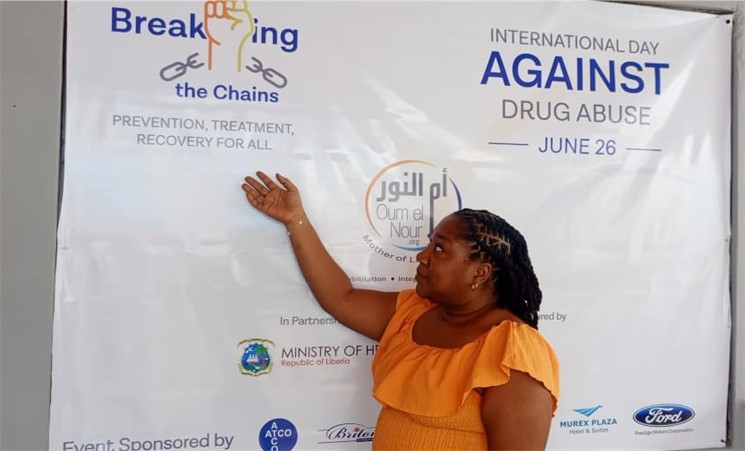
Meanwhile those working to help those already addicted to drugs say they are receiving little help. The Mother of Light center, a Liberian off-shoot of a Lebanon-based anti-addiction program, here at Congo Town is the only official facility funded by government to rehabilitate addicts.
Artinique Curtis, administrative coordinator and outpatients lecturer, says the partnership with the Minstry of Health has capacity for 50 people in the inpatient program. She says 450 beneficiaries have come through outpatient program and about half that are actively coming to the group therapy sessions weekly.
Over the years, in the absence of government support, a range of facilities have sprung up across the country, some charging large fees to desperate families. Their lack of training in the complex work of drug addiction recovery has sparked fears over patient safety, abuse, and ineffective treatment.
Experts say unqualified rehab centers pose serious risks and may do little to help long term. Even in the best settings in the United States as many as 60 percent of addicts relapse after an initial treatment. A Harvard Medical School study found that 75 per cent eventually recover though it often takes multiple attempts.
“Without trained personnel and standardized practices, rehabilitation becomes a risk and not a solution,” says James Koryor, executive director Global Action for Sustainable Development, a civil society organization that advocates for better approach to drug prevention and enforcement. He calls for government regulation on who can operate a center and oversight of those that already are. “This vacuum opens the door for the proliferation of substandard centers, exploitation of vulnerable clients, human rights violations, and unsafe treatment practices.”

On a recent visit to Blayhi’s Journey Against Violence center in Mount Barclay, a new patient was locked behind a chained door that looked like a prison cell as he went through the first grueling stage of withdrawal. Blahyi claims his center has treated over 700 addicts since 2007. The center has 21 staff – 9 of whom are graduates of the program. Three are trained nurses.
Blahyi claims an 84 percent success rate, but gives no evidence of this. He says “out of 50 users that enrolled, about 42 will be ok and not go back to the drug den.” Blahyi, who was the only former warlord to confess his crimes to the Truth and Reconciliation Commission, says he does this work because of a sense of penance for his crimes which included use of child soldiers who were given drugs to ease the commission of their crimes. In return for his confession, the TRC recommended amnesty for him.
“I thought it was an unusual kindness. So, I decided that I would sentence myself to community service,” he says. “These people are not criminals. They are wounded souls.”
But Blayhi is getting more than just emotional rewards. The center charges each addict up to $US1,700 for six months, and $US3,740 over the full 18-month rehabilitation process. The money is paid by families or addicts in installments – $US660 for enrolment, and $US160 every month thereafter.
Another leading center in Paynesville, the Center for Rehabilitation and Reintegration, founded by Montserrado County Senator Abraham Darius Dillon, opened in 2023 and promises a range of services with expert support and “complete recovery” on its website. It claims to have graduated “three groups of clients” and have 17 staff but it does not mention their qualifications. Dillon, as well as other officials at the center, refused to speak with this reporter and denied access to the facility.

Staff at the National Rehabilitation for Drugs and War Affected Persons center, operated by Augustine J. Nagbe known during the war as “General Power”, also declined to comment.
Mother of Light’s Curtis is skeptical about Blahyi’s data “84 percent sounds like a high number. So without seeing their data, it’s hard to say,” she says. “Addiction is a lifetime battle; we don’t use the word recovery. So when you leave the program, you are reintegrated back into society, but you are going to be dealing with addiction for the rest of your life.”
The Ministry of Health is now working on a program to streamline all substance abuse care in Liberia, using the Mother of Light as the pilot, according to Artinique Curtis. “That program is being built and it’s starting here.”
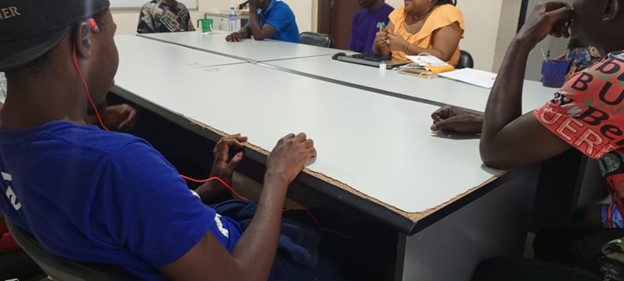
For those still battling addiction, the disconnect between promises and reality is palpable.
Washington, 29, has lived in Monrovia’s cemetery for over two years. NN/FPA is withholding his last name because of the stigma. A high school graduate, Washington started taking in drugs with friends at the Center Street graveyard.
“We bust graves to sleep inside,” he says of his life now. His parents are heartbroken. “They are not happy because they don’t expect me to be living such life.”
He wants to stop and has met with social workers from the government several times but nothing has come of it. “They promise to help us, but they don’t come back.”
Kimba, 44, another addict here filled out forms after police came recently. But he heard nothing more. “We are asking the government to give us great help because this is a demonic issue.”
Koryor advocates for a $US5 million annual budget and a specialized National Drug Prevention and Rehabilitation Authority to coordinate the effort.
“When you declare a national emergency, the country expects urgency. There is no clear roadmap,” Koryor says. “We fought Ebola. We fought COVID. Why can’t we fight drugs with the same seriousness? If we don’t act now we’re not just losing a few kids to addiction, we’re losing a whole generation.”
This story was a collaboration with New Narratives as part of the Investigating Liberia Project. Funding was provided by the Swedish Embassy in Liberia. The funder had no say in the story’s content.