
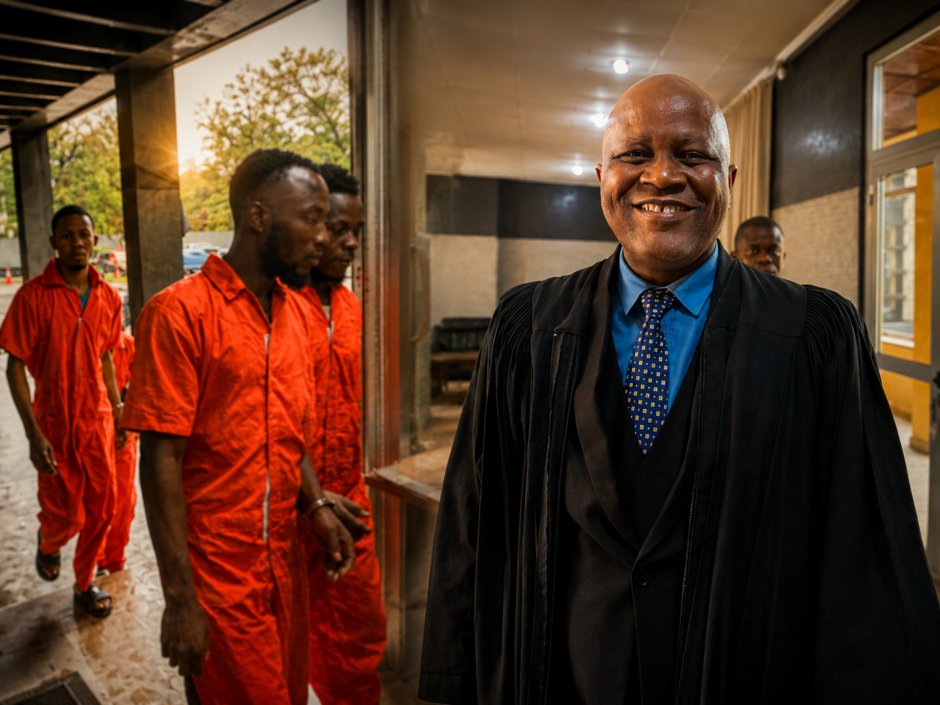
By Anthony Stephens, senior justice correspondent with New Narratives
Summary:
• A defendant in Liberia’s largest human trafficking trial testified Monday that four members of Vice President Jeremiah Koung’s security detail inspected the compound where victims were allegedly held before the vice president moved into a house nearby and found no evidence of the crimes.
• Rudolph Flomo denied allegations that he beat, tortured or abused victims after earlier testimony from victims and a former co-defendant said he played a role in enforcing discipline at the compound.
• Co-defendant Bill Plato denied charges of human trafficking, rape, criminal conspiracy and theft, disputing testimony from an alleged victim who accused him of raping her and forcing her to terminate a pregnancy.
A man accused of overseeing the beating, torture and other degrading treatment of 57 victims at a compound at the center of Liberia’s largest human trafficking trial testified Monday that four security officers assigned to Vice President Jeremiah Koung visited the property and did not report any of the alleged crimes.
In his testimony to Criminal Court A, Rudolph Flomo said four members of Koung’s security detail, whom he did not identify, were introduced to him and other staff members by Daniel Davis, whom prosecutors and victims identified as Wuo Zekarso Garteh, and by co-defendant Bill Plato. Davis and Plato have acknowledged serving as leaders of Infinity Millennium Platinum Star Limitless Institution, an organization they said was affiliated with the Malaysian multilevel markeing company QNet.
“It was after the road construction, that was when he moved there,” said Flomo. “After the VP moved, four guards from the VP security center, they entered the fence. All of them were in coat suit. After the presentation, I left.”
The trial is the largest human trafficking prosecution in Liberia’s history — 57 freed victims, more than two dozen accused traffickers, and allegations of rape, torture and bribery tied to an operation that ran near the vice president’s home. As defendants deny the charges and the court prepares to visit the compound at the center of the case, the proceedings are testing whether Liberia can hold a trafficking network to account and deter a crime that has ensared thousands of poor Liberians.
Flomo corroborated testimony from victims and Nathaniel Walker, the lead police investigator, that he served as a security guard for the alleged trafficking network. But he denied the charges of human trafficking, criminal conspiracy and theft of property.
The testimony marked the first time a defendant has alleged in court that members of Vice President Jeremiah Koung’s security detail visited the compound at the center of the case. Experts say the claim could draw renewed scrutiny to the facility, which authorities raided in September 2025 after allegations that dozens of people were being held there against their will.
No evidence was presented that the officers witnessed criminal activity or were aware of the allegations later brought against the defendants.
Victims told police, FrontPage Africa/New Narratives and the court that after hearing their loud protests, members of Koung’s security detail opened the compound’s gate, allowing them to leave.
Following Flomo’s revelation, Judge Roosevelt Willie granted defense lawyer Sennay Carlor’s request for the court, jurors, victims, defendants and lawyers for both sides to visit the compound at the center of the case. Such site visits have occurred in Liberia’s human trafficking prosecutions before, but they have become relatively uncommon in recent years.
Solo Ware, a spokesman for Vice President Jeremiah Koung’s office, said the defendant had not identified the four security officers who allegedly visited the compound, making it difficult for the office to substantively address the allegation. He said officials were seeking additional information before commenting further.
Questions about the compound’s proximity to the vice president’s residence have surfaced repeatedly throughout the trial. In an interview with FrontPage Africa/New Narratives at the start of the proceedings, Augustine C. Fayiah, Liberia’s solicitor general, said the location of the alleged crimes would not affect the government’s prosecution.
“The government is after the crime,” Fayiah said. “Wherever it happened…. It happened before the vice president, we will go after you. It happened before the president, we will go after you. We are after the criminal. The fact that it happened around the vice president’s [residence] does not change the event. They have committed a crime. So we are doing after them and we will prosecute them properly.”
All of the victims who testified for the prosecution accused Flomo, whom they also referred to as “Luther,” of beating and physically torturing them.
Their testimony was corroborated by Shelley Jonny, one of four defendants who pleaded guilty. Jonny is the only defendant against whom prosecutors dropped charges before calling her as a witness for the state. Flomo denied her allegations.
“Nobody was punished while in that fence [compound],” he said in Liberian English.
Flomo also denied charges of human trafficking, theft of property and criminal conspiracy.
“I na trafficked anybody,” he said. “I did not take anybody document from them to travel. I na bring anybody in the business. I na know how they entered the business, but I used to use them in the office for presentation.”
Like Davis, Flomo admitted that he was an “independent representative” of QNet, the Malaysian direct-selling company that has become associated and synonymous with human trafficking allegations across West Africa. QNet has repeatedly denied involvement in trafficking and says criminals have misused its name and business model to deceive victims.
Flomo also corroborated the testimony of previous defendants who said the victims only paid for a three-day training on “how to sell the products, to know much about the products,” sold by Qnet. He also said the products came from “Malaysia and USA.”
“The more people buy the products, the company gives you two spaces,” he said.
“And the money people buy, the more you will get income. For the two persons, the company will pay US$225 per week.”
Flomo testified that he was recruited into the organization by Jeremiah Johnson, whom prosecutors say remains at large. He said he paid Johnson US$900 to join.
In his testimony Bill Plato corroborated Davis’ testimony that he was one of the leaders of Infinity Millennium, saying “Infinity Millennium is the same as QNet.” He addressed the allegations against him, including rape, human trafficking, criminal conspiracy and theft of property.
“I did not traffic. I did not conspire,” he said. “I did not take anything from any of those complainants.”
Plato is accused of raping a woman identified in court only as P. She testified that Plato raped her and later forced her to terminate a pregnancy. Plato denied the allegations.
“P. is my girlfriend that was pregnant for me,” he said, gesticulating and shaking his head. “I did not rape her. We were loving. I did not force her. We have been in a relationship from 2022-2024.”
Plato also testified that he paid P.’s graduation fees and rent and introduced her to the Qnet selling opportunity.
Although the indictment alleges that the victims were recruited from seven of Liberia’s 15 counties — Bong, Nimba, Lofa, Grand Bassa, Margibi, Montserrado and Bomi — and trafciked to Montserrado under deception that they would be sent to good jobs in Canad and Australia, Plato disputed that claim, testifying that all of the complainants were recruited from Montserrado County.
Judge Roosevelt Willie granted a prosecution request for officials from the Ministry of Health to produce records showing whether Infinity Millennium had been authorized to sell health products. The court ordered the ministry to provide any relevant documentation covering the period from 2023 to the present.
The trial resumes Tuesday, with more defense witnesses scheduled to testify.
This story was a collaboration with New Narratives as part of the Investigating Liberia project. Funding was provided by the Swedish International Development Cooperation Agency. The funder had no say in the story’s content.