


By Anthony Stephens, senior justice correspondent with New Narratives
- Former President Ellen Johnson Sirleaf endorsed the proposed Specialized National Anti-Corruption Court, urging President Joseph Boakai to address “the several scandals that plague the society” and calling on all branches of government and Liberians to strengthen the fight against corruption.
- The proposed court drew mixed reactions, with Liberia Anti-Corruption Commission Chairperson Alexandra Zoe backing the creation of a standalone court but opposing provisions that would transfer the commission’s direct prosecutorial powers to a new National Anti-Corruption Prosecutor.
- Speakers agreed corruption remains one of Liberia’s greatest challenges, while differing on how the proposed legislation should balance stronger enforcement with constitutional safeguards.
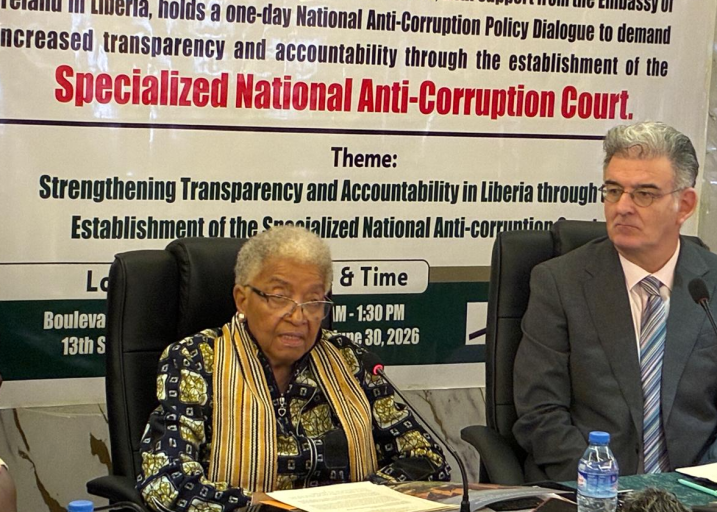
Ellen Johnson Sirleaf, Liberia’s and Africa’s first democratically elected female president, on Wednesday urged President Joseph Boakai to intensify the fight against corruption, calling on him to address what she described as “the several scandals that plague the society” while backing the creation of a Specialized National Anti-Corruption Court.
Speaking as the keynote speaker a one-day National Anti-Corruption Policy Dialogue in Monrovia, Sirleaf said Boakai, who served as her vice president for 12 years, must lead the fight against corruption—an issue she once described as a “public enemy number one” and later likened to “a vampire.”
“We therefore call on the President to treat the request for the Specialized Court with the seriousness it deserves and to take necessary corrective executive action on that and the several scandals that plague the society,” Sirleaf said. She also called on the Supreme Court “to improve its record of performance by taking corrective action on the workings of the court and the overall judiciary system as required by the Constitution,” urged lawmakers to “set the example” in the fight against corruption and appealed to Liberians to become “champions of change.”
Sirleaf’s remarks come as Liberia grapples with growing public concern over corruption, drug abuse, youth unemployment and other governance challenges that have dominated national debate during President Boakai’s first years in office. Experts say her renewed endorsement of a specialized anti-corruption court, coupled with a call for Boakai to confront what she called scandals, elevates the country’s debate over accountability and the government’s response to mounting public discontent.
Yet Sirleaf also acknowledged that her own administration fell short.
“Our administration was not perfect and my legacy on this issue is unfinished,” she said, arguing that while her government established key accountability institutions, Liberia never completed the system because investigations too rarely resulted in convictions.
For decades, corruption has been a major issue in Liberia, including under Sirleaf. Liberia was ranked as one of the most corrupt countries in the world by the time she left office more than eight years ago, according to a perception index by Transparency International. In her final annaul message to the Legislautre in 2017, Sirleaf, who in 2006, had pleaged to fiight corruption, admitted that her administration had “not fully met the anti-corruption pledge.”
The challenge remains significant. According to the Center for Transparency and Accountability in Liberia, the Liberian chapter of Transparency International, its June 2026 Corruption Case Tracker documented 133 corruption cases, with 82 still under active investigation and only three resulting in convictions.
Transparency International’s 2025 Corruption Perceptions Index Index gave Liberia a score of 28 out of 100, ranking the country 136th out of 182 countries and territories—a one-point improvement from the previous year but still among the world’s poorest-performing countries on perceived public-sector corruption.
The Liberia Anti-Corruption Commission’s public Anti-Corruption Dashboard shows the government is currently tracking 150 LACC reports, 44 General Auditing Commission reports, 57 Public Accounts Committee reports and one Public Procurement and Concessions Commission report.
The issue has also drawn criticism from prominent Liberians. Last year, Nobel Peace Prize laureate Leymah Gbowee said in an exclusive FrontPage Africa/New Narratives interview that the scale of corruption under the Boakai administration made Sirleaf’s government looked “like a diamond” by comparison.
Human rights lawyer Tiawan Saye Gongloe said Liberia’s fight against corruption would be won through leadership.
“I don’t think speeches can take us to the promised land,” Gongloe said. “Actions by leaders—from the President, to the Legislature, to the Judiciary, to those who work in the different ministries and agencies, as well as civil servants—are what matter.”
He argued that Liberia’s strong presidential system meant the President must set the tone.
“If the President shows a strong commitment to fighting corruption, everybody follows,” addressing an audience that included diplomats, academics, civil society advocates and students and youth leaders.
Gongloe also renewed criticism of the Legislature, whose members are among the world’s highest-paid lawmakers relative to the country’s economy, and argued that legislative bribery had become institutionalized.
“Under Gyude Bryant, because of the government he had, some legislative bribery started. It continued under the first UP government,” said Gongloe. “And I must say frankly, it became institutionalized under the first UP government. When you have institutionalized legislative bribery, you have a serious problem.”
His remarks on corruption frequently drew laughter from the audience, reflecting the resonance of his criticism.
Tuesday’s dialogue was the latest in a series of consultations on the proposed court over the past year. In April, the U.N. human rights office trained Liberian prosecutors, investigators and senior civil society leaders on investigating and prosecuting corruption through a human rights-based approach. The Office for the Establishment of the War and Economic Crimes Court has also been consulting lawmakers, including members of the House of Representatives during a retreat in Buchanan, Grand Bassa County, as it seeks support for the legislation.
Against that backdrop, a central focus of Tuesday’s dialogue, organized by the Center for Democratic Governance, the Center for Transparency and Accountability in Liberia, Naymote Partners for Democratic Development and the Office for the Establishment of the War and Economic Crimes Court of Liberia, with funding from the Irish Government, was a critical review of the draft legislation. Alexandra Zoe, executive chairperson of the Liberia Anti-Corruption Commission, justified the creation of a standalone court.
“The establishment of a specialized anti-corruption court presents an opportunity to address the culture of impunity,” said Zoe, also a lawyer.
But Zoe, one of five panelists at the dialogue, raised concerns about provisions that would strip the commission of “our direct prosecutorial powers.”
The draft instead creates an Office of the National Anti-Corruption Prosecutor, which would have exclusive authority to indict and prosecute corruption cases before the proposed court.
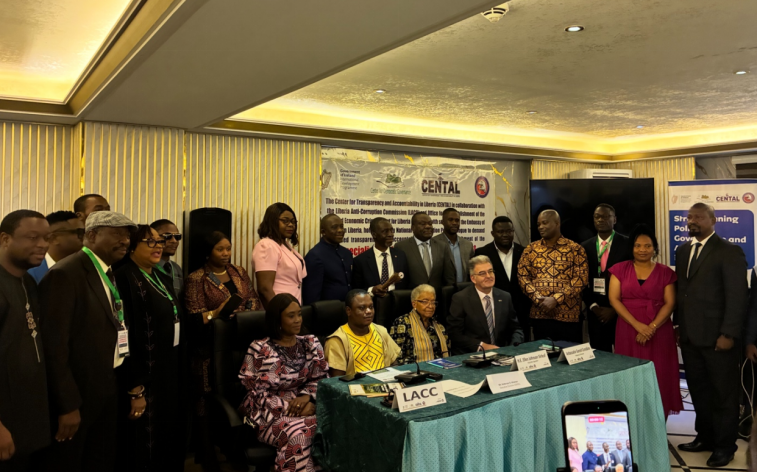
Jallah Barbu, executive director of the Office for the Establishment of the War and Economic Crimes Court, which drafted the bill, said the legislation remained under review.
“We are welcoming as many suggestions as possible,” Barbu said, also a lawyer. He also served as panelist. “Because this is an all-inclusive process, we urge every civil society actor to take this process seriously.”
The draft bill has also raised constitutional concerns. It provides that the presumption of innocence is “inapplicable” where there is a reasonable basis to suspect corruption, shifts the burden to the accused to disprove the allegation, requires all cases to be tried by judges without juries, and permanently bars certain convicted officials from holding public office.
Those provisions have drawn criticism from legal and human rights advocates, who argue that they undermine fundamental constitutional protections, including the presumption of innocence, the right to a jury trial and other due process guarantees afforded to accused persons.
Barbu defended the draft, saying it reflects Liberia’s determination to confront entrenched corruption while remaining a work in progress.
“Corruption is a critical issue,” he said. “Liberia has to come to terms with the fact that jury trial has become a problem. We review the instrument every day and will do our best to rephrase it.”
Another panelist, Lawrence Yealue, chairman of the National Civil Society Council of Liberia, urged lawmakers to complement the proposed court with a lifestyle audit law for public officials.
The dialogue brought together government officials, civil society organizations, lawyers and anti-corruption advocates as Liberia continues debating one of the most consequential governance reforms proposed since the end of the civil wars.
This story was a collaboration with New Narratives as part of the Investigating Liberia project. Funding was provided by the Swedish International Development Cooperation Agency. The funder had no say in the story’s content.