
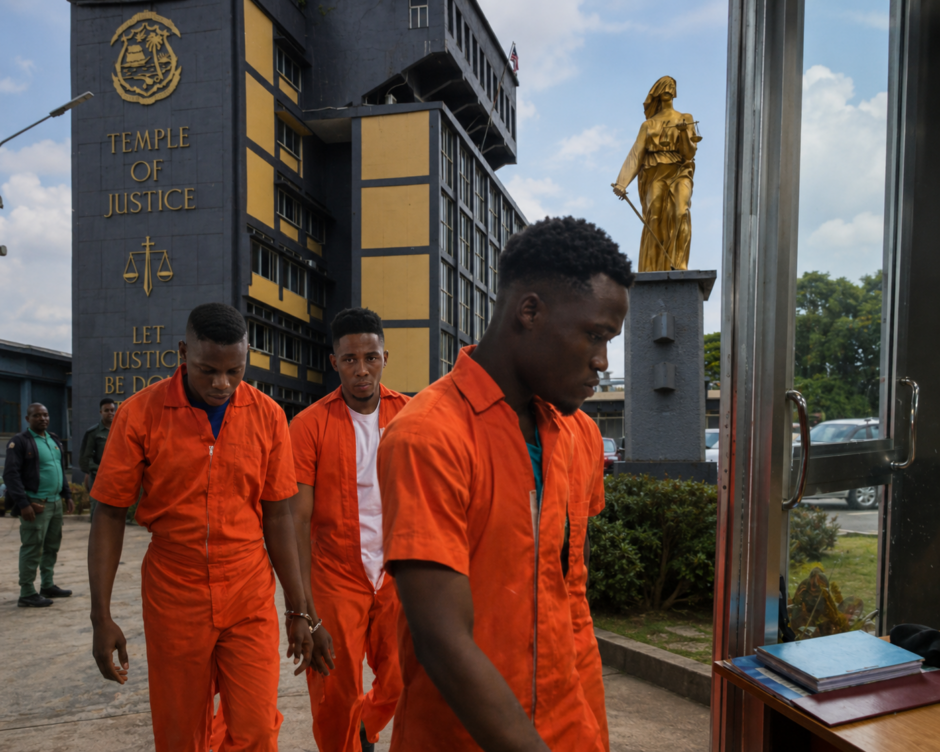
By Anthony Stephens, senior justice correspondent with New Narratives
- The Liberian government has announced a probe into bribery allegations that victims say nearly derailed Liberia’s largest human trafficking prosecution.
- Nine victims told investigators that a bribe was allegedly offered to reduce charges, while several identified Bestman Juah, a public defender, as playing a central role in the effort.
- A senior police investigator who investigated the case says the evidence they gathered is overwhelming that all the defendants, indicted for human trafficking, criminal conspiracy and theft of property, committed the crimes.
Liberia’s government said on Tuesday that it will investigate bribery allegations connected to the country’s largest human trafficking trial, which is now in its second week.
Sumo C. Kutu Akoi, a senior human trafficking prosecutor, when asked about the prospect of a probe, told FrontPage Africa/New Narratives that Augustine C. Fayiah, Liberia’s Solicitor General, ordered the creation of a special investigative panel “to establish the authenticity of those statements by the victims —whether it’s true or not.”
“It will be prosecuted as a separate case,” said Akoi in the interview after Tuesday’s proceedings at Criminal Court A at the Temple of Justice, the seat of Liberia’s judiciary. “The jurisdiction lies with the power of Criminal Court C which has original jurisdiction with those cases. So, for now, we are focusing on the trafficking in persons case.”
Liberia’s largest human trafficking trial is in its second week, following dramatic events last week when four of the 12 defendants in the case, pleaded guilty to the charges in bids to have the charges reduced. (Another 15 alleged traffickers in the case are at large). Prosecutors dropped charges against the first defendant to flip and testify for the defense, but refused to drop charges against the other three, reflecting prosecution confidence that they no longer needed them to win the case in a trial that has drawn international scrutiny after revelations by FrontPage Africa/New Narratives in March that nine of the 57 victims alleged the charges had been reduced or dropped against almost all of the defendants because of bribery payments.
His disclosure came after Fayiah, in an interview last week, said the government was determined to investigate all allegations in the case after the international community “raised with some of my actors, most especially the Minister of Labor and other people.” Liberia has spent two years on a U.S. government watch list for its failures to tackle human trafficking in persons. It may lose aid if it stays on the list for a third year.
Fayiah’s remarks referenced allegations of bribery of government officials revealed in reporting by FrontPage Africa/New Narratives in March.
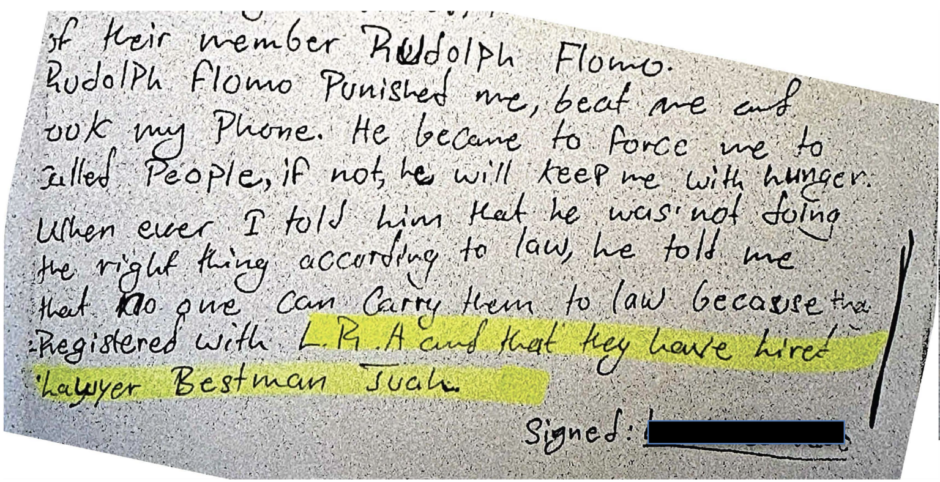
Victims said bribery nearly derailed the case, reducing charges or removing them in some cases and paving the way for the defendants’ release. Nine victims told investigators that Bestman Juah, a public defender, offered a bribe to a prosecutor on behalf of the traffickers in an effort to reduce the charges. Seven victims identified Juah, in statements to police, saying Daniel Davis, also known as “Wuo Zekarso Garteh” and one of the accused ringleaders, had openly claimed that Juah was protecting them.
Victims accused Juah, now president of the Public Defenders Association of Liberia, of paying bribes to police officers and prosecutors on behalf of the accused traffickers.
“Police are in our pocket,” victims quoted the defendants as saying. “We own the government.”
The allegations gained traction after all four women who accused the defendants of rape told police and New Narratives that their statements had been altered. They accused Enoch Dunbar, head of the anti-human trafficking desk at the Liberian police, of changing their statements to police.
The women also alleged that Dunbar accepted a bribe from Juah after a prosecutor in the Paynesville Magisterial Court, where the case originated, rejected a US$7,000 bribe. According to the victims, the goal was to drop the rape and human trafficking charges and secure the defendants’ release on bail.
Both men denied the allegations.
In Tuesday’s session, Nathaniel Walker, a senior police investigator who took the victims’ original statements, told the court that the evidence against the defendants was overwhelming.
Walker testified that investigators interviewed victims, defendants and residents of Gbankpa Town, where the compound was located near the residence of Vice President Jeremiah Koung along the Roberts International Airport highway.
“These people used deception,” said Walker. “They lied to the victims that they were carrying them Canada. They used coercion. They locked those people up, depriving them of their liberty. They forced those people to perform forced labor against their will.”
During cross-examination defense lawyers led by public defender Sennay Carlor argued that prosecution evidence did not support the theft-of-property and criminal-conspiracy charges, pointing to Walker’s testimony that investigators had recovered no stolen property from the compound.
The defense also argued that Daniel Davis, another of the remaining eight defendants in custody, had not been charged with rape and therefore could not be prosecuted for it in the current proceedings.
Prosecutors objected. Two women have women testified that Davis raped them.
Judge Roosevelt Willie rejected the defense’s challenge to the court’s jurisdiction over the rape allegations. He agreed with prosecutors that rape was among the offenses allegedly committed during the course of the crimes before the court.
The ruling marked the second time the defense had challenged the court’s jurisdiction over the charges in the case. A similar challenge was rejected last week.
With Walker’s testimony, the prosecution rested its case after calling 11 witnesses.
Akoi said prosecutors plan to call five rebuttal witnesses after the defense concludes presenting its case.
Earlier in the day, Carlor, pleaded with the court to drop charges against Daylue Kargon, a woman defendant who was indicted the day before the trial, arguing that she was not named in the original indictment.
“She got no business being here,” Carlor argued. Daylue Kargon was brought before this court improperly.”
But prosecution dismissed the motion. Fayiah said the state had made a “harmless error” by not including her in the indictment, but that the prosecution was firm she had committed the crimes.
“ That frivolous motion has no merit in law,” he said.
Judge Willie ruled she would not be dismissed. Tears rolled down Kargon’s face as the court considered her fate. At one point, she bowed her head and buried it in her hands.
The trial resumes Friday, when defense attorneys are expected to begin presenting their case.
This story was a collaboration with New Narratives as part of the Investigating Liberia project. Funding was provided by the Swedish International Cooperation Development Agency. The funder had no say in the story’s content.