
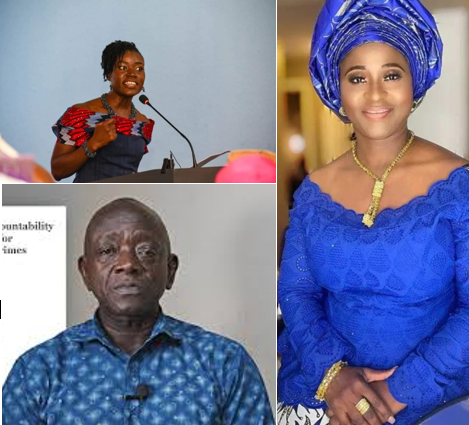
By Anthony Stephens with New Narratives
MONROVIA, Liberia— Leading advocates of war time justice for Liberia have welcomed criticism by Dr. Robtel Neajai Pailey, in this year’s Independence Day oration, of the process to appoint Cllr. Jonathan Massaquoi as executive director of the War and Economic Crimes Courts Office.
Dr. Pailey called on President Boakai to rescind the appointment, saying it was done under “dubious circumstances with apparently no civil society vetting or endorsement.”
Dr. Pailey, a distinguished Liberian activist-academic, joined a growing list of critics, including major human rights advocates and the country’s powerful Bar Association, to condemn the president’s choice and the selection process for the head of the Office of the War Crimes and Economic Crimes Courts.
“The call to remove Cllr. Jonathan Massaquoi from the Office of War and Economic Crimes Courts and to restart the appropriate process of recruiting credible and impeccable characters will be the defining moment of President Joseph Boakai’s legacy as the leader of this once great nation,” said Madam Lovetta Gbeh Tugbeh, Founder Coalition for Justice in Liberia, in a WhatsApp message. The Coalition recently published an open letter, urging the president to rescind Massaquoi’s appointment. “By heeding the advice and demands for justice and accountability, President Boakai can set Liberia on a path of integrity and restore faith in its institutions, ensuring a brighter and more just future for all its citizens.”
Dr. Pailey, an assistant professor at the London School of Economics, was the orator at 177th Independence Day celebration held at the Centennial Memorial Pavilion. She did not mince words in her impassioned speech, at one point, prompting a walkout by the U.S. delegation when she criticized the U.S.-Liberia relationship.
The Office of War and Economic Crimes Courts will craft a blueprint for Liberia’s transitional justice program, seen by experts as critical for the country’s long-term peace and stability. Dr. Pailey insisted Cllr. Massaquoi’s appointment was “unacceptable,” echoing critics who have said the opaque process of his appointment and his legal representation of accused warlords who may appear before the courts will undermine public trust in the process.
“We must institute a transparent and merit-based process of selecting who shapes the court’s mandate. And we must hold accountable those who bear the greatest responsibility for economic and war crimes without fear or favor, including foreign financiers and external state actors.” And Dr. Pailey warned the president that the clock is ticking against his executive order for the Office, a directive that has a legal lifespan of only 12 months, more than two months of which have elapsed.
“Time is of the essence, but we are moving at a snail’s pace,” Dr. Pailey warned.
Mr. Hassan Bility, Director of the Global Justice and Research Project, which together with its Swiss partner, Civitas Maxima, has been behind the investigations and prosecutions in the U.S. and Europe of dozens of individuals accused of war crimes and crimes against humanity during Liberia’s civil wars, agreed with Ms. Tugbeh.
“I believe the orator spoke about what the potential funders of the court believe: that Massaquoi’s appointment should be withdrawn, and an open process encouraged,” Mr. Bility said by text. “It’s time, we believe, President Boakai withdrew the said nomination in the interest of his own noble vision and the interest of the Liberian people.”
President Boakai, who honored Dr. Pailey with Libera’s highest honor by admitting her into the Order of the Star of Africa with Grand Band, did not respond to Dr. Pailey’s criticism of his appointment of Cllr. Massaquoi’s appointment when he spoke at the event.
Kula Fofana, his press secretary, did not respond to a request for comment on Dr. Pailey’s criticism. As with every other story FrontPage Africa/New Narratives has reported about his appointment, Cllr. Massaquoi did not respond to an FPA/NN request for comment on Dr. Pailey’s call.
While Dr. Pailey’s views reignited criticism of Massaquoi’s appointment from human rights advocates, it was her criticism of the U.S. that attracted most attention, including its role in Liberia’s transitional justice.
“I remain very concerned about the outsized influence of the United States in our transitional justice process,” she said. “We must forge new strategic partnerships based on mutual benefit and disabuse ourselves of the notion that we have a ‘special relationship’ with America. Truth be told, this so-called ‘special relationship’ only exists in our imagination. Lest we forget, the United States was one of the last countries to recognize our independence. Lest we forget, the United States has taken more from us than it has given.”
Dr. Pailey also called on the Liberian government, which has allotted $US500,000 in the 2024 national budget to the courts’ Office, to fully fund the courts.
“We must be the chief sponsor and architect of this court, including providing the lion’s share of financing for it,” said Pailey.
While it is expected that the U.S. will play a key role in supporting a Liberian court financially and technically, in public statements, U.S. officials have insisted the process must be Liberian led. As it was with the Special Court for Sierra Leone, the United Nations will be in charge of coordinating international support for Liberia’s courts. The Liberian government has already sent a letter to the U.N. asking it to play that role. Many leading donors in Liberia, including the second and third largest after the U.S. – the European Union Mission and Sweden – also expect to be asked to provide significant financial support for the courts. But no one expects European governments, under pressure from right leaning politics at home and without any historic connection to Liberia, to provide anything like the level of funding the U.S. will provide.
Many donors and human rights activists share Dr. Pailey’s desire for the court to be primarily funded by Liberia itself, but all say that is inconceivable given the dire state of the Liberian treasury. No one is willing to put a price tag on the Liberian courts yet but the Sierra Leone Special Court cost $US350 million – a sum equivalent to half the Liberian government’s annual national budget. Every dollar diverted to the courts is money that could be used to support crippled health, education and other public services as Liberia’s poverty rate hits 60 percent – among the highest in the world.
Even pared down courts, modeled on the trial of Chadian dictator Habre, would cost tens of millions of dollars. Court advocates, who have been actively courting U.S. Congress members for funding, say the simple fact is that either the U.S. funds a substantial part of the cost for the courts, or the courts won’t happen.
The U.S. Embassy issued a statement immediately after the speech, saying: “The United States has a long history of providing foreign assistance, amounting to at least $163 million annually. This is separate from the U.S. government’s contributions to several international organizations that also provide aid to the Liberian people. Additionally, numerous U.S. foundations, private American citizens, and nongovernmental organizations are dedicated to uplifting the Liberian people.”
Tod Etheredge, Acting Public Affairs Officer of the US Embassy, declined to comment beyond the statements released Friday.
In a statement published on the Ministry for Information website, the government of Liberia thanked Dr. Pailey for her speech.
“The Government thanks the Independence Day Orator for her oration and notes that the National Orator is a private citizen of Liberia. Her comments are solely hers and are protected by the Constitution of Liberia. The National Orator struck strong points in her speech, of which the Government has taken note and will take appropriate actions where necessary, possible, and feasible.”
This story was produced in collaboration with New Narratives as part of its West Africa Justice Reporting Project.