
By Anthony Stephens, senior justice correspondent and New Narratives editors
Summary:
- Liberia’s largest human trafficking case goes on trial Monday as lawyers selected 12 jurors, with three alternates still to be chosen.
- The case, involving 57 alleged victims, has drawn national and international attention and is widely seen as a major test of Liberia’s ability to prosecute human trafficking.
- Survivors say they were lured with promises of jobs abroad, then confined, abused and extorted. Prosecutors are seeking nearly US$200,000 in restitution.
Jury selection began Monday in what prosecutors and anti-trafficking advocates describe as Liberia’s largest human trafficking case, nine months after victims, some of the country’s poorest citizens, first filed complaints against the accused perpetrators.
Prosecutors and defense lawyers screened prospective jurors at Criminal Court “A” at the Temple of Justice, the seat of Liberia’s judiciary, selecting 12 jurors from a pool of 27 to hear the high-profile case. Three additional jurors will be selected Tuesday to serve as alternates. Under Liberia’s jury system, 12 jurors decide the outcome of the trial, while alternate jurors may be called upon if needed.
In Liberia’s criminal justice system, the fate of defendants in serious criminal cases rests largely in the hands of ordinary citizens serving as jurors. Unlike judges and lawyers, jurors are not expected to be legal experts. Instead, they are tasked with weighing the evidence presented at trial and deciding whether prosecutors have proved their case beyond a reasonable doubt. Their verdict can determine whether a defendant walks free or spends years behind bars.
For that reason, lawyers on both sides closely scrutinize prospective jurors for potential conflicts of interest, bias or other factors that could affect their impartiality.
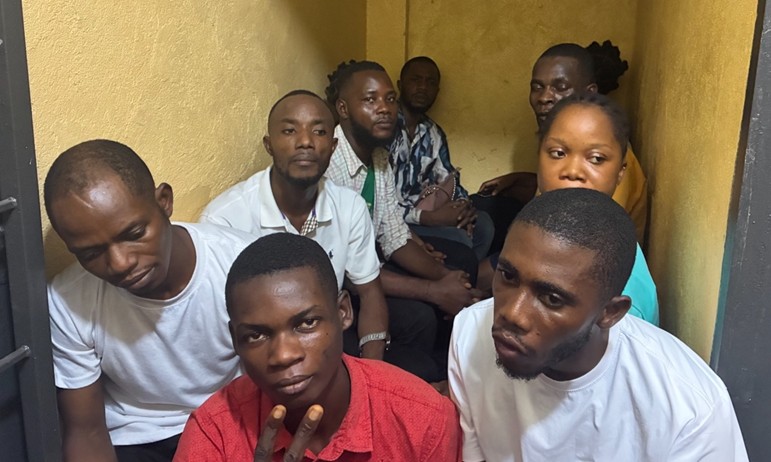
The proceedings drew a packed courtroom of victims, family members, anti-trafficking advocates, well-wishers and the defendants themselves. The case has attracted significant public attention and concern from the international community, with victims, experts and advocates describing it as one of the most important tests of Liberia’s justice system in recent years.
During jury selection, 12 prospective jurors were removed or challenged for various reasons, including inadequate reading ability, prior jury service and potential conflicts of interest. Five prospective jurors were challenged after telling the court they knew members of the prosecution team, including Cllr. Randolph D.M.O. Johnson, Cllr. Aloysius F.K. Allison and Cllr. Adolphus Karnuan.
Sumo Kutu Akoi, the lead prosecutor, argued that allowing those jurors to serve would create “a conflict of interest.” Defense lawyer Sennay Carlor did not object.
Such a scrutiny is routine in criminal trials, where lawyers seek to ensure that jurors can fairly and impartially decide the case. But the process carries particular significance in Liberia, where jurors ultimately determine the guilt or innocence of defendants in serious criminal cases.
“To see this matter progress to this stage brings hope to the victims and reinforces confidence in the pursuit of justice,” said Saye Charles Guinkpa, one of the prosecutors who handled the case in its early stages at the Paynesville Magistrates’ Court.
“This is how a justice system should function,” Guinkpa said in a WhatsApp message. “When justice is seen to work fairly, transparently and effectively, it helps address many societal challenges, including the growing problem of mob violence, while strengthening public trust in the courts and the rule of law.”
“For victims, the advancement of such cases provides not only a sense of relief but also answers and accountability for the wrongs they have suffered,” he added. “It reassures them that their voices have been heard and that their grievances are being taken seriously.”
Jurors were questioned about their educational qualifications, familiarity with the case, relationships with lawyers, knowledge of the defendants and other factors that might affect their impartiality.
The focus on jury integrity comes at a time when Liberia’s justice system is facing renewed scrutiny. Allegations of jury tampering and bribery have long plagued the country’s courts. An investigation remains ongoing into claims of jury misconduct in the corruption case involving former Finance Minister Samuel Tweah, who was sanctioned by the United States in 2023 for what the State Department described as “significant corruption.”
The trafficking case itself has been marked by controversy.
Last month, a grand jury in Montserrado County unanimously concluded it was “more probable than not” that the defendants committed first-degree human trafficking. The indictment alleges that the accused lured victims to a compound, denied them food and water, raped and sexually assaulted some of them, and coerced them into contacting relatives for additional money. Prosecutors say the conduct amounted to “slavery-like practice/labor exploitation.”
The case is unprecedented in Liberia because of the number of alleged victims — 57 people — and the amount of money involved. Prosecutors allege that the defendants extorted US$124,921 from victims and their families between 2024 and 2025. One woman told investigators that her family sold farms, property and other assets to raise more than US$16,500 for a promised trip to Canada that never materialized. Prosecutors are also seeking nearly US$200,000 in restitution, one of the largest compensation requests in a Liberian trafficking case, for victims’ medical and psychological care, rehabilitation expenses and emotional suffering.
According to complaints filed with the Paynesville Magistrates’ Court last October, police investigators and interviews with FrontPage Africa/New Narratives, the victims — 22 women and 35 men from seven counties — were promised jobs and better lives in Canada and Australia. Instead, they say they were confined at a compound in Gbankpa Town, near the residence of Vice President Jeremiah Koung along the Roberts International Airport highway.
Victims told investigators they were starved, beaten, tortured and raped. They also said they were forced to deceive relatives into believing they had already traveled overseas and were living comfortably, prompting families to send more money.
One woman, Ophelia Melway, disappeared from the compound. Victims said traffickers told them she had died, but they were unable to verify what happened and feared she may have been murdered.
The case took a dramatic turn earlier this year after a FrontPage Africa/New Narratives investigation uncovered allegations that corruption had compromised the investigation.
Victims alleged that Bestman Juah, president of the Public Defenders Association of Liberia, was receiving payments from the accused and that a prosecutor told them Juah offered a US$7,000 bribe to drop trafficking and rape charges, which could have allowed the defendants to obtain bail. Juah denied the allegations.
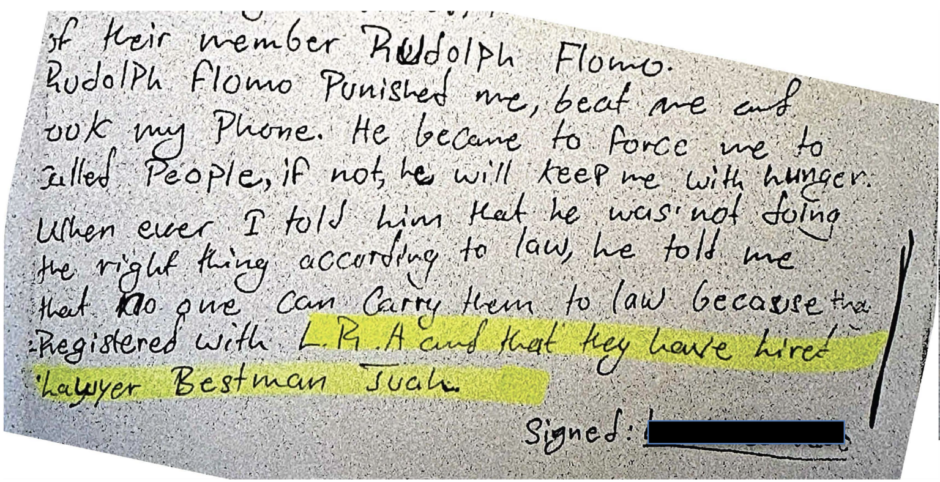
Victims also alleged that when prosecutors rejected the offer, Enoch Dunbar, head of the Liberia National Police’s anti-trafficking desk, accepted the money. Dunbar denied the allegation.
The indictment renewed hope among victims after months of uncertainty and concern that the case might stall. Guinkpa praised FrontPage Africa and New Narratives for continuing to report on the case.
“The role of the media in this process also deserves commendation,” he said. “By bringing attention to important issues and keeping the public informed, the media helps promote transparency, accountability and greater confidence in the justice system.”
Although only 10 of the 11 defendants originally indicted had been arrested, two additional suspects were brought before the court Monday, bringing the number currently facing trial to 12.
With their right hands raised, the defendants loudly pleaded “not guilty” as Varney Dafuwah, assistant clerk of Criminal Court “A,” read the indictment in open court.
The indictment charges all 11 defendants — Bill Plato, Wuo Zekarso Garteh, Preston Godfred, Maxson Wonlebaye, Jerome Genseh, Luther Flomo, Alexander Plato, Marthaline Tompia, Shelley Jonny, Blessing Favor Suah and Stanley Wonlebaye — with offenses including trafficking in persons, theft of property and criminal conspiracy. Plato, Garteh and Wonlebaye also face rape charges. Prosecutors say another 11 suspects named in the indictment remain at large.
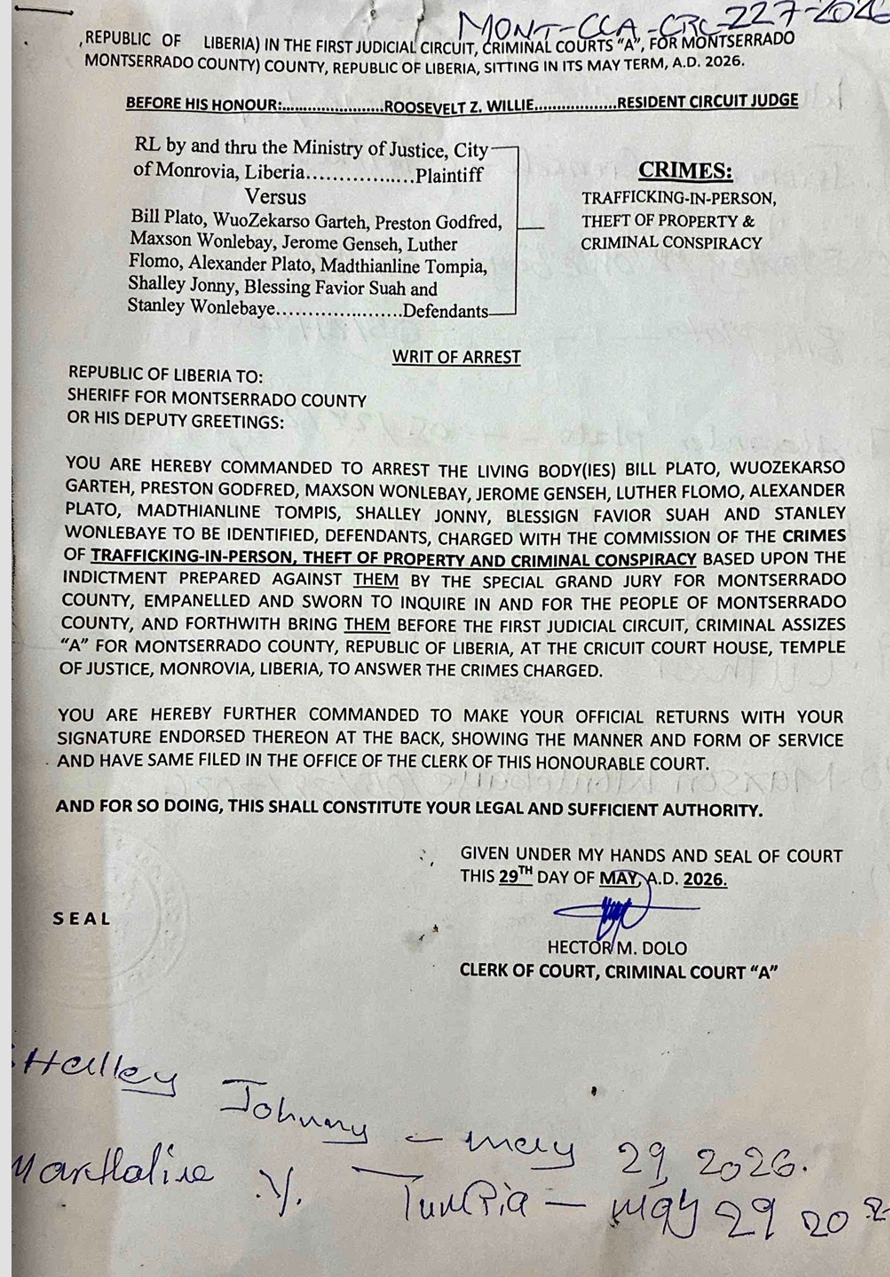
The charges represent a significant expansion of the case. Earlier reporting by FrontPage Africa/New Narratives found that police initially charged only five of the defendants with trafficking in persons, the most serious offense in the case and one that carries a minimum 20-year prison sentence upon conviction. At the time, only Plato was charged with rape.
Three defendants — Marthaline Tompia, Shelley Jonny and Blessing Favor Suah — who had been accused by multiple victims of trafficking, theft and other abuses were not included on the original charge sheet. Their inclusion in the indictment addressed concerns raised by victims and advocates who questioned why some suspects appeared to have avoided prosecution despite allegations against them. Prosecutors say efforts are continuing to locate and arrest the remaining suspects. Under Liberian law, criminal defendants cannot be tried in absentia.
Outside the courthouse, members of the Liberia Anti-Trafficking Scam and Victim Support Initiative staged a protest in support of the victims.
“We are here to stand in solidarity with these victims that were duped,” said Zokerseh Saye, the group’s executive director. “It is devastating. It damages our image as a country and shows the world that we are failing to protect our citizens.”
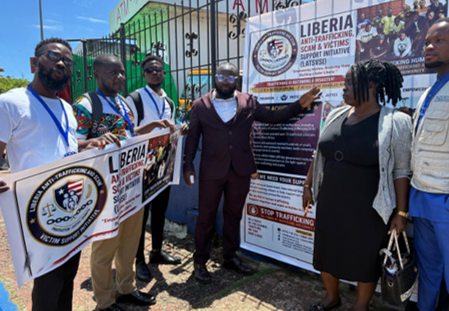
“Our expectation is that the perpetrators should face the full force of the law,” he added. “A lot of people have suffered because of this, and some have even died.”
The court is expected to complete jury selection Tuesday before prosecutors begin presenting witnesses in a trial that could last about a month.
This story was a collaboration with New Narratives as part of the Investigating Liberia project. Funding was provided by the Swedish International Cooperation Development Agency. The funder had no say in the story’s content.