
By Anthony Stephens, senior justice correspondent with New Narratives
Summary:
· Justice advocates say surprise bills from Senator Joseph Jallah and Pro-Tempore Nyonblee Karnga-Lawrence could shield accused perpetrators and undermine years of advocacy for a war and economic crimes court.
· The bills would send appeals from the War Crimes Court to Liberia’s Supreme Court, a change critics warn could invite political interference.
· The Office of War and Economic Crimes Court says its own bills for the War and Economic Crimes Court and a National Anti-Corruption Court will be submitted to President Boakai in the next three months.
Justice advocates said they were surprised by last week’s introduction of two bills from two Liberian lawmakers, which they say are designed to shield accused perpetrators from prosecution for wartime atrocities and economic crimes. The bills moved through the Senate procedures at an unusual speed causing alarm among advocates.
The proposed laws — one to establish a War Crimes Court and another to create a Special Economic and Corruption Crimes Court— were co-sponsored by Senator Joseph Jallah of Lofa County and Senate Pro-Tempore Nyonblee Karnga-Lawrence, of Grand Bassa County.
The Jallah-Karnga-Lawence bills seemingly came out of nowhere and include controversial elements that contradict a War Crimes Court bill submitted to the Legislature in 2021 by Liberian National Bar Association. That bill had buy-in from most of the court’s advocates and was seen to be a starting point for new bills that must go to the Legislature soon to trigger the start of the court. Jallah Barbu, appointed head of Liberia’s Office for a War and Economic Crimes Court a year ago, has repeatedly promised that the Office’s versions of the bills would be taken to the president and the Legislature as a priority.
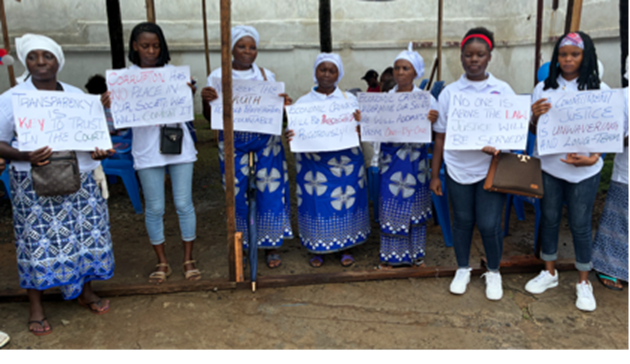
The controversial proposals dominated Friday’s meeting of Liberia’s leading transitional justice advocates, including senior foreign diplomats and representatives of groups including the Women in Peacebuilding Network, the Liberian National Bar Association, the Global Justice and Research Project, the Liberia Massacre Survivors Association, the Union of Organizations of the Disabled in Liberia, and the Liberia Council of Churches. The issue was deemed an emergency, and all other agenda items were suspended.
Speaker after speaker expressed disappointment and frustration at the Senate’s decision to advance the bills without consultation. Barbu, who chaired the meeting which fell on day one of his second year in the job, also voiced dismay at the speed with which the bills moved though the Senate in an interview with FrontPage Africa/New Narratives.
“It is impossible for any legislation of this kind to be drafted or concluded in a week, or two weeks or a month, especially in a process like this without consultation, without serious desk review, without informing or involving people who understand this stuff,” said Barbu.
One of the key differences between the new bills and the 2021 bill is how the appeal process from the war crimes court would work. The Bar’s bill, which Jallah said he was unaware of, proposed a separate appeal chamber outside Liberia’s existing judiciary and allowed for non-Liberian judges and lawyers to sit on the bench and practice before the court — a model similar to other hybrid post war justice courts around the world.
The Bar’s proposal called for “10 independent full-time judges,” including two non-Liberians nominated through the United Nations by their respective countries, with both trial and appeal chambers composed of Liberian and foreign jurists. The trial chamber would consist of three judges: two Liberian Counsellors-at-Law with at least ten years of experience and one non-Liberian. The Liberian judges would be appointed by the president from a list of seven candidates vetted and submitted by civil society organizations, led by the Bar, in coordination with the Office of the United Nations High Commissioner for Human Rights and the Ministry of Justice, among others.
The appeal chamber would consist of five judges — three Liberians and two from abroad. The foreign judges would be nominated to the United Nations by their respective governments, while the Liberian judges would be appointed by the president on the recommendation of a special committee with the same composition as the one that selects trial judges.
There will be two alternate Liberian judges — one assigned to each chamber — vetted and appointed by the president. They would assume the duties of any judge who becomes “temporarily or permanently incapacitated” to serve. Chosen and appointed in the same manner as the other Liberian judges, and drawn from a list of nine candidates, they will hold the same qualifications as those serving on the trial and appeals chambers.
Advocates have argued that international judges should be included because the Liberian people would have low confidence in a Liberian judiciary which has proven itself untrustworthy over the years. They were also concerned about the perception of tribal biases among Liberian judges.
By contrast, the Jallah–Karnga-Lawrence bill would route all appeals through the Supreme Court of Liberia and uphold the ban on foreign lawyers and judges. He appealed to a strong desire among many in Liberia to prioritize Liberians for all jobs in the country.
“We got enough lawyers in Liberia that can be hired,” Jallah said. “Foreign lawyers and judges can be international consultants to Liberians, but they will not go any stand before the court, unless otherwise agreed by the Supreme Court.”
Leading transitional justice experts argued that the lack of international participation would erode public trust and open the process to manipulation. Hassan Bility, director of the Global Justice and Research Project, which together with Civitas Maxima, its Swiss partner, documents war-related crimes in Liberia, said if the court’s appeal chamber remained in the Liberian judiciary, it “risked political interference, conflict of interest and partiality” because of the “lack of international expertise and international standards.”
He also said the actions by the legislators appeared designed to protect some potential defendants and slow down the process to implement the court.
“There are individuals, both in and out of government, who believe the court may come after them since they were either active or inactive participants of the Liberian civil wars,” said Bility by text. “Some of these people are wealthy people while some sit in influential government posts.”
Adama Dempster, another leading advocate, asked why no traditional stakeholders in the court process were involved in the design of the new bills.
“We would have loved to see a public hearing with transitional justice actors, human rights groups, and victims before the bills were submitted,” he said in a WhatsApp message. “We look forward to meeting the senators for clarity and dialogue.”
Justice advocates said the targets of an economic crimes court are particularly concerned about the court, and many continue to have deep pockets and influence in the country. In its final 2009 report, Liberia’s 2009 Truth and Reconciliation Commission recommended prosecution for 26 officials accused of committing economic crimes during the country’s civil wars. Among them are sitting lawmakers, including Bomi County Senator Edwin Snowe. The list includes Lewis Brown, Liberia’s current ambassador to the United Nations; Roland Massaquoi, former agriculture minister under ex-president Charles Taylor; Oscar Cooper, former Margibi County senator; Benoni Urey, businessman and former maritime chief; Emmanuel Shaw, former presidential adviser; and Nathaniel Barnes, former U.N. ambassador.
“Some of these people will do anything and everything to short-circuit the process,” said Bility. “They want to save their necks. We must all rise and oppose such a politically skewed and interest-driven technique.”
In an interview with FrontPage Africa/New Narratives, Jallah rejected the criticism.
“We are not going to be distracted by all the criticism in the world,” said Jallah. “We are deliberate people. We know our objective in life, and we are here to do things that the people will cherish because the people want justice.”
Jallah conceded that his bill gives economic crimes a statute of limitation, meaning some of the crimes committed during the period of the wars from 1989-2003 would no longer be eligible for prosecution. Jallah insisted the timing of their bills was ripe.
“This time we have understanding among ourselves,” Jallah said. “The Executive is interested. The Legislature is interested. I don’t think the judiciary will refuse to take the cases if we give them the logistics and support they need.”
Kula Fofana, the presidential press secretary, did not respond to requests for comment on the matter.
The Liberian Senate has been embroiled in war crimes court controversy before. In 2021, it urged George Weah, the President at the time, to set up a Transitional Justice Commission to review recommendations from Liberia’s Truth and Reconciliation Commission. The effort was abandoned after heavy criticism from leading advocates.
The Office for the War and Economic Crimes Court of Liberia — created by President Joseph Boakai to oversee the creation of the courts — has also been tasked with establishing a National Anti-Corruption Court before the war crimes court in a move advocates warn could divert attention from long-awaited war crimes prosecutions.
The anti-corruption court would handle cases of bribery, economic sabotage, collusion, tax evasion, and extortion. Those likely to face trial include former officials already charged with corruption, such as Samuel Tweah, former finance minister; Jefferson Karmoh, former national security adviser; and Abdullah Karama, former acting telecommunications chief.
Experts say the court could prosecute individuals sanctioned by the United States for corruption — including Tweah, Sayma Syrenius Cephus, Jefferson Koijee, and Nathaniel McGill.
Barbu had previously projected to submit the bill for the national anti-corruption court to President Boakai in September. But he said more consultations were needed, assuring that it will now be submitted “between now and the end of November.”
He said the War and Economic Crimes Court bill will also be submitted to the president by December or January 2026.
Both Jallah–Karnga-Lawrence bills have been referred to the Senate Committees on Judiciary, Human Rights, Claims and Petitions, and Defence, Security, Intelligence and Veteran Affairs for review. The committees are expected to report back to Plenary within two weeks, though observers note that legislative reports on politically sensitive matters are often delayed.
This story is a collaboration with New Narratives as part of the West Africa Justice Reporting Project. Funding was provided by the Swedish Embassy in Liberia which had no say in the story’s content.