
By Anthony Stephens, senior justice correspondent with New Narratives
Summary:
- Three more defendants pleaded guilty in Liberia’s largest human trafficking trial on Thursday in a bid to win clemency from prosecutors, saying they were victims who were drawn into the scheme through duress and coercion.
- The three joined a co-defendant who pleaded guilty yesterday in exchange for having charges dropped. But prosecutors refused to grant them the same deal.
- Victims said they were relieved and overjoyed to see justice being done when they had feared the case was going nowhere.
Day three of this mammoth human trafficking trial with 57 victims and 27 defendants started with more drama as three more defendants pleaded guilty Thursday, claiming they were victims who had been coerced into recruiting others. They made the admissions in a bid to win clemency from prosecutors in a trial where the evidence against them is overwhelming.
The admissions came 24 hours after a co-defendant, Shelley Jonny, broke ranks and testified for the prosecution in what experts said could be a decisive moment for the jury.
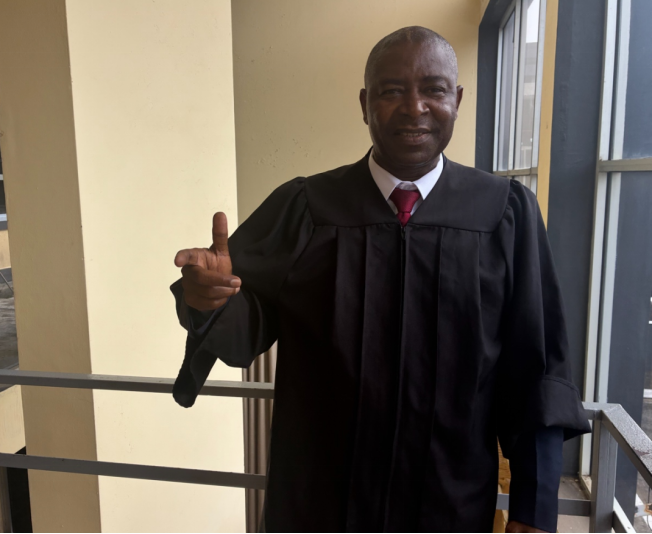
The defendants — Maxson Wonlebaye, Martherline Tompia and Preston Godfred — were permitted by Criminal Court “A” Judge Roosevelt Willie to address the court. Wonlebaye, had been accused of rape by two of the victims.
“I am one of the victims,” he said.
Godfred testified that he had been recruited from Nimba County in 2024 by “Wuo Zekarso Garteh,” whom prosecutors identify as Daniel Davis.
“Yes, I am a victim,” Godfred said. “I came to testify to say the truth and nothing but the truth.”
Tompia offered a similar explanation.
“I am a victim,” she said.
Their confessions stood in stark contrast with the evidence given by witnesses to investigators and to New Narratives/FrontPage Africa in an explosive investigation that put a spotlight on the case that appeared to be derailing. Victims said the defendants had bragged to them that they “owned the government” and “could not be touched” because they were paying a public defender named Bestman Juah to pay bribes to police and prosecutors to protect them.
Judge Roosevelt Willie ordered a five- minute recess. But when the parties returned prosecutors told the court they had refused to grant the three the same deal they had given Jonny. Rather than dropping the charges of trafficking in persons, criminal conspiracy and theft of property, prosecutors asked the court to consider the defendants’ admissions only as a mitigating factor in sentencing if they are convicted.
“The victims identified these three persons as the prime instigators that meted harm on them,” Adolphus Karnuah, prosecutor, told the court defending the decision.
Sennay Carlor, the public defender and lead defense lawyer objected, argued that prosecutors had accepted Jonny’s plea while refusing to extend the same treatment to the three defendants.
After hearing arguments from both sides, Judge Willie accepted the prosecutor’s decision but ruled that the trio would not testify.
“They will not testify in these proceedings, neither for the state nor for the defendants,” Willie said. “At the end of this trial, whatsoever the outcome will be, the court will exercise justice with mercy for these three defendants.”
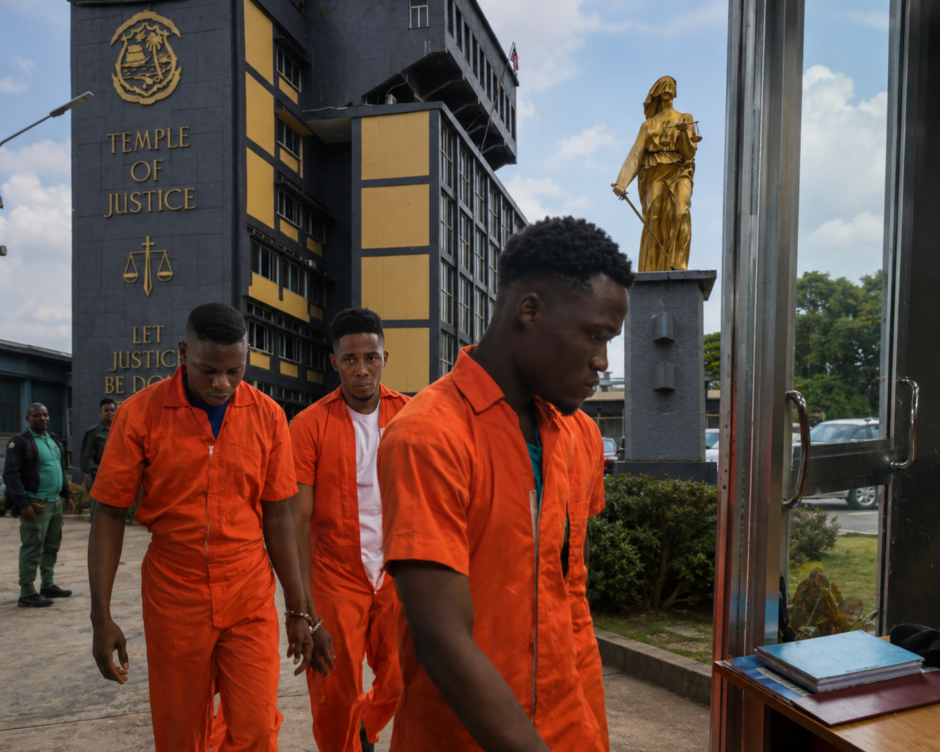
The three were then handed over to prison officers who escorted them from the courtroom and back to prison. Judge Wille ordered that they be separated from the other defendants to ensure they were not molested or harmed.
Sumo Kutu Akoi, a senior human trafficking prosecutor, appeared confident that with Jonny’s defection the state now had overwhelming evidence to convince the jury to find the defendants guilty. He said the three had waited too long and no longer had any value to offer to the prosecution case.
“We’re not just going to let everybody out because they confessed,” Akoi said in an interview after the proceedings. “The applicability of the Trafficking in Persons Law is quite clear that the minimum sentence is 20 years. The crime was committed. It was perpetrated against the victims.”
The trial proceeded with the remaining 8 defendants in custody (15 have not yet been located to arrest) seated in the dock talking urgently with defense lawyers and looking nervous.
The prosecution then called another witness, identified only as M. to protect her identity. Fighting back tears, M. testified that Davis raped her after threatening her with a pair of scissors.
“He told me say lay down,” she said in Liberian English. “I say, ‘for waiting?’ He said, ‘you na small child.’ He was having scissors in his hand. I was forced to lay down and he had me that night,” she said crying. “He told me that ‘You tell anybody, I will do something to you.’”
She is the second woman in the trial to accuse Davis of rape. Earlier this week, another witness, identified only as S., also accused him of the crime.
M. said the alleged rape, combined with repeated intimidation and abuse, compelled her to conceal the truth from her mother, who had sent approximately US$3,500 for what she believed would be a trip to Canada. She said her mother had sold their home to send the money.
M. said she had been lured in by what she believed was a legitimate travel operation because of what appeared to be a well-furnished office.
She testified that she spent two months in a compound near the residence of Liberia’s vice president in Gpanka Town on the Robertsfield Highway, before being freed by guards from the vice president’s compound after the women made a desperate bid for help by screaming and banging for attention.
Like previous witnesses, M. described a system of intimidation and torture.
“They say you must kneel down,” she told the court. “Da na training there.”
The remark drew laughter in the courtroom.
“All of them that there, they used to punish us,” she said. “Everyone of them. If they tell you to talk and you not talk, that beating you will take.”
The defense continued a strategy it has deployed throughout the trial: challenging the reliability of witness testimony. Carlor questioned witnesses about who told them about the promised travel opportunities, who imposed requirements and punishments, and who allegedly carried out acts of rape and coercion. After M. acknowledged that she could not read or write, Carlor pressed her about the statement she gave police, asking who had written it and whether it accurately reflected her account of events inside the compound prosecutors say the alleged crime happened.
Her testimony was corroborated by two additional witnesses, including a man identified as D., who said he was recruited by Davis. Another witness, also identified as M., testified that she had been recruited by a churchmate from Nimba County, Samuel James. She said her mother borrowed US$4,500 from a local savings club and that she paid the money to defendant Bill Plato in hopes of traveling to Canada.
She said she spent 18 months in the compound where many of the alleged victims were housed. In court, she displayed a receipt she said Plato had issued for the payment. She pointed him out in the court before returning to the witness stand.
Throughout their testimony, all the witnesses said they eventually escaped after learning of the alleged death of another victim, Ophelia Melway. According to the witnesses, Melway became ill and was taken away by her captors, who said they were returning her to her family. The witnesses later learned that she had died.
Akoi said the prosecution’s homicide division was investigating the circumstances surrounding her death.“Based on the evidence that prosecution will gather, we can make that decision to either charge them with murder, negligent homicide or manslaughter,” he said.
For several victims, simply taking the witness stand was a milestone.
Three women who testified in the case told FrontPage Africa/New Narratives that they were relieved to finally confront the people they accuse of trafficking and abusing them after months seeing charges reduced and no move to trial.
“I am feeling fine,” said P., an alleged rape victim. “I am happy.”
Another witness, M., said she had previously worried the case was going to disappear.
“My heart was spoiled with the way the case was going first,” she said. “No head. No tail.”
S., another alleged rape victim, said she felt a sense of relief after testifying.
“I feeling better,” she said with a smile. “Breeze blowing me.”
The trial continues Monday.
This story was a collaboration with New Narratives as part of the Investigating Liberia project. Funding was provided by the Swedish International Cooperation Development Agency. The funder had no say in the story’s content.