


By Anthony Stephens, senior justice correspondent with New Narratives
Summary:
• A second defendant in Liberia’s largest human trafficking trial corroborated earlier testimony that four members of Vice President Jeremiah Koung’s security detail visited the compound at the center of the case and went further by claiming they “accepted” the operation after being briefed on their activities.
• Stanley Wonlebaye denied charges of human trafficking, theft of property and criminal conspiracy, rejecting allegations from victims and prosecutors that he served as a security guard who helped oversee abuse at the compound.
• The testimony offered additional insight into how Infinity Millennium Platinum Star Limitless Institution, an organization defendants said was affiliated with QNet, operated, while courtroom tensions later led Judge Roosevelt Willie to fine defense lawyer Sennay Carlor US$100 for conduct the court said violated professional standards.
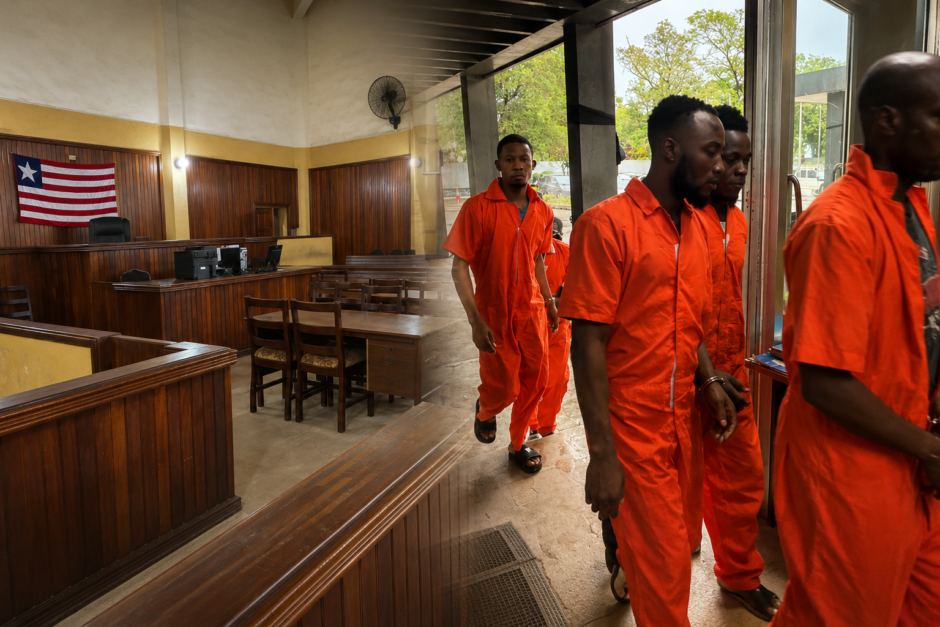
Another defendant in the human trafficking trial involving 57 alleged victims testified Tuesday that four members of Vice President Jeremiah Koung’s security detail visited the compound where victims say they were held and abused,corroborating testimony given a day earlier by a fellow defendant.
Victims told the court they were cut off from their families, denied adequate food and water, beaten, forced to endure punishment under the hot sun and subjected to other forms of abuse while being held there.
But in more than four hours of testimony, Stanley Wonlebaye, who, like the other defendants, denied charges of human trafficking, theft of property and criminal conspiracy, went further than the previous witness. Corroborating Rudolph Flomo’s account of the visit, Wonlebaye testified that the officers — whose identities he said he did not know — approved the operation after being briefed on its activities.
“Yes,” Wonlebaye said when Judge Roosevelt Willie of Criminal Court A asked whether he was aware that four members of Koung’s security detail had visited the compound. “I only saw them. They entered, and when they entered, that’s how Wuo Zekarso Garteh called them inside and explained the business to them because they came to inquire what we do. From there, they just walked outside. They na used to bother anybody from there. Yes, for me, it was accepted by them.”
The case is the largest human trafficking prosecution in Liberia’s history. All 57 alleged victims accused more than two dozen defendants of human trafficking, rape, torture, assault and other inhumane acts. Victims who testified for the prosecution said they were lured with promises of jobs and financial opportunities before being held at the compound. On Monday, Judge Willie granted a defense request for the court, jurors, victims, defendants and counsel for both parties to visit the compound at the center of the case, where victims say they were held and abused.
In a WhatsApp message after Flomo’s testimony, Solomon Ware, a spokesman for Vice President Jeremiah Koung’s office, said the defendant had not identified the four security officers who allegedly visited the compound, making it difficult for the office to substantively address the allegation. He said officials were seeking additional information before commenting further.
The compound has become the focal point of the case because prosecutors say it served as the base of operations for Infinity Millennium Platinum Star Limitless Institution, an organization that defendants said affiliated with Qnet, multilevel Malaysian e-commerce company, that has become synonymous with human trafficking throughout West Africa, undertaking legal activities recruiting people to be representatives and sellers for the company.
Victims told police, FrontPage Africa/New Narratives, and later the court and jury that Wonlebaye served as a security guard at the compound where they said they were held for periods ranging from six to 18 months. Wonlebaye rejected those allegations.
“It’s a lie. We na used to harm anybody,” he said in Liberian English. “All the people that say they ‘were kept at the office there,’ I know some of them houses. I want you, Honor, to put cuffs on my hands and I will direct you to where these people were living. That will be my recommendation.”
As with Flomo, victims said Wonlebaye was a security guard. Flomo corroborated victims’ testimony; Wonlebaye denied.
“There was no security,” he said. I am one of the distributors. “Whenever someone was coming in [the compound], anyone that was near the front door, when that person hears someone coming, they will open the gate. So, there was no specific security that was assigned there.”
As with all defendants, including Daniel Davis and Bill Plato, who acknowledged serving as leaders of the organization, Wonlebaye also testified that he was a member of Qnet, a direct-selling company that has repeatedly been linked to human trafficking in Liberia and other West African countries.
Wonlebaye told the court that he joined Infinity Millennium in 2024 after paying US$900 and signing what he described as an agreement form and receiving a PIN code and security credentials.
Wonlebaye’s older brother, Maxson Wonlebaye, is among the defendants standing trial. Prosecutors have accused him of raping two women. Although he and two others pleaded guilty, prosecutors did not drop the charges against them, leaving any sentence to the discretion of the court should he ultimately be convicted.
Victims told police, FrontPage Africa/New Narratives and the court that they were promised weekly earnings of US$225 if each of them recruited additional people into the organization. Plato corroborated that testimony on Monday. The younger Wonlebaye likewise acknowledged the arrangement and described how participants earned commissions by recruiting new members.
“When you advertise to two persons, and the two persons advertise to two persons, the commission vary,” he said. “That’s why they called it Biodisc system. When I entered the business, some of them[victims] over there encouraged me that they get money inside.”
Tempers flared when defense lawyer Sennay Carlor accused Judge Willie of being “unfair” after the court refused to admit photographs of Biodisc products into evidence, an allegation the judge swiftly rejected.
Judge Willie sided with prosecutors, ruling that the defense had failed to provide the required notice before seeking to introduce the photographs. He reminded Carlor that if he disagreed with the ruling, he could file a complaint with the Supreme Court Justice in Chambers, Yusuf Kaba.
Willie later fined Carlor US$100, saying his conduct had undermined the dignity of the court and violated the ethical and professional standards governing lawyers.
“Based on his remark, this court hereby fines Carlor an amount of US$100 to be paid in the judiciary account within 72 hours,” Willie ruled.
Another defendant, Jerome Genseh, denied allegations by victims that they were beaten, tortured, starved or subjected to other forms of abuse and humiliation.
“There was no one that they did harm to like drink water, put under the sun, showing knife or cutlass on them,” Genseh said. “And there is no one that can say they were in that office. If somebody was raped, maybe it will be outside the office, I don’t know anything about it. When the office was working, no one was sleeping there. And the two room we have within that office, was only intended for the office. But it was not for boyfried and girlfried to sleep there.”
He also claimed that the organization’s activities were recognized by the government, noting that members had been permitted to use two government facilities — the Ellen Johnson Sirleaf Ministerial Complex and the Executive Mansion — for conferences.
Shaking his left leg and pointing his left hand toward the pew where the defendants, their relatives and well-wishers were seated, Genseh also corroborated Bill Plato’s testimony that he and P. were in a relationship. Genseh testified that P. had admitted terminating her pregnancy without Plato’s approval and later asked him, “to forgive her.”
Testimony by the two defendants that they were agents, or “Independent Representatives,” of QNet added to a growing number of defendants who have acknowledged ties to the direct-selling company during the trial. QNet, which victims and prosecutors have repeatedly linked to the alleged trafficking network, again denied any involvement in the case.
“We wish to state clearly that QNET has NO involvement in the matter before the court,” Francis Sam, QNet’s public relations manager for Sub-Saharan Africa, wrote in an emailed statement to FrontPage Africa/New Narratives on Tuesday. “Any claims to the contrary do not reflect the position or conduct of QNET as a company.”
Sam said the company would not comment further because the matter is before the courts.
“QNET categorically condemns human trafficking, forced labour, and any form of exploitation,” he said. “We have zero tolerance for the misuse of our brand for illegal purposes and will cooperate fully with any relevant authority where appropriate.”
Meanwhile, prosecutors said they would call additional rebuttal witnesses to contest so many claims made by the defendants, including their denial of the charges.
They also said they would present a rebuttal witness after two defendants alleged that Emmanuel Tarr, a prosecutor, told them during preliminary proceedings before the Paynesville Magisterial Court that there was “sufficient evidence to prosecute” them.
The trial continues Wednesday.
This story was a collaboration with New Narratives as part of the Investigating Liberia project. Funding was provided by the Swedish International Development Cooperation Agency. The funder had no say in the story’s content.