
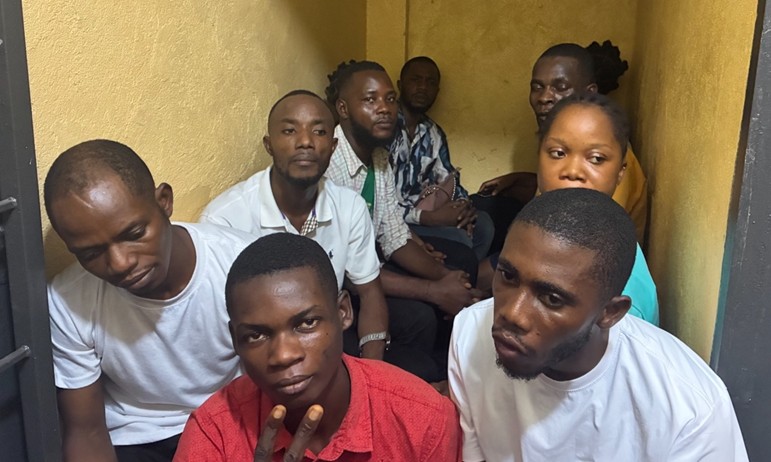
By Anthony Stephens, senior justice correspondent with New Narratives
Summary:
- Liberia’s government has been silent after revelations that victims accused public officials of taking bribes to protect human traffickers in the country’s biggest trafficking case to date.
- Eleven suspects in the case with more than 50 victims, will be eligible for bail on April 12 if prosecutors fail to move the case forward.
- Victims expressed outrage as advocates warned the case reveals deep corruption in the judicial system and risks further undermining trust in the country’s rule of law.
- The case comes as the country awaits the United States Human Trafficking Report in Persons report due in June. Liberia has been on the Tier 2 Watch List for two years and risks a cut in aid if it stays on the watch list for a third year.
Victims in Liberia’s largest human trafficking case said they were deeply disappointed by the government’s silence after they revealed to FrontPage Africa last week that they were repeatedly told by traffickers that they had paid bribes to Bestman Juah, a public defender, to keep the cases from free from justice. Eleven defendants in the case will be eligible for bail on April 12 because of the government’s delay in prosecuting them.
Oswald Tweh, justice minister, who said last May that he was investigating trafficking networks
in Liberia, did not respond to multiple requests for comment by FrontPage Africa/New Narratives. President Joseph Boakai’s office also did not respond to requests for comment.
Experts said the accusations and the government’s failure to act cast a new cloud over Liberia’s widely discredited law enforcement and justice system, and the government’s willingness to protect the thousands of poor Liberians falling prey to human trafficking scams in recent years.
“If the government really has a political will to act, it can,” said Tiawan Gongloe, a leading human rights lawyer and former solicitor general. “There are trained people in the law enforcement agencies of Liberia to actually do it if there’s a political will from the top, from the Ministry of Justice, from everywhere. In fact, if the president is involved, that makes it stronger, because when the president of the nation says ‘This is a serious matter that affects my citizens’, everyone will take it seriously.”
The case involves more than 50 women and men who say they were lured with promises of jobs in Canada or Australia, only to find themselves trapped in a Paynesville compound where they were abused, extorted and, in some cases, raped. Some of the victims told FrontPage Africa/New Narratives they were devastated by the government’s silence over their revelations, which they made knowing they risked their safety by doing so.
“The population involved in this case is not something that people supposed to play low, because there are lot of Liberians,” said one of the victims. “So, if you start giving cool shoulder to us, it’s very frustrating. What we want is that the case is being resumed in a short period of time. Our expectation is that we go to court.”
Most were financially devastated by the crimes. One woman from Nimba County told FrontPage Africa/New Narratives she had sold her farm and everything she owned to raise $US16,500 to give to traffickers. Another had been forced to lure her brother with false promises that she was happily in Canada. Now their mother was on death’s door hounded day and night by debt collectors seeking repayment for money loaned to send them abroad.
The case also raises questions about the government’s commitment to tackling trafficking in persons just as the United States State Department finalizes its 2026 Trafficking in Persons report. Liberia has been placed on the Tier 2 Watchlist for the last two years. Any country that stays on the Watchlist for three consecutive years can lose access to United States aid.
After the revelations one anti-trafficking group held a press conference on Tuesday calling on the government to act.
“We are actually disappointed when it comes to the government approach on these things,” said Zokerseh B. Saye of the Anti-Trafficking Scam and Victim Support Initiative, in an interview afterward. “This is seriously against human rights.”
Victims Said Traffickers Told Them They Were “Protected” and “Owned the Government”
In police statements reviewed by reporters, seven victims said one of the accused named Daniel Davis, had boasted that Bestman Juah, a public defender and current president of the Public Defenders Association of Liberia, was their lawyer and was being paid $US500 a week to shield them from prosecution. Nine victims also said their captors claimed the police were “in the business” and that they “owned the government” because officials were “in their pocket.”
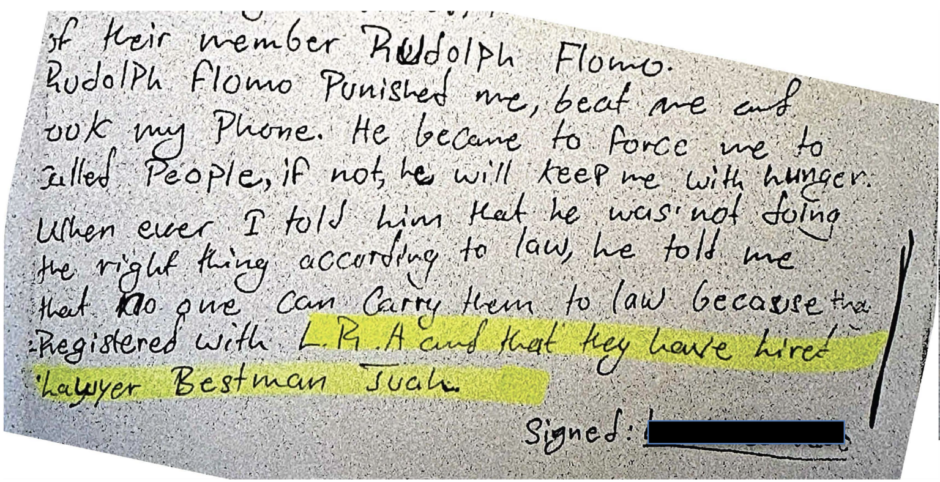
Victims also told FrontPage Africa/New Narratives that a prosecutor in the Paynesville magistrates’ court told them Juah had offered him a $US7,000 bribe to drop charges of human trafficking and rape. The prosecutor declined to comment. Juah denied the allegations.
Victims and experts have also flagged concerns that charges have already been dropped. Though Paynesville prosecutors and Gongloe said there was evidence to charge all 11 defendants with no-bailable offenses of gang rape, trafficking in persons – which carries a minimum sentence of 20 years – just one of the 11 defendants was charged with rape, while five were charged with trafficking. Three were not charged at all.
Liberia’s lead prosecutor for trafficking Sumo C. Kutu Akoi said he did not know why the charges were not applied to all the defendants and pointed reporters to Enoch Dunbar, the head of trafficking investigations at Liberia National Police, who had interviewed the victims and drawn up the charges.
Dunbar did not answer questions about the case put to him via WhatsApp. He denied he had engaged in bribery.

The defendants will be eligible for bail at the the end of this term of court on April 12 when the state fails to prosecute the case during the current court term. Akoi said prosecutors did not have the funds to try the defendants this term. Experts expect them to flee the jurisdiction to avoid the charges as happened in an earlier case.
Victims are despairing.
“I want for the government to really look into the case,” said one victim. “We need justice because since we carry this case, we na hearing nothing. We ourselves we tired now. We need justice.”
The Country’s Biggest Trafficking Case Comes as Thousands of Poor Liberians are Falling Prey
The case is just one of an unknown number of rings that have targeted Liberians and been uncovered across West Africa. In January at least two compounds were raided in Lagos by Nigerian police and military. An alleged victim from one of the compounds said there were 200 Liberians there. Videos from a second raid were posted to Facebook.
All 11 defendants, along with 16 others named in the police charge sheet, were accused of being agents of “Qnet,” an online Malaysian marketing company whose name has become widely associated with trafficking schemes in Liberia, Ghana, Sierra Leone, Nigeria and other African countries. In emails to FrontPage Africa/New Narratives, the company denied involvement, saying those using its name were doing so fraudulently.
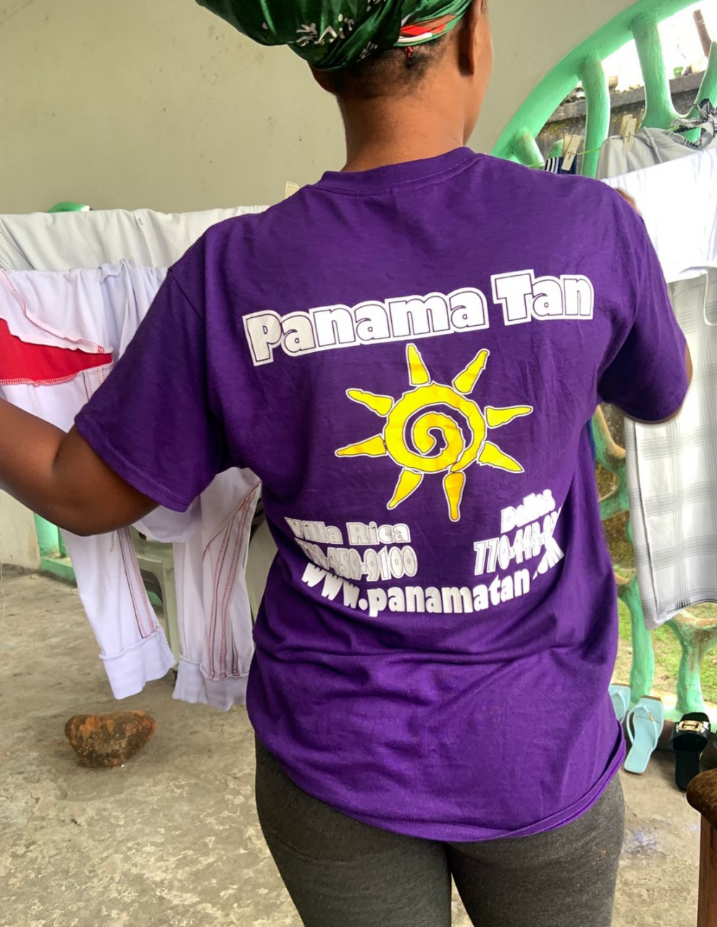
Police investigators said the victims were held in a compound next to the home of Vice President Jeremiah Koung in Gbankpa Town in Paynesville. Soloman Ware, a spokesman for the vice president, did not respond to requests for comment by press time.
Gongloe said the case raised security concerns for Koung.
“If he has received that information, he should be very serious about it. If he hasn’t, he should be informed one way or the other,” Gongloe said. “It is a security risk for such criminal activity to take place near a vice president’s residence. Could there be terrorists there one day? It means a lot needs to be done. Those responsible for the security of the vice president and the president need to strengthen their monitoring so that this does not happen near them.”
Many of the victims said they would not give up their quest for justice and will seeking new ways to force government to act.
This story was a collaboration with New Narratives as part of the Investigating Liberia project. Funding was provided by the Swedish International Cooperation Development Agency. The funder had no say in the story’s content.