
By Anthony Stephens, senior justice correspondent with New Narratives
Summary:
- A key prosecution witness stepped from the stand and identified the remaining defendants one by one, describing them as “wicked people.”
- Prosecutors say the testimony could prove pivotal in Liberia’s largest human trafficking trial, where defendants face lengthy prison sentences if convicted.
- Two other state witnesses corroborated her testimony and highlighted alleged ill-treatment including beating, torture and denial of food among others in a compound close to the residence of Liberia’s Vice President, Jeremiah Koung.
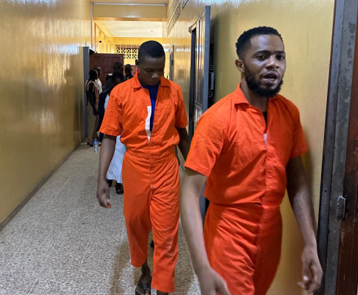
In a dramatic testimony in Liberia’s largest human-trafficking case, a key prosecution witness left her wooden chair in the courtroom and walked—about five steps—to the defendants’ dock to identify the remaining men and women on trial.
The witness, identified as L., to protect her from retribution, stood at the dock of Criminal Court “A” at the Temple of Justice, the seat of Liberia’s judiciary, and used the index finger of her right hand to point out each defendant: Bill Plato; Wuo Zekarso Garteh (also referred to in testimony as Daniel Davis); Jerome Genseh; Luther Flomo; Alexander Plato; Daylue Kargon; and Stanley Wonlebaye. Blessing Favor Suah, named in the indictment, was not present and remains at large, as do other individuals whom the prosecution said witnesses have contiuned to identify as part of the alleged trafficking scheme.
The testimony came after four of the defendents—Shelley Jonny, Maxson Wonlebaye, Martherline Tompia and Preston Godfred pleaded guilty last week. State prosecutors only dropped charges agaisnt Jonny, arguing that the evidence showed the other three were the principal perpetrators of the crimes.
“These are the wicked people them there,” she said in Liberian English.
But when Carlor directed attention to Alexander Plato, L. did not identify him. “I na see him. I know him. His name Alexander Plato,” she said.
Carlo’s concern played out audibly and visibly for those watching and for those able to overhear from the media area near the dock. Carlor then turned to Bill Plato and asked whether L. had correctly indicated him. Bill Plato nodded affirmatively.
Prosecutors say L. is a key witness and that her testimony was important to support their argument for long prison sentences. They want a minimum of 20 years for each defendant in line with Liberia’s amended human trafficking law. L.’s dramatic moment is similar to the one displayed last week by another witness identified as S. She stood firmly and pointed at Davis and from the stand and accused him of raping her.
During her testimony, L. said she became ill while being held in a compound
in Gbankpa Town, near the residence of Liberia’s Vice President, Jeremiah Koung along the Roberts International Airport highway and that her captors refused to allow her to seek medical treatment. She said the death of Ophelia Melway, one of the victims, sparked protests among those being held in the compound. The unrest, she said, eventually overwhelmed Luther Flomo, whom she and other witnesses identified as a security guard, allowing them to escape.
L. further testified that she was recruited for a failed trip to Canada by Wonlebaye, whom she described as her cousin. She told the court that her father paid a total of US$1,200—US$930 first and US$270 later.
“Be patient. To take poverty from your family, da na small thing,” L. recalled them saying.
The remark drew laughter from some jurors and others in the courtroom. A few feet away, some of the defendants she named sat quietly in the dock.
L. also testified that whenever she pressed for answers about the trip, she was punished.
“Pumping tire, drinking water, standing in the sun,” she said in response to a question from Sumo Kutu Akoi, Liberia’s senior human trafficking prosecutor. “There were so many punishments.”
Z., told the court that ill-treatment—including torture, beatings, and deprivation of food—was common in the compound.
“I did not have freedom,” he said. “I did not have right to my own communication. And they severely punished me.”They told me I should pump tire 200 times. I was forced to do that. And they determined what I ate.”
He said Davis took his phone and required him to undergo a three-day training so that he could become accustomed to what Z. described as “the white people system.” Z. also said the defendants forced him to make calls to his relatives.
Z. testified that he had been recruited from Nimba County by Godfred. Z. told the court that Godfred—his high school friend—spoke to him about a trip to Canada in place of Godfred’s brother, whose kidney condition allegedly caused a failed visa application and disrupted the plan.
According to Z., Godfred asked him to raise US$2,000 for the trip, but Z. said that he did not have the full amount. He said his father could raise only US$1,075 and that he Z. personally gave the money to Davis. He said Davis then provided a receipt. Z. told the court that once he reached Monrovia, he was taken to the compound where the other victims were being held. Z. said that he met a well-dressed Davis behind a computer there—an account that matched testimony given by other witnesses.
Z. said he remained in the compound for eight months and became frustrated after repeated failed promises. He said that Davis repeatedly urged patience: “He told me ‘traveling business is not one or two days time. So, you get to be patient.’”
During cross-examination, the defense sought to highlight perceived contradictions in Z.’s testimony. One disputed point concerned Z.’s claim that he could read and write but had not written his own statement to police. Mamae Gongbah, one of the defense lawyers, questioned him at length. Z. testified that he was confused and therefore said he could not write. The courtroom erupted into laughter when Gongbah repeated the questioning.
Prosecution objected to what it characterized as “battering the witness,” and the court sustained that objection, with Judge Roosevelt Willie ruling that the questions were “irelevent” because people could read and write and that others could write statements for them. Willie also upheld a prosecution objection requiring M. to show a document indicating that she worked for the Canaan government.
Z. also addressed the death of Melway in his testimony, saying: “she was killed.” He said she had been removed for medical reasons. “She was seriously ill and they took her out,” he said. When asked at the close of his testimony by Judge Willie whether Melway died in the compound, he replied, “She did not die in the fense.”
Later in the day, the prosecution called a second witness, identified only as “P.” to protect her from retribution. P. testified that she, like L., was recruited for a failed Canadian trip by Wonlebaye, whom she also described as her cousin. She said Wonlebaye asked her to pay US$2,000 but that she only had US$950. She testified that Wonlebaye told her that anyone she could find or recruit could be the source of additional money. “Then he said, ‘anyone you get, you can bring it,’” P. said, describing instructions from Wonlebaye. “Then he said ‘you can make your way.’”
P. testified that she paid the money to Alexander Plato and that she repeatedly raised concerns about the status of the trip.
She told the court that she was compelled to call relatives to send money. When she initially refused, she said, she was punished.
“Preston give 5 bags of water to drink,” P. said. “Then Matherline Tompia put chairs in my hand and asked me to kneel down. All those people that sitting down there, they were there. All of them used to punish me.”
During cross-examination, a 15-minute dispute developed between prosecutors and defense for over a question about the “transfer” of P. The prosecution argued the issue had already been answered, while the defense disagreed. Willie ruled that the witness should not answer the question, saying the both issues of transfer and transportation had already been addressed and that the defense should not proceed with the question because the witness had already described how she had been taken from Nimba and transferred to the compound.
The trial continues Tuesday, with more state witnesses scheduled to take the stand.
This story is a collaboration with New Narratives as part of the West Africa Justice Reporting Project. Funding was provided by the Swedish International Development Cooperation Agency which had no say in the story’s content.