

By Aria Deemie, climate change reporter with New Narratives
Summary
- As climate change ravages Liberia’s subsistence farmers, a private greenhouse farming venture — the first of its kind in Liberia —offers a promising solution.
- Experts say greenhouses – offering controlled conditions, drip irrigation, and temperature monitoring to grow vegetables year-round – will be a key tool in farmers’ adaptation to the
erratic rainfall, drought, and rising pest infestations that are devastating harvests.
- But as government agencies scramble to help farmers adapt to climate change the withdrawal of international aid has cast a cloud over future innovation in the industry.
WUNGKO FARM, Salala – The afternoon sun comes out after a sudden downpour on this farm, 50 miles from Monrovia, heating the nursery as workers gently lower seeds into tiny pots lined in long, neat rows.
The seedlings will soon be transferred into one of 12 greenhouses – translucent tents that filter light, control heat, and protect crops from extreme rainfall. Inside, baby bell peppers push through soil- filled grow bags as water drips steadily along irrigation lines, creating a calm oasis even as the climate outside grows more chaotic.
“We can’t change the weather,” says Paul Wungko, a former information technology expert with the United Nations who walked away from that career to set up Wungko Farm in 2016. “But we can adapt to it. The only way is smart agriculture.”
Wungko, 40, decided to strike out as an entrepreneur in an underdeveloped industry that was key for Liberia’s future. As climate change wrought havoc on traditional farming practices he saw greenhouses as a key solution. No profitable and sustainable, experts say he offers one example of how Liberia might build resilience to growing food insecurity.
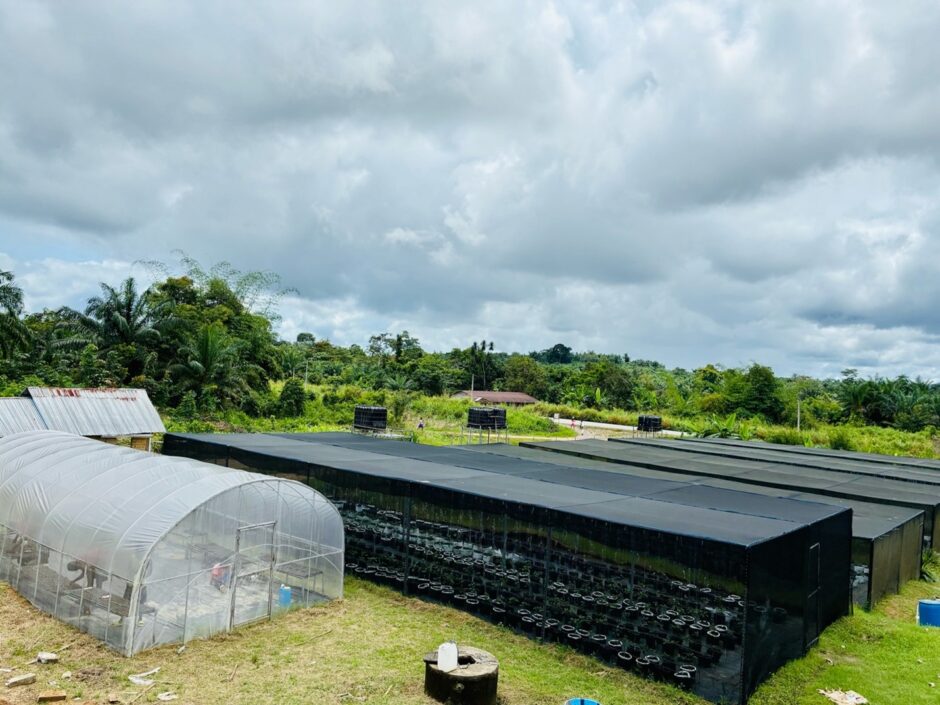
As unpredictable weather devastates traditional farms across Liberia, experts say one of the most effective tools for protecting crops is the greenhouse — a simple structure of plastic or mesh that creates a controlled environment shielding plants from heavy rains, scorching heat, and pests. Inside these tent-like enclosures, farmers can regulate water, temperature, and humidity, allowing vegetables to grow steadily even as conditions disrupt traditional planting cycles.
Across Africa, government and private innovators are scaling climate-smart farming. Kenya’s Climate-Smart Agriculture Project supports farmers adopting drip irrigation, and greenhouses. Ghana is rolling out greenhouse programs through the Ghana Climate Smart Agriculture Alliance. Nigeria and Rwanda are integrating greenhouses into national plans for protecting high-value crops from erratic rainfall. South Africa uses them to bolster horticulture in dry zones.
Liberia, by contrast, is only now experimenting with both private and public greenhouse farming, implementing what experts say is an important first step toward integrating climate-smart agriculture into national food security strategies. Experts say Wungko Farm’s model shows how commercial greenhouses could help safeguard harvests and strengthen food security as climate change intensifies.
Innovators Leading the Way
In 2023, Solidaridad West Africa, supported by the European Union, constructed Liberia’s first post-war cocoa greenhouse at the Central Agricultural Research Institute. There are now three functioning greenhouses, according to communications officers of the institute. Each greenhouse is supported by a different project, using a mix of private investor and public money to strengthen cocoa research and production in Liberia.
While these public greenhouses focus on research and export crops like cocoa, experts say Wungko’s operation shows what climate-smart agriculture can look like at the commercial level, filling a gap where national policy and government programs remain limited.
A temperature-monitoring device beeps softly as Wungko checks soil moisture on his tablet. Rows of bell peppers, tomatoes, and leafy greens stretch beneath the shade-net greenhouses, vibrant against the muddy chaos outside.
“Here, we can water when we need to, apply fertilizer at the right time, and protect crops from pests,” Wungko explains, crouching beside a young pepper plant. “It’s more expensive to set up, but it saves the harvest and ensures food reaches the table…Hunger doesn’t come in seasons so, our farming shouldn’t either.”
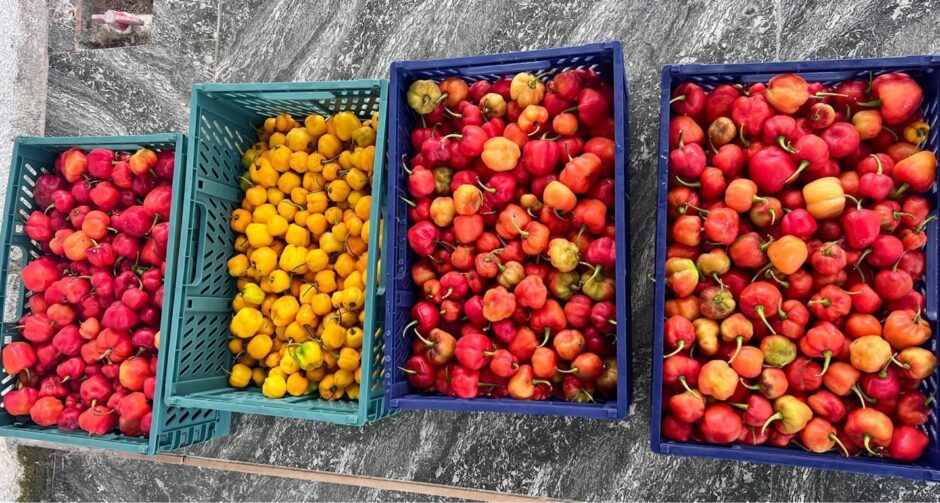
Wungko farm harvests more than 200 kilograms of vegetables weekly. The produce—including high-value crops like bell peppers and habanero peppers—is packaged and sold directly to consumers. Wungko also sells his produce through supermarkets and offers free delivery for orders over 3 kilograms in and around Monrovia. He also employs workers, many of whom are farmers who have been forced to abandon their own farms.
Wunkgo says each greenhouse requires an initial investment of around $10,000, but long-term returns are substantial due to lower recurring expenses and improved crop quality.
The operation relied on substantial donor support to get going. In 2021, the Wungko Farm won a grant of $US40,000 from the United Nations Development Programme Growth Accelerator Program. In 2023, it was among local businesses supported through the USAID Agribusiness Development Activity, part of a $US7.8 million investment in Liberia’s agriculture sector.
Wungko says those grants have been enough to help the business become profitable and sustainable. But as major donors such as USAID and Sweden are withdrawing from the country, and funding to multilateral donors including the United Nations has been slashed, future entrepreneurs like Wungko will have fewer options to start and grow their businesses.
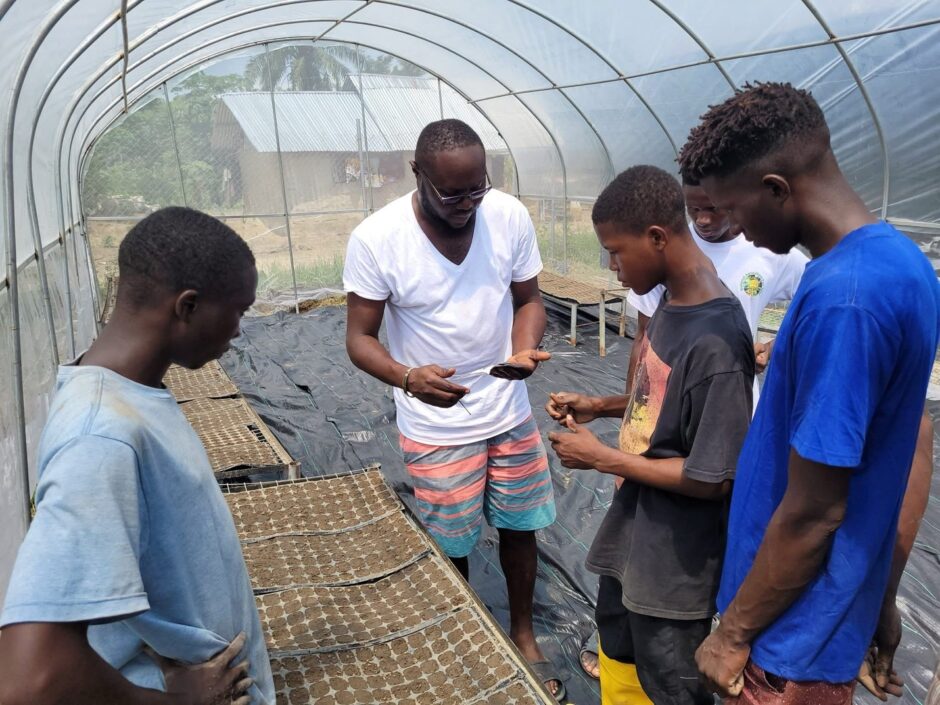
Beyond boosting yields, the farm is a training hub. Youths aged 18 to 25 complete a free three-month program in drip irrigation, soil monitoring, and pest control, skills they can take back to their own family farms. Or use to develop their own businesses that can employ traditional farmers who can’t afford to adapt to smart farming techniques.
“Before, too much rain could destroy everything,” says 28-year-old worker Timonthy G. Memah, lifting baskets of bell peppers and habaneros. “Here, sun or rain, we can still plant. This is civilized farming.”
Now Nothing to Eat and Sell
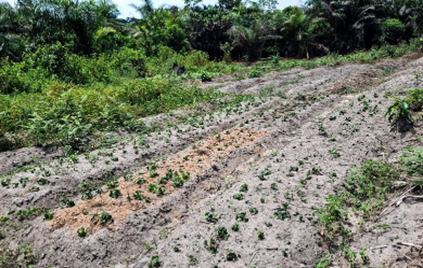
Without widespread support for climate change farming adaptation food insecurity and undernourishment are stalking the nation. A 2024 national survey by FrontPage Africa and New Narratives of 300 subsistence farmers in River Cess, Nimba, Bong, Montserrado and Grand Bassa found that climate change is already have severe impacts on livelihoods. Every farmer interviewed said climate change had made farming unviable. Nine in every ten said they were considering abandoning farming and migrating to cities, illegal mine sites or exploring options to migrate overseas.
The World Bank says rural poverty is at 80 percent and this year’s Global Hunger Survey found undernourishment is rising with more than one in three Liberians not getting enough nourishment.

In Margibi County, cassava farmer Gleekeh Peters, 45, is one of those struggling. A single mother she is farming as her family has for generations, relying on once-predictable rainfall and temperature patterns. She says unpredictable rainfall and soil diseases have halved her harvests.
“I used to sell 100 sometimes 150 bags of cassava after harvesting. Now, I can’t even sell 50 bags. The heavy rain, and soil disease spoil the cassava, now nothing to eat and sell.”
Jackson Williams, another Margibi farmer, aged 38, describes chaotic seasons:
“When we expect rain, the sun comes; when we expect sun, it rains. Sometimes drought hits my farm, other times too much rain floods it.”

Rising temperatures and shifting seasons have also allowed pests to thrive. Liberia‘s National Adaptation Plan warns that pests, diseases, and land degradation will intensify without widescale adaptation. A 2024 New Narratives/FrontPage Africa investigation found that found that outbreaks of nematodes and fungal diseases devastated farms in six counties— Lofa, Nimba, Rivercess, Gbarpolu, Bong, and Bomi.
According to Garmonyou A. Sam, an entomologist at the Ministry of Agriculture, many pests were in “diapause” – a dormant state in which they wait for favorable climate conditions to resume activity and spread. That is happening now with devastating impact. The National Disaster Management Agency’s 2023 Situation Report listed pest infestation among Liberia’s four most serious disaster incidents.
Greenhouses offer protection from all these blights. Experts say expanding their availability across the country will be essential to helping farmers adapt to changing climate. But cost will be a major obstacle. A single greenhouse costs about $10,000 and can last up to seven years, often paying for itself within two. But the upfront cost remains far out of reach for most smallholder farmers.
The Boakai government has unveiled major plans to modernize Liberia’s agriculture sector. At the Africa Food Systems Forum in September, officials launched the US$900 million Legacy Investment Program, described as the country’s most ambitious agricultural plan in decades.
The initiative will focus on modernizing farming practices, increasing productivity, and attracting both public and international investment. Greenhouses will be part of the plan according to Halala Kokulo,director for Land Development and Water Resources at the ministry of agriculture.
Kokulo says the government understands that these structures are expensive for subsistence farmers, and plans are being developed to begin rolling out access this year.
“We have already targeted several greenhouse structures for vegetable farmers in Bong and Nimba through the government’s Public Sector Investment Program. The project is active — we just revised the work plan and budget for 2026, and greenhouses are part of the climate-smart support we’re rolling out.”
The Boakai government has worked hard to increase tax and royalty revenue, expanding the government budget by 20 percent in 2026 to $1US billion. But with so many pressing needs, the government acknowledges the ambitious agriculture plan will depend heavily on private investors, and development partners. As international aid has been withdrawn from the country, the needed support will be hard to come by. Investors will also likely be nervous to invest in Liberia given the economic and governance uncertainty and historic corruption.
Paul Wongko says his farm shows that agricultural entrepreneurialism is one key answer to Liberia’s growing food security challenges. It will also offer jobs for many displaced subsistence farmers. But experts say, as international support dries up, future startups will likely need to rely on government to step up in a way it has not done before. The next year or two will likely test government’s stated commitment to seriously address the problem.
This story was produced in collaboration with New Narratives with funding from the American Jewish World Service. The donor had no say in the story’s content.