
By Nemenlah Cyrus Harmon, New Narratives climate and environment reporter
Summary:
- President Joseph Boakai has created a Carbon Market Authority to trade forest carbon credits, potentially generating hundreds of millions for development. It comes as international news media reports that the African Development Bank is pressuring the government to speed up the process to begin carbon trading
- Experts warn weak oversight and “carbon cowboys” could repeat past timber-sector scandals and risk Liberia’s reputation.
- Advocates say forest communities may struggle to secure fair shares of carbon revenue, with intermediaries potentially taking much of the profit.
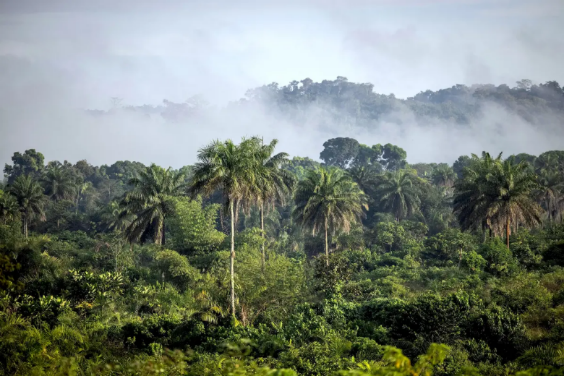
In Liberia’s dense tropical forests, where the canopy stretches unbroken for miles, the country is sitting on what could become a major financial windfall. Experts estimate the nation holds one billion tons of stored carbon, the ecological inheritance of centuries-old trees that have quietly absorbed carbon dioxide while the industrialized world created it by burning fossil fuels.
For the administration of Joseph Boakai, that carbon represents a potential economic lifeline. In October, Boakai issued an executive order creating a Carbon Market Authority, signaling Liberia’s intent to formally enter the global carbon credit trade, a market that allows countries and corporations to offset emissions by paying forest nations to preserve their trees. Jeanine Cooper, the newly appointed presidential envoy on climate action, said the country is finally ready to claim its rightful place in global climate finance — and she is determined to lead it there.
“Carbon markets represent for Liberia the next frontier to finance our sustainable growth,” she said in a recent Ok FM radio interview. “It offers mechanisms that can monetize our huge forests and natural capital assets.”
But as the new Authority takes shape a growing chorus of environmental and governance experts warn Liberia risks repeating the very mistakes that once brought international sanctions on its timber industry by the United Nations Security Council in 2003.
The sector could be the goose that lays the golden egg, according to Nathaniel Blama, head of the Environmental Protection Agency under the Weah administration. “But if it is not properly done, it could become a nightmare for us. It could be a colossal corridor for cartels, money launderers to come in and undermine the system.”
Cooper did not respond to a request for an interview but she told Ok FM the danger is already here and all levels of government, including the Legislature and executive, need to take it seriously.
“We need to take a commercial approach and hold ourselves to certain standards of excellence,” Cooper said. “A lot of people have their eyes on Liberia already. There’s one project that I’m looking at and I wonder how that one passed. People are making carbon credit money on our backs, claiming to do things they are not doing. There’s no regulation, no scrutiny.”

Under global climate frameworks such as the United Nations Framework Convention on Climate Change’s REDD+ mechanism and the Paris Agreement, countries are required to respect the rights of Indigenous peoples and local communities and to promote sustainable development in carbon market activities.
While those international agreements do not mandate a fixed revenue percentage, Blama said a majority share up to 60 percent of carbon income should flow directly to forest communities to fund schools, clinics and roads. The remainder, he said, should support national administration and conservation programs.

Liberia needs to build technical systems and a financial infrastructure to track carbon extraction site-by-site – like national carbon registry linked to mapped forest blocks, a robust monitoring, reporting and verification system to measure emissions reductions, and a transparent public dashboard showing where credits are generated and where money is spent. Building those systems, Blama said, could require millions of dollars in upfront investment, without which foreign consultants could effectively control the architecture of Liberia’s carbon trade, reducing national oversight, diverting a significant share of revenues abroad and weakening transparency over how much carbon is sold and how much money reaches forest communities.
Blama draws parallels to Liberia’s oil sector. When Liberia sought offshore seismic surveys, it relied on a foreign firm that retained ownership of the geological data. Today, prospective oil bidders must travel abroad and pay to access information about Liberia’s own resources.
“That’s where national ownership is,” Blama said. “If you don’t own the system, you don’t own the resource.”
Carbon Authority chief Jeanine Cooper did not respond to request for an interview but she told Okay FM that she is clear-eyed about the challenges. “This whole thing looks new and strange, not only in Liberia, but also in Africa.”
Cooper described the Authority’s mandate as three-pronged:
- Serving as the lead national entity for all carbon market development;
- Hosting a Blue Economy Secretariat to capture the carbon value of mangroves and wetlands. Unlike forests which are part of the “green economy” the “blue economy” is responsible for integrating marine and coastal resources into Liberia’s climate and carbon-market strategy, these marine and coastal resources are wetlands and mangroves for example.
- Functioning as a special climate finance vehicle capable of attracting institutional investors and securing Liberia’s first sub-sovereign credit rating. A sub-sovereign credit rating works like a financial report card for a city or regional government — separate from the national government’s rating — telling investors how likely that local authority is to repay its debts.
Emmanuel Urey Yarkpawolo, executive director of the Environmental Protection Agency, declined to comment. In a WhatsApp message, Yarkpawolo called the carbon credit issue “a sensitive matter.”
The government is now getting pressure from a new source. The Financial Times newspaper reported this month that the African Development Bank is pressuring the government to move faster to get carbon trading going. According to the report, part of Liberia’s African Development Bank funding including support linked to budget financing and private bank lending – depends on the government approving a national carbon sales framework.
Haunted by Timber’s Past
Civil society groups are skeptical that the government can pull off the market and deliver for forest communities. Jonathan W. Yiah of the Sustainable Development Institute says so-called “carbon cowboys” — speculative brokers seeking to lock in carbon rights before laws are fully developed — have circled Liberia for nearly two decades.
Liberia’s forestry sector offers a cautionary tale. During the civil war, timber revenues were found to be fueling armed factions, prompting sanctions from the United Nations. Years later, the Private Use Permit scandal saw vast tracts of forest land illegally allocated, with little benefit reaching rural communities. Private Use Permits were introduced to allow Liberian landowners to manage and benefit from their forest resources, including logging and other activities. The policy was intended to empower communities and individuals to control the use of their land and derive economic value from it.
The system was widely abused. Between 2.5 and 4 million hectares of forest—roughly 20 to 40 percent of Liberia’s land area – were allocated under permits, often to logging companies through fraudulent or coercive agreements. In many cases, communities either did not fully understand the contracts or did not give informed consent. Officials within key government institutions, including the Forestry Development Authority, were accused of corruption, negligence, or complicity. In response, the government suspended all permits in 2012, launched a full investigation, and subsequently cancelled most of them.
“If that happens with carbon, Liberia could be blacklisted,” says Blama.
The forestry blacklist imposed by the United Nations Security Council in 2003 crippled Liberia’s timber industry, cutting off a major source of revenue and causing widespread job losses. Enacted during the rule of Charles Taylor, the sanctions aimed to halt funding tied to regional conflicts, including Liberia’s role in the Sierra Leone Civil War.
The sanctions also forced reforms in the forestry sector, including changes to the Forestry Development Authority, helping restore international trust and leading to their lifting in 2006
Such a blacklist would effectively bar Liberia from participating in reputable international carbon markets, a reputational blow that could take years to reverse.
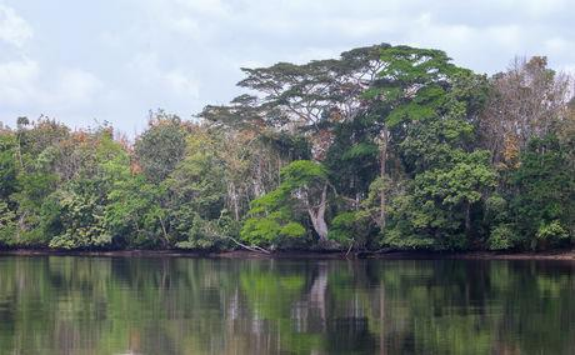
Liberia’s land and community rights laws recognize local ownership of natural resources. The 2009 Community Rights Law grants forest communities control over their customary land. Yet many communities lack the technical and financial literacy to negotiate complex carbon agreements.
“Communities don’t fully understand the potential rights that they have,” Yiah said. Without capacity-building, he warned, rural populations could sign away long-term benefits for short-term payments.
Cooper said she shares the concern. She recounted a project developer who offered communities cheap cookstoves while making millions from their trees. “What is a cook stove? You were very excited they’ll give you some cookpots. Why are you making millions off of their trees? The communities not only need to know exactly what they are getting, they need to understand the full potential.”
Exclusion Breeds Encroachment
Experts say another key part of the puzzle will be enforcement. If communities don’t see the benefit of carbon trading they will continue hunting – endangering the biodiversity – and clearing the forest for their livelihoods.
“The adjacent communities don’t see themselves as participants,” said Blama. “If anybody comes, they will not stop them.”
The government has deployed security forces to address incursions, a move Blama calls unsustainable without community buy-in. “The people need to be participants.”
Cooper said the Authority is planning for exactly that. She described a pilot project in the Wonegisi area, funded by the French Development Agency, that would protect 135,000 hectares of forest across 34 communities.
“You tell people ‘don’t cut down the trees, don’t go in there, don’t hunt the animals,” she said. “In exchange, we train you to do something else plant fruit trees, grow crops between the trees.”
If carbon revenue were properly packaged on top, she argued, communities now receiving a few hundred thousand dollars in assistance could receive “seven, eight million dollar’s worth of infrastructure development — schools, clinics per year.” That would be game changing in forest communities that now have clinics and schools that barely function.
With foreign aid dwindling and Liberia’s economy struggling to grow fast enough to employ Liberia’s booming youth population, and reduce poverty and inequality, the country may finally need a miracle if it is to turn things around.
Cooper said carbon trading should be that miracle.
“We have forests,” she said. “Many developed countries have cut down their forests. But we have not. And so it’s time that we receive some sort of — they call it payment for ecosystem services. We’ve been keeping these forests. We should get some money out of it.”
This story was a collaboration with New Narratives as part of the Investigating Liberia Project. Funding was provided by the Swedish Embassy in Liberia. The funder had no say in the story’s content.