


By Nemenlah Cyrus Harmon, climate and environment reporter with New Narratives
Summary
- A new UN declaration could strengthen Liberia’s appeal for coastal protection funding as 230,000 people set to lose homes and livelihoods by 2100.
- Coastal erosion is destroying homes, threatening ports and fishing livelihoods across Liberia while monitoring and early warning systems remain limited.
- Officials say defending the coast could cost at least US$1 billion.
A new United Nations declaration could help Liberia press for international support to protect a coastline where erosion is destroying homes and threatening ports and fishing livelihoods, international officials and climate experts say.
The UN General Assembly adopted the Declaration on Sea Level Rise in September calling for stronger international cooperation, better coastal monitoring and early warning systems, and long-term planning to protect vulnerable communities.
For Liberia the threat is growing by the day.
“It is true that God is not making new land,” said Emmanuel Urey Yarkpawolo, executive director of the Environmental Protection Agency, referring to a remark made by Liberia’s president in February. “So when the sea level rise is taking the land from the coast, it’s reducing the land of the country, literally. Not figuratively — literally it’s taking land.”
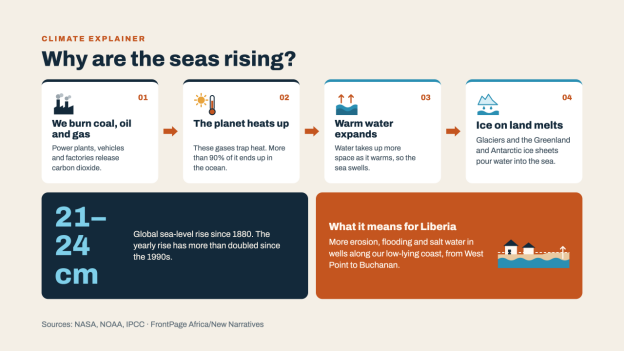
Global warming is raising sea levels in two ways: warmer seawater expands, and meltwater from land ice flows into the ocean, with the ice coming chiefly from the Greenland and Antarctic ice sheets and glaciers around the world.
Warming is caused by burning fossil fuels such as coal, oil and gas which release greenhouse gases like carbon dioxide and methane, which have warmed Earth’s atmosphere beyond what natural causes can explain, with deforestation and agriculture adding to the problem. The biggest emitters of greenhouse gases are China, the United States, India and the European Union. All of Africa is responsible for just 4 percent.
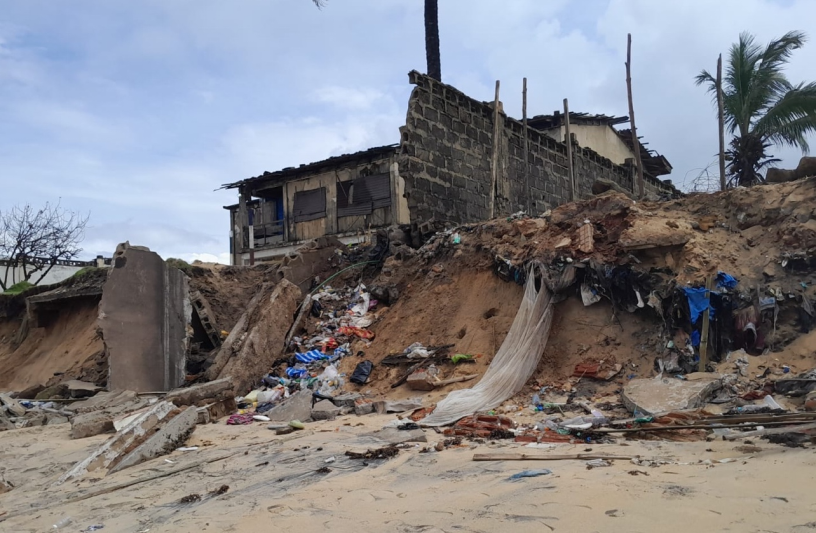
Liberia’s coastal communities are already losing land and homes. About 0.8 km² of land has been lost to coastal erosion in recent decades. In West Point, Monrovia, more than 6,500 people have been displaced and about 800 houses destroyed since 2013 because of sea-level rise and coastal erosion, according World Bank and Liberian government assessments.
The Bank’s has found that with a one-metre rise in sea level, more than 230,000 people will lose their homes and livelihoods. Major cities including Monrovia, New Kru Town, Buchanan, River Cess and Robertsport will face significant damage.
For Liberia, the stakes extend from crowded coastal settlements in Monrovia to ports in the southeast. Yarkpawolo estimates that defending the country’s threatened coast would cost “not less than a billion dollars.”
At the moment Liberia lacks a sophisticated system to monitor coastal risks in real time putting lives and livelihoods in danger when high swells happen without warning.
The UN declaration could strengthen its appeal to donors, said Isaac Nyaneyon Kannah Teah, a Liberian climate expert. It is not legally binding and guarantees no new funding yet but it’s another importation step to encourage the world’s heaviest emitters of the gases causing climate change.
“It’s an open door for financing of our coastal land,” Teah said.
The country has already secured nearly US$40 million for combined coastal defense projects including the US$10 million coastal defense project is underway in Sinoe County to protect Greenville. And the $25m project designed to place boulders along the shoreline at West Point to protect the settlement for 40 years. All of them have faced yearslong delays because of a lack of Liberian experts with technical knowledge for the projects and Weah government failure to provide agreed co-financing. Projects have slowly resumed progress under the Boakai administration.
“We’ve already been receiving a lot of financing of our coastal land, but this will also add more opportunities as well,” said Teah.
Land is already disappearing
In Greenville, Sinoe County, Yarkpawolo has seen how quickly sea is encroaching. In May last year, he stood beneath three coconut trees on Mississippi Street with a United Nations Development Program official to break ground for the US$8.9 million Sinoe Coastal Resilience Project, funded by the Global Environment Facility, to put rocks along the shoreline to protect communities there. When he returned in September, the trees were gone. The ocean had swallowed them in a matter of months.
Land near 17th Street, Sinkor where Yarkpawolo trained as a track athlete in the early 2000s is now several meters out to sea, he said. Waves are also undermining fences in a nearby neighborhood.
“Sea erosion is very, very, very serious,” Yarkpawolo said.
Teah said World Bank data put the average loss along Liberia’s roughly 580-kilometer coastline at one to one-and-a-half meters a year, with some areas losing land faster.
Illegal sand mining adds to the erosion, Teah said.
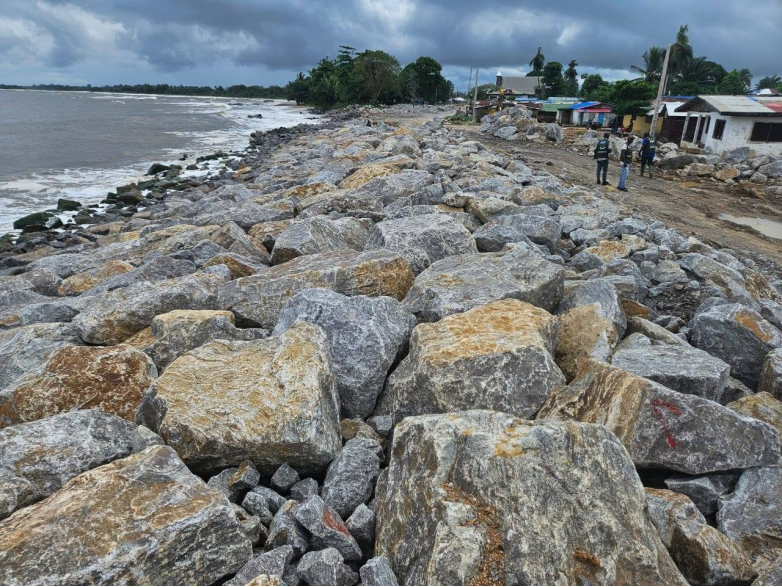
Farther southeast, Yarkpawolo warned that the Port of Harper in Maryland County could be lost within ten years without intervention. Greenville’s port is also threatened, he said, but faces a less severe risk.
The damage extends beyond homes and ports. Erosion is destroying sites where fishing communities land boats and process their catch. Mangrove loss is damaging fish breeding grounds, while saltwater intrusion is affecting soil and drinking water in low-lying farming areas.
In Greenville, parts of streets, including Mississippi Street, have been submerged, damaging roads, sanitation systems and homes.
“It’s going to affect our homes, it’s going to affect infrastructure, it’s going to affect a lot of things,” Teah said. “It’s an economic, food security, infrastructure, and public health and development issue.”
Coastal projects face a much larger funding need
Yarkpawolo said the EPA has mapped vulnerable areas along the coast and developed County Climate Action Plans covering 2026 to 2035. Liberia has submitted a US$17 million funding proposal to the international Loss and Damage Fund, another global fund made available to vulnerable countries, to protect the coastline behind JFK Memorial Hospital and the stretch toward Bernard Beach community, Yarkpawolo said.
Yarkpawolo’s estimate of at least US$1 billion reflects the broader cost of combining natural protection with engineered defenses along the country’s threatened coast. But Liberia’s financing challenge is part of a wider gap between the money developing countries need to adapt to climate change and the support they receive.
At the UN meeting, General Assembly President Khalilur Rahman said developing countries’ annual adaptation needs could reach between US$310 billion and US$365 billion by 2035. But international public adaptation finance reaching those countries totaled just $26 billion in 2023.
Better monitoring is another urgent need
The September UN declaration also calls for better data, risk assessments and early warning systems. For Liberia, those priorities address gaps that Yarkpawolo and Teah said limit the country’s ability to understand and prepare for coastal threats.
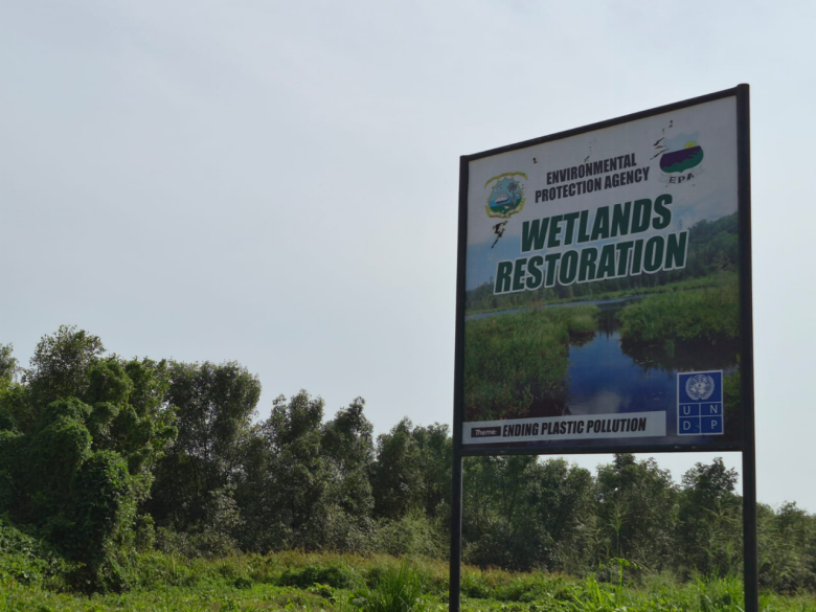
The EPA is working with international partners, including the Comprehensive Nuclear-Test-Ban Treaty Organization, to develop a data center capable of tracking storms and tsunamis. A national coastline observation system to record tides, shoreline changes and storm data over time.
Yarkpawolo said public awareness is also urgent. Sand mining, building on wetlands and close to the shore can increase communities’ exposure to coastal hazards. He warned that Liebrians can’t wait for international help to save them. We need to work together to protect what land we can.
This investigation was produced in collaboration with New Narratives as part of the Investigating Liberia project. Funding was provided by a private donor.