
By Fatu Kamara with New Narratives
Summary:
- Families say women and babies are dying because families cannot afford costs at public health facilities when pregnancies need medical intervention.
- Frontline health workers estimate that one in three women arriving late for childbirth care delayed seeking treatment while trying to raise money.
- Liberia reviews maternal deaths linked to delays in care, but there is no public data specifically tracking deaths linked to inability to pay.
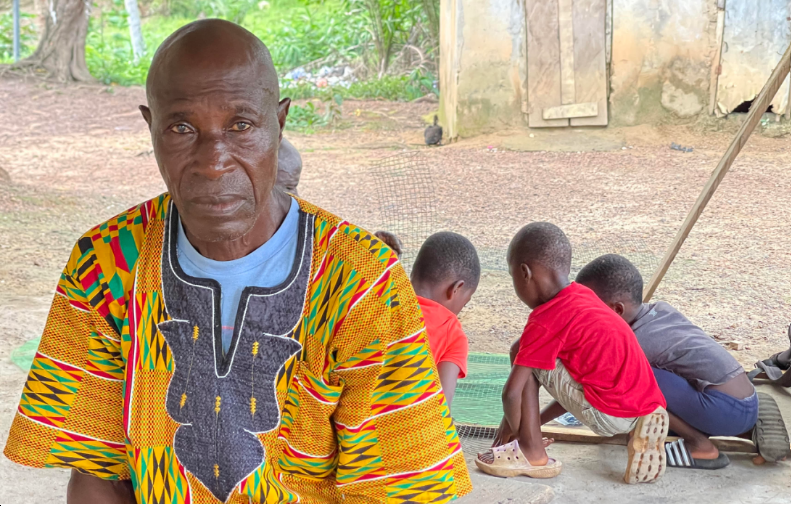
KAKATA, Margibi County — By the time Kolubah Kollie scraped together the last of the money, his daughter was already gravely ill.
Zoe Kollie, 29, had been in labor for eighteen hours, some of it endured as she traveled over unpaved roads, when her family finally got her here to C.H. Rennie Hospital, the closest hospital to her home in Bong Mines, in Lower Bong County. Doctors told them she needed an emergency Caesarean section that would not begin until the family paid the L$21,000 (US$150) cost for surgery.
Kollie did not have it. “I begged them,” he said in an interview at his home. “I am a retired soldier earning L$7,500 Liberian dollars monthly. Where do I get that money from?”
By the next morning Zoe’s condition was worsening. Kollie had managed to raise $80. But hospital workers refused to begin until they had all of it.
Relatives eventually delivered the remaining US$70. Zoe was wheeled into surgery. But it was too late. She and her baby died.
“For money business they killed my daughter,” said Kollie angrily. Kollie is now left to provide for Zoe’s seven orphaned children.
Zoe’s story is not isolated. In two rural counties, families interviewed by Frontpage Africa/New Narratives described delaying hospital visits during labor or scrambling to raise money while women suffered life threatening complications. Health advocates estimate that three in five women in rural Liberia and two in five women in urban areas struggle to pay emergency delivery costs.
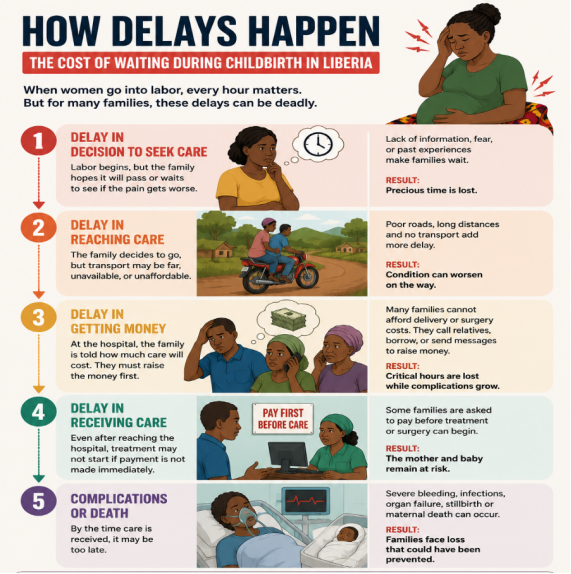
At Liberia’s largest referral hospital, John F. Kennedy Medical Center, in the capital Monrovia, a normal delivery costs US$50 while a Caesarean section costs US$150. Interviews with healthcare workers at public facilities in Montserrado and Margibi Counties found that emergency delivery fees in hospitals there vary, with additional charges arising from laboratory tests, blood transfusions, medications and emergency procedures.
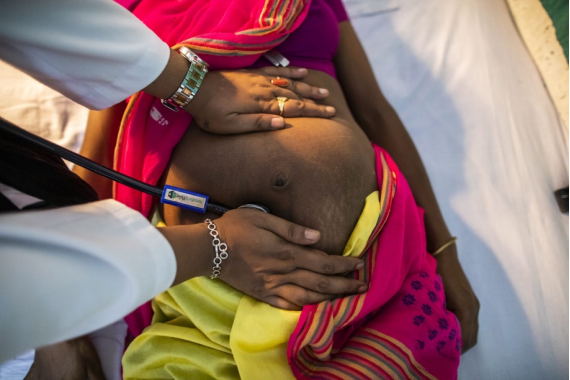
Pregnancy complications are often unpredictable. A woman expecting a normal delivery may suddenly require emergency surgery like a caesarian section to save the baby and the mother. Health workers say the time spent searching for money can be the difference between life and death.
Rebecca Cephas began feeling labor pain at midnight in February 2024 but remained silent till morning. At her home in Careysburg in Montserrado County, northeast of the capital, she realized the pregnancy was in trouble by the next afternoon. But she knew the family did not have money for hospital. By then it was already late. The baby died before she could reach the hospital.
“We could not even raise all the money,” she said. “I called everybody I know, but they all gave excuses. I was in pain and frustrated.”
Cephas said she, like many young women with unplanned pregnancies interviewed by FrontPage Africa/New Narratives this year, was abandoned by her boyfriend after becoming pregnant. During the first months of her pregnancy, she developed pelvic weakness and was advised to avoid strenuous work. A high school dropout with no professional skills, she survived by selling plantain chips.
“It really hurts,” she said. “I carried my baby for nine months. But because of money I am left empty-handed. After all the pain and suffering. It’s not easy to be poor.”
She says the experience has left her unwilling to have another child while living in Liberia.
Even after the birth women and babies can be held captive while relatives search for money. Families increasingly turn to journalists, radio stations and social media appeals to raise emergency funds.
Kollie says that while trying to save his daughter, he witnessed another woman in labor being forced out of a hospital because her family could not pay.
“I had to call journalists to help raise money for that woman before they accepted her again,” he says. “It broke my heart because my own daughter was also fighting for her life.”
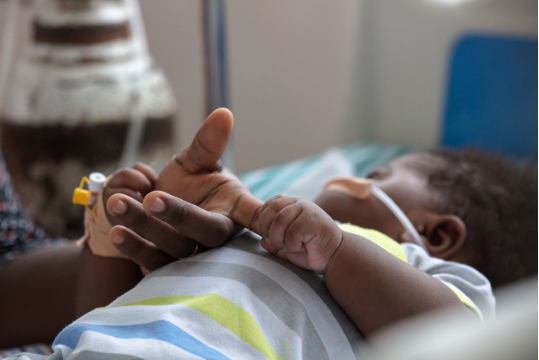
These stories happen to women every day according to frontline health workers. Liberia continues to record one of the highest maternal mortality rates in the world despite years of interventions. World Bank data estimates that for every 100,000 live births in Liberia, about 628 women die from pregnancy-related causes. That translates to three women dying every day from pregnancy and childbirth complications.
Newborn deaths also remain high. UNICEF estimates Liberia’s neonatal mortality rate remains around 24 to 25 deaths per 1,000 live births, compared with a global average of about 17.
The government has launched several initiatives aimed at reducing maternal mortality. Millions in donor money has been spent on things like building maternal waiting homes and improving drug supply chains and storage. Last April, the Boakai administration banned home deliveries and traditional birth attendants in an effort to encourage more women to seek care at health facilities. This March, the Ministry of Health launched a nationwide campaign deploying doctors, nurses and midwives across all fifteen counties.
At C.H. Rennie Hospital in Margibi County, Dr. Wilmot Frank, medical director, said the hospital launched a revolving fund in 2025 – after Zoe Kollie died – to loan money to families that they must then repay.
Frank said the program covers many medications, leaving families mainly responsible for laboratory tests, blood and emergency requirements. However, those costs can still increase sharply during complicated deliveries.
Yet maternal mortality remains stubbornly high. Liberia has committed under the United Nations Sustainable Development Goals to reduce maternal mortality to fewer than 70 deaths per 100,000 live births by 2030. In 2024 UN Resident Coordinator Christine Umutoni warned the country was not currently on track to meet that target.“There have been a lot of changes in the health sector, but yet we are having maternal deaths. So what are the issues, what deeper dive do we have to do to end preventable maternal deaths?” said Dr. Louise Kyoto, the health minister, during the commissioning of a refurbished maternity wing at JFK in April.
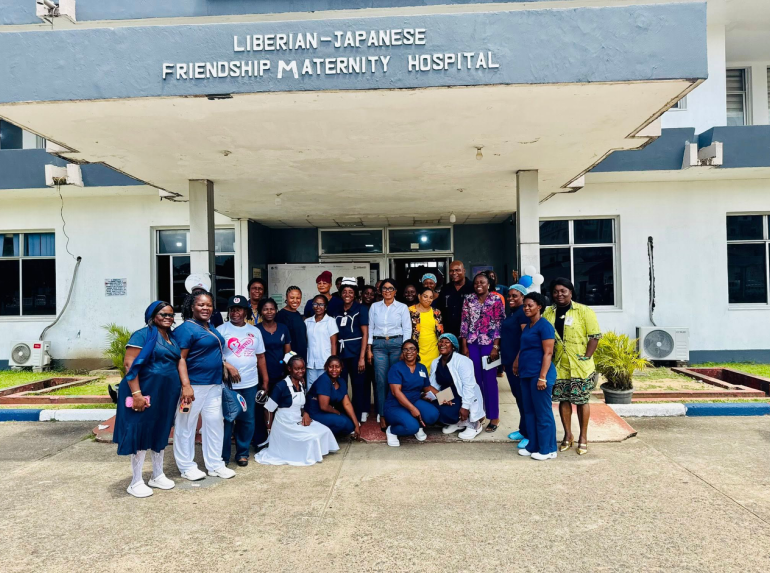
Public health advocates say the country is unlikely to achieve major reductions in maternal deaths while childbirth costs remain out of reach for poor families.
“We cannot ask women to come to facilities and then charge them when they get there,” said Joyce Kilikpo, executive director of Public Health Initiative Liberia, which works to connect communities with healthcare services and often settles maternity related debts, in an interview. “We have made some progress and facility-based births have increased over the years, but we are stuck. Most of the women still giving birth at home are poor women in underserved rural communities.”
“Most families in Liberia live on very little income,” said Joyce Kilikpo of the Public Health Initiative Liberia. “When complications arise, they simply cannot pay. And if they cannot pay, they wait. When it comes to childbirth, waiting costs lives.”
Liberia’s Maternal Death Review system tracks deaths linked to delays in seeking care, reaching facilities and receiving treatment. However, health workers and advocates interviewed for this story say the system does not publicly isolate deaths specifically linked to financial hardship.
The Ministry of Health did not respond to multiple requests for interviews and data for this story, including questions about childbirth fee policies and whether maternal death review findings are publicly accessible. Officials told this reporter that approval from Health Minister Kpoto was required before information could be released. Despite follow-up letters and WhatsApp messages sent over several weeks, no response was received before publication.
Healthcare workers say without enough funding they are left with impossible choices
At Grace of God Medical Clinic in Monrovia, Thomas Wolobah, the officer-in-charge, says the facility has assisted more than 200 women to deliver safely since 2023. But those who arrive late are often at risk. Wolobah said the clinic quickly refers complicated cases to larger facilities.
“Among women who arrive late, one in three report delaying care because they could not immediately afford treatment or were waiting for relatives to raise money,” he said.
Naomi Gboco, a certified midwife at JFK Medical Center with seventeen years of experience, said she regularly sees the consequences of delayed care.
“Almost every day we see women come very late,” Gboco said. “Sometimes they lose their kidneys, sometimes we lose the fetus. Even today we had two women who came very late. The mothers survived, but we lost the fetuses.”
Gboco says she understands the pain personally. She lost an aunt in childbirth when she was young. “I feel so bad when a pregnant woman walks in and we lose her. Sometimes we cry as midwives. It’s like nursing your own child and losing them at the end of the day.”
She says financial hardship frequently emerges in conversations with patients and families.“Most times the pregnant women will stay home, and they will not feel fetus movement and they won’t say it because there is no money,” she said. “Sometimes there is one person in the family responsible for finances, so they wait for that person before they can come to the hospital.”
Some hospital officials argued that public hospitals with limited funding must charge patients in order to operate. Dr. Augustine Fannie, technical assistant to the CEO of JFK Medical Center, said the hospital’s charges cover laboratory tests and specialized services.
“At other private facilities, normal delivery is around US$200 and Caesarean section is around US$300 or US$350,” Fannie said. He said the hospital is overwhelmed and underfunded. (Dr. Philip Ireland, another doctor at JKF told New Narratives in January that the hospital cost $30 million to $40 million annually to run but was only receiving $2 million. “The hospital was built in 1971 when Monrovia’s population was around 150,000 people. Now we have about 1.5 million people.”
Fannie said JFK provides grants for some women who cannot afford treatment, though he could not provide figures showing how many women have benefited.
Kollie is now struggling to support seven grandchildren alone. He said local and national health authorities visited him and made promises after the tragedy, but he has received no help.
“When I think sometimes about my daughter, or I see her picture in my phone, I feel bad especially when I see the little children are motherless. It’s only God that’s carrying me. If not so myself I could have died,” he said. “Even today we have not eaten anything. I am not worried about myself but the children. When I see the children sitting down saying they are hungry, I feel bad. It’s not easy.”
This report is a collaboration with New Narratives as part of the “Investigating Liberia” project. Funding was provided by the Swedish International Development Cooperation Agency which had no say in the story’s content.