
By Fatu Kamara with New Narratives
Summary
- The Ministry of Health is yet to publicly release data showing where thousands of promised reading glasses were distributed.
- Official acknowledges that glasses that have been distributed were provided by international donors.
- Transparency actors say the failure to release evidence of the disbursement makes it difficult to verify the true reach and impact of the program.
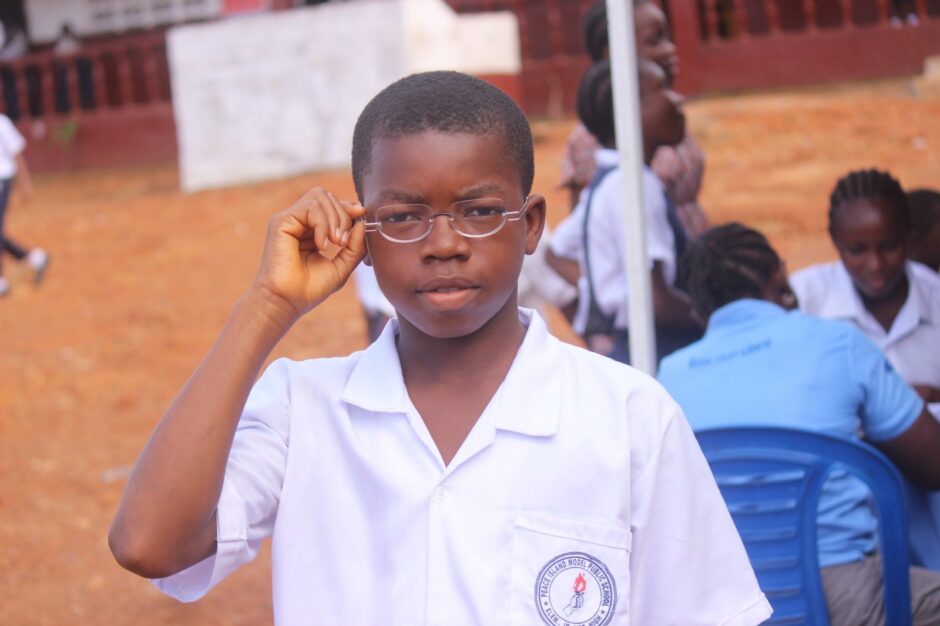
In October, as part of World Sight Day celebrations, Liberia’s National Eye Health Program made an exciting announcement: an ambitious program by the unit housed in the Ministry of Health promised to deliver badly needed help to Liberian students struggling with poor vision. The program was to screen 1,000 students and distribute 12,000 reading glasses.
According to a statement from Health Minister Dr. Louise Kpoto the program was a major step toward addressing widespread, untreated vision problems among schoolchildren which has been affecting learning outcomes nationwide.
But more than three months later, the ministry has yet to release a detailed, public breakdown showing how many glasses were distributed, raising concerns among potential beneficiaries about accountability for the project.
The lack of data has angered some eye health advocates who say timely and detailed reporting is especially important for programs tied to publicly announced targets.
“How do we know the impact when the numbers are not announced publicly?” says an optician who asked not to be named for fear of retaliation from government. “Communities expect to see where those services went. Without that information, it becomes difficult to verify the impact.”
He also expressed concerns about the figures that provided at the program launch.
“How do you screen 1,000 people and distribute 12,000 glasses?” he asks. “Does that mean the remaining 11,000 will receive the glasses without screening?”
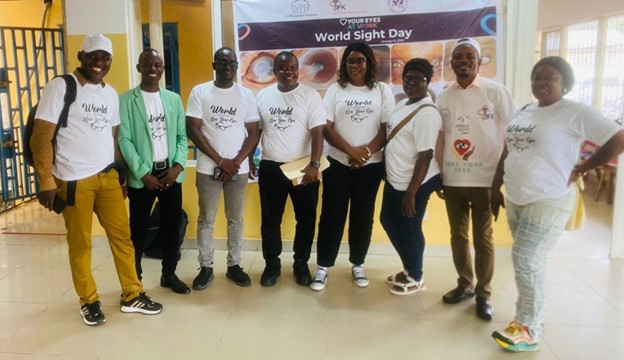
In December, after months of repeated inquiries by this reporter and several missed interview appointments, the Ministry of Health provided figures via WhatsApp, stating that 2,500 students were screened and 5,719 glasses (including clip-on prescription lenses) were distributed across Montserrado, Bong, River Gee, and Nimba counties.
Hiaka Hinneh, deputy director of the National Eye Health Program, said all were provided by donors and most had not yet been distributed.
“We received 12,000 reading glasses,” he says. “Seven thousand were supplied by OneSight and five thousand by Better World” (two international nonprofits). “Only 3,108 reading glasses have so far been distributed. The remaining 8,891 glasses are still at the ministry and will be distributed during upcoming campaigns.”
FrontPage Africa/New Narratives found donor and government data appeared to have blurred making results unclear. Ministry figures show that the 2,600 ready-to-clip prescription glasses distributed in Bong County were part of a OneSight initiative. Hinneh said the ministry had intended to include data from Good Vision’s outreach in its overall total but acknowledged that the information was not added.
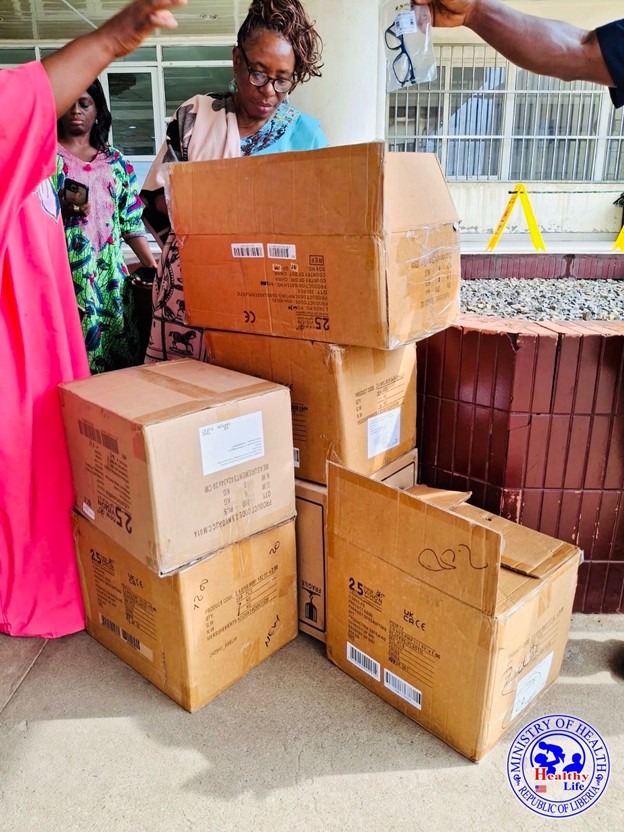
Hinneh said ministry teams visited two schools in Montserrado County – Gaye Town Public School and Paynesville Community School – but he could not provide a breakdown of how many students received glasses at each school or community.
Hinneh attributed this lack of data to random screening methods and reporting practices.
Bonyonnoa McCarthy, principal of the Gaye Town Public School, confirmed that the ministry visited the school but he would not give official numbers on how many students were screened or received glasses.
A Widespread Need

The lack of clarity on the program comes amid significant national need. Health experts estimate that one in three Liberians requires vision correction. A 2021 Ministry of Health survey found that 85 percent of Liberians who need glasses do not have access to them, largely due to cost and limited availability of services. Many schoolchildren are having schooling impacted by the lack of vision correction.
Nonprofit organizations have increasingly stepped in to fill the gap. Good Vision, the local arm of an international NGO that provides subsidized eye care services, says it regularly submits outreach reports to the Ministry of Health after community screenings.
“When we do outreaches, we submit our reports to the ministry,” says Jackson Smith, Good Vision’s country director. “But we don’t control how the figures are later compiled or reported.”
Since 2019, Good Vision said it has provided free eye screenings and subsidized glasses across Liberia. In 2025 alone, the organization conducted 446 outreaches across Grand Bassa, Grand Cape Mount, Margibi, Bomi, Bong and Montserrado counties, screened more than 16,000 people and distributed over 8,000 pairs of glasses, giving more than 300 away free of charge.
Clear Vision Becomes Affordable
One of Good Vision’s beneficiaries is 26-year-old Stephen Korvah, a classroom teacher who earns $US150 a month. He says access to affordable glasses has been life-changing.
He began experiencing vision problems in high school, but his family initially assumed he was not serious about school. It was only after he began working in 2016 that he learned he was myopic or “short sighted” – meaning he could not see long distances, a problem that afflicts one in three people globally.
His first pair of prescription glasses, purchased several years ago from a private clinic in Monrovia, cost $US150. “That was my entire salary,” Korvah says. “But without the glasses I was in total darkness.”
Three years later when his glasses needed to be replaced he had to pay another $150. “I already accepted the price,” he said. “Because every other place I went; the price was similar.”
That changed in 2023, when Korvah received prescription glasses through Good Vision for just $US5.
“It was shocking,” Korvah said. “I was saving $US145 of my salary. That can do a whole lot for me.”
Smith says affordability is central to Good Vision’s mission.
“Part of our core ethics is that no one should come to Good Vision and leave without glasses, especially for refractive error,” Smith says. “If the glasses cost $US40, we cover about ninety-eight percent. People pay these small amounts just so they feel ownership of the glasses and the program can continue.”
Smith says the need in Liberia is vast. In addition to the one in three Liberians who need help with myopia, he said nearly everyone over the age of 50 experiences some form of vision impairment.
Smith says Good Vision regularly conducts outreach programs in counties and remote communities without permanent eye care facilities.
Liberia faces systemic constraints in eye care delivery, including a severe shortage of trained professionals with only three optometrists nationwide and a reliance on imported glasses, which drives up costs. As donors withdraw from the country the need for government to step up has only increased.
“That’s why we NGOs have a responsibility to partner with the Ministry of Health on capacity strengthening,” Smith says. “NGOs may not be here forever, but the government will remain.”
As for the remaining World Sight Day glasses, the Ministry of Health says distribution is ongoing. But until detailed, school-level data is made public, parents, educators, and communities are left uncertain about who benefited from the program.
This report was produced with New Narratives as part of the Investigating Liberia project. Funding was provided by the Swedish Embassy in Liberia, which had no say in the story’s content.