
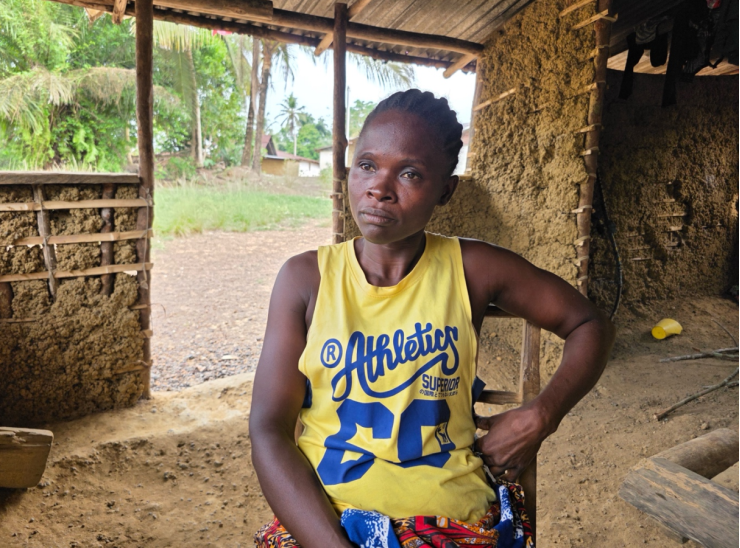
By Tetee Gebro and Joyclyn Wea, gender and health correspondents with New Narratives
Summary
- A measles outbreak struck a remote town in January, sickening several families before anyone understood what was spreading through the community.
- Families treated sick children with herbs and home remedies, including alcohol, because clinics were far, locked, or had no medicine. One four-year-old boy died. Another lost his hearing.
- Liberia faces a vaccine financing gap of more than US$1 million a year as World Bank support ends in 2026. Health advocates warn what happened in Kiangia Town could happen anywhere if that gap is not filled.
KIANGIA TOWN, Todee District — The measles came to this town in January.
Nobody announced it. Nobody warned families here. It moved quietly from home to home, the way measles does — through the air, between children playing; spreading before anyone understood what was happening.
By the time people in Kiangia Town realized an outbreak was unfolding, several families were already fighting it. There were no medications at the nearest clinic. In some cases there was no clinic open at all. So parents and grandparents turned to what they could find — traditional remedies of leaves, beans, honey and alcohol that experts say would do nothing at all.
Some children survived. Samuel did not. He was four years old.
Health advocates say Samuel’s death was avoidable; what happened in Kiangia Town is a warning of what could happen across the country as donor money for vaccines dries up.
Measles is one of the most contagious diseases in the world. One infected person can spread it to as many as eighteen others in an unvaccinated community. It is especially dangerous for children. It is one of the leading causes of childhood blindness in West Africa. Children who develop brain inflammation — one of measles’ most serious complications — have a one-in-four chance of permanent damage, including deafness, seizures, or intellectual disability. Measles kills about one percent of those it infects in Liberia — and in the poorest, most remote districts, that figure can reach ten percent.
To stop it from spreading, health experts say at least ninety-five percent of a community must be vaccinated. Below that level, the disease moves quickly — and in communities like Kiangia Town, it moves without resistance.
Measles vaccination coverage in Liberia currently stands at 82 percent — a significant recovery after it dropped to just 58 percent during the COVID pandemic in 2021, but still well below the 95 percent threshold needed to stop the disease from spreading. And now, the money that has helped protect Liberian children against measles is running out.
Liberia has relied on foreign partners to pay for vaccines. Between 2020 and 2024, the Global Vaccine Alliance, known as GAVI, gave US$13 million to the country’s immunization program. Liberia’s government gave US$2 million in co-financing— about 15 percent of the cost, below the 20 percent share Gavi expects. But the money did not come from the government’s coffers. Instead, the World Bank provided loans to the government to pay its share.
Now the World Bank is ending the loans. Starting this year, the government must find more than US$1 million annually to pay for vaccines. Advocates are worried. In 2021 and 2023, the Weah administration disbursed nothing at all toward vaccine co-financing.
But in Liberia, even when money is allocated it doesn’t reach people. A June 2025 report by Public Health Initiative Liberia found that lawmakers approved US$79 million for primary health care over those years, but only US$28 million was actually spent. More than US$51 million never reached the clinics and communities it was meant for. The money had been approved. It just never arrived.
“When funding is not available on time, it results in stock-outs,” said Joyce L. Kilikpo, executive director of Public Health Initiative Liberia. “Children come to the facility, but the vaccines are not there. These are not just numbers. These are children who will be left unprotected. Some of them will be permanently damaged. Some of them will die — and none of that has to happen.”
With no warning and no medicine, families were left to fight the outbreak alone
Even an early warning of the outbreak may have saved Samuel’s life. His grandmother Rebecca, brought him and his three-year-old sister home to Kiangia Town from their home with their mother in Fendell, not knowing measles was already moving through the community.
One night at church Rebecca felt feverish. The children were restless and clingy. By the next morning, their skin was hot. She gave them boiled herbs Monday, Tuesday and Wednesday. The fever did not break. Their skin kept getting hotter. By Wednesday, she heard the word measles for the first time along with more advice for traditional cures.
“They say maybe that the thing what is passing around in the town, look for beans leave and boil it,” she said. She mixed the leaves with honey and fermented cane juice that had become alcoholic.
But the children were getting worse. The little girl’s palms were covered in bumps. Her eyes turned red and her feet blue. Neither child could sleep. During the day they would not eat. When Rebecca and her sister, who was helping her, forced food into them they vomited it back.
By Thursday, neither child could open their eyes. By Friday, Rebecca found Samuel unable to move. The people around her told her not to worry. The sun was hot, they said. She rubbed chalk on him. His tiny body began stiffening.
Her sister grabbed him and they ran. The first clinic they reached was locked. At Plemu Clinic, the health worker said he could not treat him. “The way the boy looking, I can’t touch him,” Rebecca recalled him saying. “You carry him to the next clinic.”
By the time they arrived at Gballey Kamarah Memorial Clinic, Samuel was gone.
When asked why she waited so many days before going to the clinic? Rebecca’s answer was simple and devastating. “No money.”
Plemu Clinic did not respond to requests for comment before publication.
Samuel’s mother was in Fendell. His father and the father of his sister had disappeared during the pregnancies. Rebecca’s own husband died in 2020. She survived by doing daily labor when she can find it — earning the equivalent of US$2.50 a day.Also in Kiangia Town Marcia Morris was fighting the same battle, with three children sick.
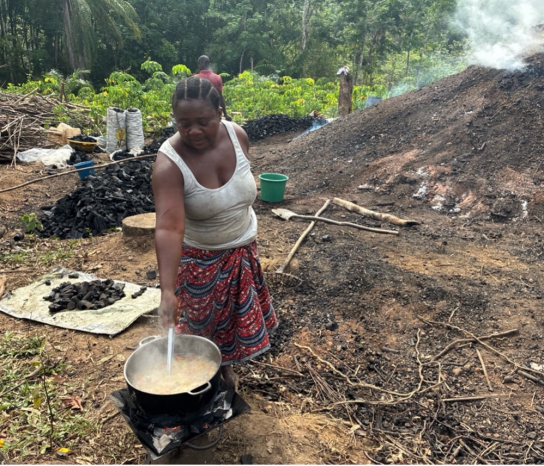
Their bodies burned with fever. Their eyes became red and swollen. One child vomited whenever he tried to eat.
Morris took them to the nearest clinic. But there is no cure for measles. Health workers can only manage the fever with paracetamol, and the World Health Organization recommends vitamin A supplements to reduce the severity and risk of death. At the clinic Morris reached, there was nothing.
Morris’s children survived but her oldest son, 13, lost a significant amount of his eyesight. Days passed before health workers arrived from Monrovia. By then, the outbreak had already done what outbreaks do when they meet communities without vaccines. It had taken what it came for and moved on.

About 45 minutes drive away in Garnos Town, Fatu Jarbateh’s body began to ache and she thought it was from hard work in the field beating palm and digging cassava. When the headache came and her body began to feel heavy, she waited.
Then her skin got hot. Red bumps spread across her body. Her eyes turned red. Soon her baby became sick too and she became scared. “We walk for two hour before we reach to the clinic,” she said. “No bike.”
At the Gballey Kamarah Memorial Clinic the pair were diagnosed with measles. Fatu could not say what the clinic gave them and the clinic refused to speak to FrontPage Africa/New Narratives directing all questions to the Ministry of Health. But Fatu said staff told her both she and the child might have died had they come later.
Fatu does not know anything about World Bank loans or co-financing agreements. But when asked what she thought about international partners cutting the funding that helps pay for vaccines in Liberia, her answer was clear.
“We will just die,” she said. “All of us.”
A New U.S. Health Compact That Does Not Buy Vaccines
There will be no help coming from anywhere else. The cuts come amid a massive pullback in aid. The United States’ Trump administration has made major cuts to global bodies including a more than US$1 billion from Gavi. The United Kingdom, another major donor, has cut its foreign aid budget by 40 percent. Gavi warns the cuts could leave 75 million children unvaccinated over the next five years and cause more than 1.2 million deaths.
Liberia’s health sector is also making a painful adjustment to a new five-year health agreement with the United States, worth $124 million, slashing U.S. health aid to Liberia by more than 60 percent according to the Center for Global Development. In recent years U.S. aid made up more than half of the roughly $200 million bilateral aid given annually to Liberia.
The full text of the agreement was never officially released and became publicly available only through a leak. Health advocates said they found no provision covering the cost of routine childhood vaccines.
Advocates are calling on the Liberian government to treat vaccine financing as a fixed obligation. They want the $1 million annual co-financing required by Gavi built into the national budget and released on time. They are calling for a joint monitoring committee made up of health ministry officials, finance officials, and civil society to track vaccine spending quarterly and publish the results. And they want the government to negotiate a clear transition plan with Gavi before donor support disappears entirely.
Rep. Julie Fartoma Wiah of Lofa County has been raising the alarm for more than a year, calling for a Legislative Caucus on immunization and primary health care. New Narratives contacted Rep. Wiah directly via WhatsApp to ask whether legislators have responded to her calls. She agreed to an interview date but then did not make herself available or respond to calls or messages.
Adolphus Clarke, program manager of the Expanded Programme on Immunization at the Ministry of Health, set two interview dates over a two week period. He did not make himself available for either.
New Narratives also contacted Dr. Sia Wata Camanor, interim director-general of the National Public Health Institute of Liberia, with questions about the outbreak in Kiangia Town, vaccination coverage in Todee District, and NPHIL’s preparedness for future outbreaks as donor funding declines. Dr. Camanor asked that the questions be sent in writing. New Narratives complied but Dr. Camanor did not respond before publication.
Back in Kiangia Town, the outbreak is over. Life has returned to what it was before January — but Rebecca’s grief is still overwhelming. Rebecca asks why the government could not have warned her to keep her grandchildren away from an outbreak that could take their lives.
“Before I came here my children were alright,” she said, wishing she could go back in time. “In the morning I will bathe them and they will just lay out here sleeping.”
This story was produced in collaboration with New Narratives as part of the “Investigating Liberia” project. Funding was provided by a private donor and the Swedish International Development Cooperation Agency. The donors had no say in the story’s content.