
By King Brown with New Narratives
Summary:
- 21-year-old Lovetee did not know breast milk is all babies under six months can consume. She fed her four-month-old daughter, Princess, soft rice and well water, and the baby is now dangerously malnourished.
- Health workers across the country say this is common. UNICEF found only about half of Liberian babies under six months are exclusively breastfed, and many caregivers wrongly believe infants need water or food to grow strong or stop crying.
- The problem is getting worse. A 2025 study saw a nearly tripling in cases of acute malnutrition, alarming health officials. They say USAID cuts have left them without first-line tools to treat malnourished children, meaning more will die.
- The introduction of fees for service at public facilities means many babies are born and die without ever being registered or getting any support.
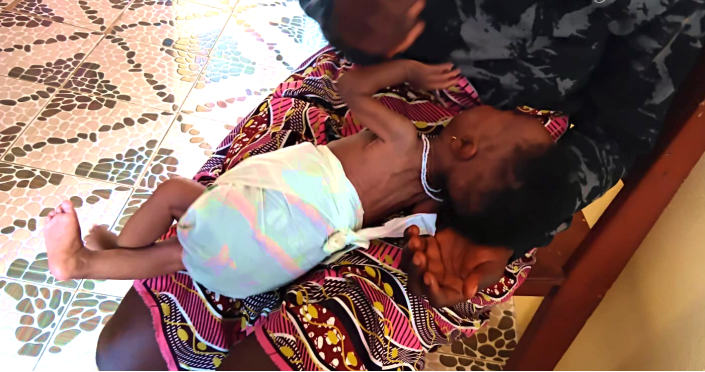
BUCHANAN, Grand Bassa County— The sun is hot here in Big Joe Town, outside Grand Bassa’s capital city. Lovetee, 21, sits on a wooden chair watching her four-month-old daughter, Princess, lying weak on her lap, suffering from diarrhea. Princess’s ribs show through her skin, and her hair is thinning instead of growing.
Lovetee, a first-time mother, has not eaten properly in days and she says she barely sleeps because Princess cries until morning. She has been feeding Princess soft rice mixed with soup, plus water from the open community well, a practice she learned from her brother’s partner. Lovetee says no one ever told her a baby under six months cannot eat food or drink water. Mother and baby are paying for that lack of knowledge.
“When my baby crying, my breath can want cut off, because she can just be breathing fast, fast,” Lovetee says. “Her stomach just running. She weak, weak in her body. To even lift her, I have to balance her neck with my one hand and her waist with my other hand before she break.”
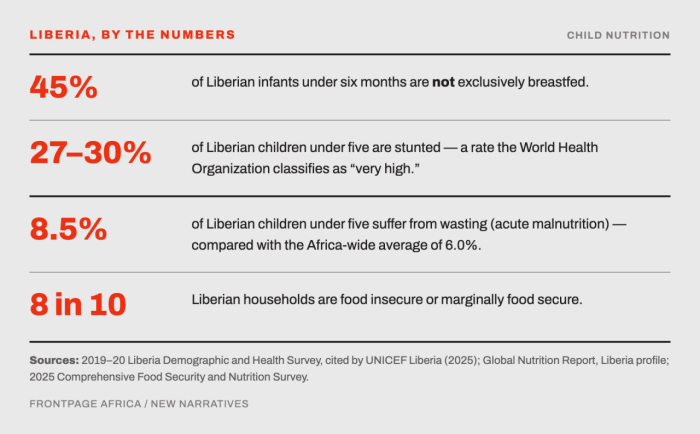
Experts say that knowledge gap, between what families believe and what a newborn’s body can process, sits at the center of a public health crisis playing out quietly in homes across Liberia. In 2020 – the most recent data – the Demographic and Health Survey found that 56 percent of young Liberians surveyed incorrectly believed babies needed water in their first six months, and 46 percent believed babies needed something beyond breast milk to grow strong. Only about half of Liberian babies under six months are exclusively breastfed.
A more recent survey is alarming public health experts. The 2025 Comprehensive Food Security and Nutrition Survey, not yet published online, found that 8.5 percent of children in Liberia, below the age of five years, suffer from acute malnutrition or wasting, a dramatic increase from the Demographic and Health Survey, which put the number at 3 percent.
Experts think the numbers are actually higher because they see women who have been told the dangers of giving infants food and water and do it anyway. Experts don’t trust that caregivers are telling survey takers the truth.
The problem is compounded by the introduction of fees and aid cuts. Lovetee wants to take Princess to the government hospital, but under the new policy, started in March, requiring all patients to pay for services at public health facilities that were previously free, she would need roughly L$500 upfront for a bed, plus money for medicine. Unemployed and single, she does not have the money.
Even if Lovetee got Princess to a health facility, nurses no longer have the “plumpy nut” nutrition boost and antibiotics that used to be provided with funding from USAID. All they can do is teach her to feed the baby breastmilk alone.
“If things are not handled within five to 10 years, it will lead to an outbreak [explosion of cases],” warns Samuel Moiwai, public health lecturer at Grand Bassa University.
A Body Not Yet Built for Food
According to the World Health Organization, for the first six months, an infant’s digestive system is built to process one thing: breast milk, since it supplies all the nutrients and fluids an infant needs. The only other thing they can take in is formula, but it must be prepared with sterilized bottles and clean water, often out of reach in rural areas.
But Debra Bah, a pediatric nurse in Buchanan, says she regularly sees babies under six months drinking plain water and eating softened family food, believing breast milk alone is not enough. It is a mistake, says Bah.
“When you give soft rice or water, the baby goes quiet for some time, so family believes the baby is satisfied, not knowing such silence can be very dangerous,” she says.
Solid food introduced too early can cause gas, diarrhea, a swollen abdomen, dehydration, respiratory infections and vomiting.
A father learns too late
Archiebald Moses, 33, says his partner grates and sun-dries eddoes bought at market, then cooks the powder as a daily meal for their five-month-old son, alongside breastfeeding. The baby is not doing well.
“I never heard from anybody before that giving young baby the food we are giving him is harming him,” Moses says. He says fathers should be included in nutrition education too.
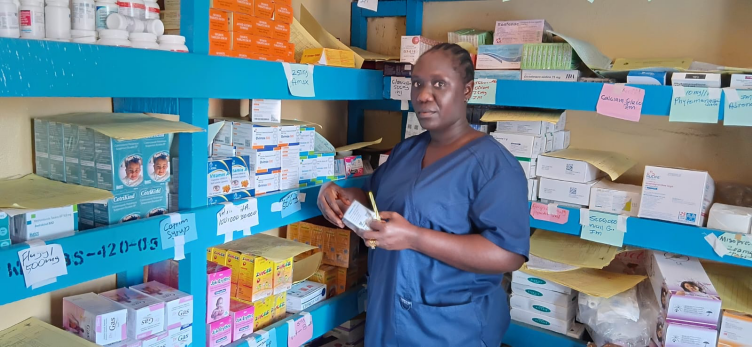
Joyce Albert Mitchell has screened babies at Buchanan’s Well Baby Clinic for five years. About 50 infants pass through weekly, and staff logs one or two malnutrition cases almost daily. She says the real number is higher since many rural mothers never reach the clinic.
The number of women giving birth in health facilities has hit more than 80 percent – a record high. There they are educated about breastfeeding. But Joyce says that guidance is constantly undermined by relatives insisting babies need water and food.
“Giving water to a baby is very dangerous. The child’s immune system is very small and weak,” Joyce says. “If the mother forces water into the child’s stomach, the gut will get filled, and the child will be unable to suck the breast milk well; the water already filled the stomach, it can cause damage for the child.”
Eunice Feekpah Bundor, a community health services supervisor and clinic screener, says giving babies water and food early is common and getting worse. She says some mothers start giving water almost immediately after birth; by one, two or three months, caregivers add fufu, dumboy, rice and other foods.
“Yesterday I received a patient; you could see the spinal cord, the skin dry, the face looked almost like an oldman’s face,” Bundor says.
Nearby health worker Rebecca Karr recalls a three-month-old who died after weeks of eating rice and drinking well water that led to diarrhea and fever.
“By the time they brought the baby, she could not drink or breastfeed,” Karr says. “We tried, but we could not save her.”
The staff worry that numbers may be higher. The babies being born at home without ever having their births registered can die and no one ever knows they existed.
Malnutrition doesn’t only shrink bodies; it damages brain development, lowers IQ, and delays walking and learning, says Sundayway Vungee, Grand Bassa County’s Nutrition Supervisor and a ten-year veteran of the Liberia Government Referral Hospital’s maternity ward. She worries about the next generation of children.
“For Liberia to flourish, our young generation coming up, they have to be well-nourished. When they are well-nourished, they will be able to think well, go to school, and pick up well.”
Traditional misinformation persists
Oretha Tukpeh is a face of the problem. The 55-year-old grandmother of six says her own children were given water and family foods, country rice, plantain, eddoes, and creek water from a young age, and none died or needed hospital care.
“People can hear plenty funny things in the city,” she says, laughing. “But in the bush, you will not hear it, don’t give the baby this one, give the baby that one.”
Vungee says old habits are especially hard to change among teenage mothers as young as 12 who are too young to understand the gravity of raising a baby and are vulnerable to grandmother’s messages. (One in three Liberian girls is pregnant before 18, one of the highest rates in the world). Vungee says some discard the deep-yellow colostrum produced right after birth, believing it unclean, though it is dense with the antibodies newborns need most. Many lack support from the baby’s father, making breastfeeding harder.
Joanna Fahwor, who runs an organization supporting single mothers in Grand Bassa, says many mothers she works with were told by relatives that breast milk was “weak” and that water, rice, eddoes and oatmeal would make babies “strong.”
One case has stayed with her, a two-month-old girl who, within a week of starting solid food, developed severe diarrhea and skin sores, her weight dropping so fast her clothes hung off her. She says the baby later improved after clinic treatment.
The county runs nutrition programs at 18 health facilities and 25 mother-support groups around Buchanan. But programs have been crippled by aid cuts. The therapeutic food supplies known as “plumpy nut” and antibiotics supplied to treat severe malnutrition that used to be supplied by USAID have run out.
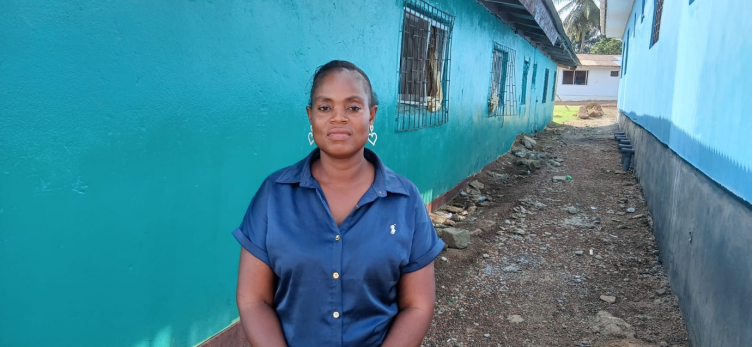
“Most of the children are dying because of no product in the country,” she says.
Liberia is not alone in facing these challenges, but some countries have achieved far higher breastfeeding rates. UNICEF reported that up to 87 percent of Rwandan mothers exclusively breastfed in 2019, aided by national campaigns, evidence that public education and supportive policy can make a difference.
Back in Big Joe Town, Lovetee frets as she watches her daughter fade. The tragedy is that she along with thousands of other mothers, had the means to help her child thrive, for free, but for now, she lacks the knowledge.
This story is a collaboration with New Narratives. Funding was provided by the Swedish International Development Cooperation Agency. The donor had no say in the story’s content.