

By Nemenlah Cyrus Harmon, climate correspondent with New Narratives
Summary
- Women and children are at the center of Liberia’s growing hunger crisis, according to experts, driven not by war or famine but by deep poverty, absent fathers, teenage pregnancies and fragile livelihoods, with many surviving on one meal a day.
- Malnutrition remains widespread despite signs of improvement, with Liberia ranked 112th of 123 countries on the 2025 Global Hunger Index; health workers report rising cases of severely malnourished children, even as government officials say newer data shows gradual progress.
- Female-headed households are especially vulnerable, as women working in informal jobs often skip meals to feed their children, while charities and feeding centers struggle to fill gaps left by weak social protection and limited employment opportunities.
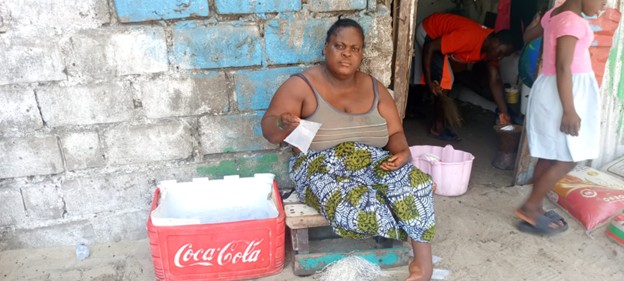
WEST POINT, Monrovia – Favor James wakes up every morning thinking about water. Not drinking it but selling it – cold water in plastic bags that she hawks on Kru Beach here in the capitals’ largest informal settlement, for a few coins.
Born with limited use of her legs, the now 44-year-old has been doing this long enough to know the math by heart: three sacks of ice water bring in $L150 on a good day. Just enough to buy a few cups of rice for the seven mouths she feeds.
“We can eat only one time, only in the morning,” James said with a weary voice, “I can feel bad, but what to do?”
Across Liberia, a crisis is unfolding in slow motion. While war and Ebola once made headlines, a quieter disaster now grips the country: mothers and children going hungry. Not from famine or conflict, but from poverty so deep it has become the water they swim in.
According to the 2025 Global Hunger Index, Liberia ranks 112th out of 123 countries, showing a “serious” level of hunger. The Index found one in every three Liberians is undernourished. One in every four children under five are stunted.
The Index uses data from national governments and various UN and other multilateral agencies to assess the state of hunger and malnutrition globally, regionally, and nationally.

James’s husband, a fisherman, disappeared into the Atlantic Ocean in 2014. His body was never found. Their four children, the youngest now 13, no longer attend school. When the water doesn’t sell, the children scavenge for plastic to trade for a few dollars. Some days, they eat only gari, a grainy cassava flour, mixed with sugar.
“I need help,” James says. “I want place where I will lay down; I will not pay rent.” She currently pays $L1,000 a month ($US5) for a sleeping space. She begged the landlord to reduce it from $US10. Still, it’s too much.
The Invisible Emergency
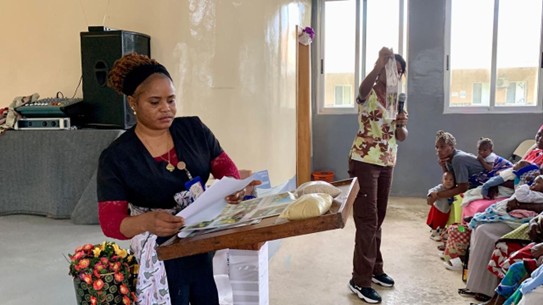
At the ELWA Hospital nutrition department, Satta S. Goteh, a physician assistant, sees proof of undernourishment every day. Since January, the program has treated more than 1,200 cases of severe malnutrition in children under five. Though she doesn’t have data for the year before she says this year is worse.
“There’s no war fighting in our country; no crisis,” Goteh says. “But we see our little ones… getting malnourished.”
Experts say the reasons for growing undernourishment are many: Climate change is driving subsistence farmers – 80 percent of whom are women – from fields into cities and mine sites or into environmentally destructive livelihoods like charcoal production and trafficking scams.
A population with low information about reproductive health and birth control is growing at one of the fastest rates in the world. Slow economic growth and the withdrawal of aid money has also added to economic struggles.
Teenage girls having babies before they’re ready and fathers who vanish when responsibility calls, keep women and children in poverty. Grandparents are too old and poor to raise another generation. And everywhere, grinding poverty makes feeding a family feel like an impossible math problem.
Here on the crowded beaches of West Point, Korpo Kollie has been solving this math for nearly a year. She wakes before dawn to fry pepper Kala—small, spicy fritters she sells for spare change. The routine is simple but exhausting. She makes just enough to feed her four children one meal on good days. On bad days they survive on scraps. Three of them no longer go to school.
“When they not buy like that, the community other people can cook and give me food for my children,” says Kollie, whose children’s father disappeared about two years ago. “Things are hard because we, the single parents where we not get help from anywhere.”
Her dream is simple: “I will want them educate my children; that’s the first thing.”
Boakai Government Says The Benefits of Investments Are Coming
Officials at the Ministry of Agriculture say the global index is lagging behind recent progress on the ground. The ministry says the Boakai administration has expanded cultivated land from 244,000 hectares in 2024 to 250,000 hectares in 2025; increased local rice output slightly to 273,852 metric tons in 2024, and is targeting an additional 50,000 hectares for production.
Farmers received improved seeds, fertilizer, and up to $US1,000 per hectare under the Emergency Rice Production Offensive project, alongside expanded extension services and mechanized farming. It has also deployed more district agricultural officers and crop technicians, introduced mechanized farming to boost efficiency, and improved road access to reduce transport costs and enhance food distribution
“The Global Hunger Index is not false,” says Francis Mulbah, assistant minister for planning and development at the Ministry of Agriculture. “But it does not represent the current reality, because it relies on data collected between 2022 and 2024.”
For the first time in years, Liberia has completed a comprehensive Food and Nutrition Security Survey, as part of a regional framework used across West Africa to assess food insecurity. According to Mulbah, these assessments paint a more encouraging, though still fragile, picture.
The survey found nearly five out of ten households spend more than 65 percent of total income on food alone but national food insecurity, he said, has dropped from 47 percent in 2022 to 20.7 percent in 2025. More than 33,000 Liberians have transitioned from food insecurity to food security since the 2022 baseline.
But thefood security indicators collectively signal that the majority of Liberian households remain economically fragile and unable to consistently access diverse and nutrient-rich diets.
“This does not mean hunger has been eliminated,” Mulbah says. “But it shows improvement-real improvement backed by evidence.”
Women On The Frontline of Hunger
Women play a central role in Liberia’s food system, as farmers, traders, caregivers, and household managers. Yet they are also among the least protected.
A Front Page Africa/New Narratives survey in 2024 found that as climate change has changed weather patterns, traditional farmers with no access to irrigation or weather forecasts, are growing less food. More and more have turned to other livelihoods like charcoal production and rock crushing.
Many women interviewed by Front Page Africa/New Narratives said they routinely skip meals so their children can eat. School fees are no longer an option for many families.
“Life is very tough,” said Massa Kollie, a farmer in Bomi who has turned to soap making to cater to her family. “These days, to even send your children to school, you have to struggle, so I am mixing caustic (soda) to fix soap so my children can sell tomorrow at least to get little thing for the home to go on.”
With No Government Help Private Citizens Are Stepping In
Across the country good Samaritans and the diaspora are stepping up to fill the void. Ne-Suah Beyan-Livingstone started Rescue for Abandoned Children in Hardship here in a Monrovia community after the Ebola epidemic left orphans wandering her neighborhood.
Every Saturday, her organization feeds 400 children. The line forms early.
“If we had too many opportunities of employment, our feeding station would have closed our door,” Beyan-Livingstone said. “So many parents would not be asking us for scholarships and other things.”
Since 2014, she has sponsored the treatment of 75 cases of severe malnutrition. Some children survived. Some did not.
“At first look, nobody would ever have imagined that some of these children would have survived,” she recalls. Most came from teenage mothers or grandparents who couldn’t afford infant formula.
Malnutrition brings a cascade of health problems that can last a lifetime including stunted brain development, lower IQ, impair memory and learning, increase developmental disorder risk, and reduce lifetime earning potential.

Helena Wenneh, who runs Destined Kids Assistance Program in Paynesville, for disabled women and children, sees another layer to the crisis. Liberia has low levels of sexual reproduction education, especially for girls who don’t go to school. Girls as young as 12 are getting pregnant, she says, often through rape. And they are giving birth without support. Often the babies are at risk because their mothers do not know how to care for them.
“Those people reaching that point of giving birth to a child, they are not ready,” Wenneh says. “Even the guys that give them the pregnancy, many times, they run away.”
For women living with disabilities the challenges can be even more extreme. As many as one in five Liberians live with disabilities. Many have been forced to beg in the streets. If people don’t give them enough money one day, their children simply don’t eat.
Advocates Urge More Government Action
Health workers, parents and advocates who spoke for this article agreed: the government must act faster. A tidal wave of problems is threatening to overwhelm Liberians. The country has laws about child protection and welfare, but enforcement is weak. Safe homes for abused children are overwhelmed. Public schools are not delivering.
“The government has a responsibility to protect, defend the citizens,” Wenneh insists. “They must do something.”
Goteh recommends investing in family planning, helping communities grow their own food, and paying attention to teenage mothers who lack the knowledge and resources to feed their babies properly.
“It is good for us to really grow our own food,” she says. “The organic food is very important. It helps fight malnutrition by providing nutrient-rich produce with no harmful side effects from pesticides compared to non-organic food.”

The Future in the Balance
On Thursdays and Saturdays, when Livingston’s Rescue for Abandoned Children opens its feeding program, hungry children line up by the hundreds. They are proof that Liberia’s recovery from war and disease remains incomplete.
“When a child dies, you say the biological parents cannot take care of the child,” Beyan-Livingstone says. “What comes to my mind is that Liberia is brain draining. You just don’t know the future of the children who are dying from malnutrition.”
Back on Kru Beach, Favor is already thinking about tomorrow. Another day of hauling sacks of ice water. Another morning meal to scrape together. Another rent payment may not be able to afford.
The ocean that took her husband stretches endlessly before her. Somewhere in those waves is the life she used to have. Now there’s only the water she sells, the children who wait, and hunger wearing a mother’s face.
This story was a collaboration with New Narratives as part of the Investigating Liberia Project. Funding was provided by the Swedish Embassy in Liberia. The funder had no say in the story’s content.