
By Joyclyn Wea, gender correspondent with New Narratives
Summary:
• Ellen Johnson Sirleaf, Liberia’s former president, said the country should be ashamed that only 11 women serve in the 103-seat Legislature, a fact that is holding back the country’s development and peacebuilding.
Advocates welcomed the president’s words, saying the low number reflects an unwillingness for male lawmakers to make room for women and to see women as equals.
• They also said Liberia should build gender equity first by intentionally opening more leadership spaces for women before expecting equal political results.
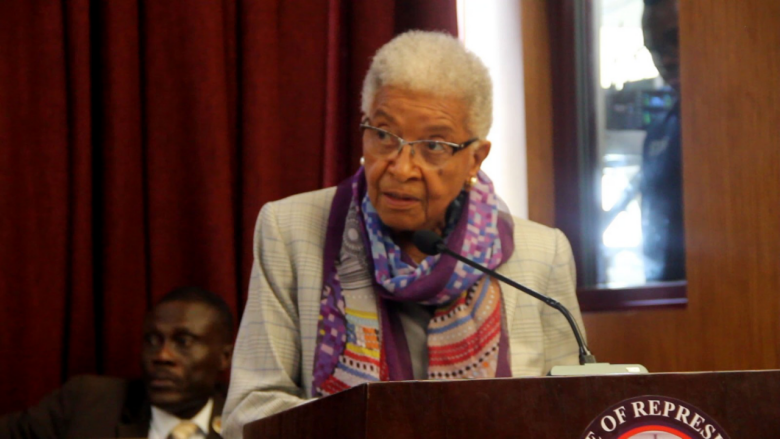
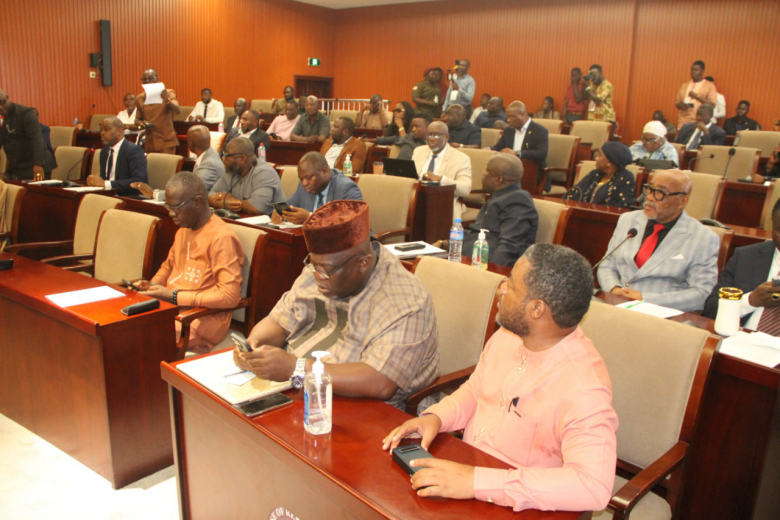
CAPITOL BUILDING, Monrovia – The chamber was full when former president Ellen Johnson Sirleaf rose to speak here on Thursday. But what she focused on was not who was in the room: It was who was missing.
In a country where women helped push for peace, carried communities through war, and once lifted Africa’s first elected female president to power, Sirleaf said Liberia still has far too few women making laws. There are just nine women in the 73-member House of Representatives and two in the 30-seat Senate. With less than 11 percent of seats held by women it is one of the lowest rates in Africa.
“It embarrassed me and every woman in Liberia and around the world,” Sirleaf said, angrily condemning the lawmakers, most of whose political parties had failed to put more than a handful of women up for winnable seats. “And I hope it embarrassed you, too.”
Her words reopened a question Liberia has not fully answered since the end of the civil war: why, after decades of praise for women’s role in peace and democracy, are women still largely shut out of political power?
Liberian women were central to ending the civil war. They organized, protested, and pushed men toward peace. Nearly 20 years after Sirleaf broke one of the biggest political barriers in Africa, women’s presence in the Legislature remains marginal. For advocates and women leaders, that is not just disappointing — it is evidence that the system has not changed. And that is hurting all Liberians.
Research consistently shows that the countries with the strongest economies and most equitable societies — from Scandinavia to Rwanda — are also those that have deliberately placed women in positions of political and economic power.
Mmonbeydo Joah, lawyer and women’s rights advocate, said the message the low numbers of women across the government sends to young women and girls is dangerous.
“We’ve been told all our lives that we can’t do this; you can’t do that as a woman,” she said. “We need to remove the fear.”
Daintown Doman Pay-beyee, a former representative aspirant and ex-director of Liberia’s Disability Commission, welcomed Sirleaf’s intervention. She said more women in decision-making would produce stronger policies on education, justice, employment, health, and protection from violence.
“Once women are in decision-making, it helps to ensure that other women are not afraid to come to the table,” she said.
Amelia Siah Siaffa, acting executive director of Sister Aid Liberia, said decisions about women’s lives are incomplete without women in the room. “That decision is not absolute if it does not reflect the presence of the demographic for which the decisions are being made.”
But getting women into the room has been a major challenge.
A 30 percent Legisture gender quota, discussed for 20 years, has never been made enforceable. First introduced in 2005 through party registration guidelines, the requirement was weakened by 2014 to language urging parties only to “endeavor to ensure” 30 percent women candidates — with no accountability mechanism. A stronger bill that would have made the quota mandatory and empowered the NEC to fine non-compliant parties passed the House of Representatives in 2022, but was vetoed by then-President Weah, who said it conflicted with existing constitutional provisions. Ahead of the 2023 elections, 25 parties signed a voluntary MOU committing to the threshold — and still failed to meet it. Advocates are now pushing for a binding law before the 2029 elections.
In the 2023 elections, only 85 of 533 registered aspirants — 15.9 percent — were women, according to reports based on National Elections Commission data. Just two smaller parties met the 30 percent threshold.
“If we don’t ensure that women are on political parties’ tickets, we cannot achieve that 30 percent,” Joah said. “We need women at all levels of government, and ensure the same opportunities that provide for women in leadership are protected.”
Advocates said parties routinely use women during campaigns while keeping them away from real power. “They still see women in the context of being in the kitchen,” said Pay-beyee. “Not in executive positions that make decisions.”
Siaffa said women are pushed into “women’s wings,” where they mobilize voters but are excluded from major decisions. “The women’s wings do not have a lot of significance when it comes to decision-making. But when it comes to the campaign processes, that is when they are most needed.” She said the conversation about representation cannot wait until election season. “It has to start from what the political party’s operational framework document says about gender.”
Joah called on the National Elections Commission to go beyond observation — demanding stronger monitoring and accountability to ensure women are placed in winnable seats, not just added to party lists to meet the appearance of compliance. “Sadly, the parties that put more women on their party list are those that are not relevant,” she said.
Advocates said the continued underrepresentation reflects three forces working against women simultaneously: fear, cost, and the tendency of voters — including women — to favor male candidates.
“Election is very, very expensive,” Pay-beyee said, describing the financial barriers facing women candidates, particularly women with disabilities.
Siaffa pointed to another hard truth: women drive campaigns for men but do not always treat women’s representation as an urgent priority. “Women are electing men, women are campaigning for men,” she said. “If this is truly our goal and our desire for equal representation, we are going to achieve it in solidarity.”
Advocates said the Legislature is only the most visible symptom of a wider failure.
Lawrence Yealue, chairperson of the National Civil Society Council of Liberia, drew a distinction between equity and equality that cut to the heart of the debate. Formal equality — identical rules for men and women — has not worked, he argued, because it ignores the structural barriers that prevent women from reaching the starting line in the first place.
Yealue said the gap begins in homes, schools, communities, and workplaces. He said girls need stronger support in education, women need protection from public bullying, and the country must start building a leadership pipeline long before election day. He criticized party structures — women’s leagues, youth wings — that can isolate people from real power rather than bringing them into it.
“It’s a deliberate exclusion issue,” he said. In his view, Liberia talks too much about equality before doing the harder work of equity: scholarships, appointments, legal protection, and intentional placement of women in visible positions of authority. “The first conversation is gender equity,” he said. “Then we follow it with gender equality.”
Advocates said the problem extended to law enforcement and the judiciary. A shortage of women judges, magistrates, and county attorneys — particularly in rural areas — means that women survivors of domestic violence and sexual abuse are routinely forced to seek justice from institutions where no one in the room looks like them, understands their experience, or is likely to prioritize their safety. When women don’t get justice their lives are often destroyed and they are unable to recover.
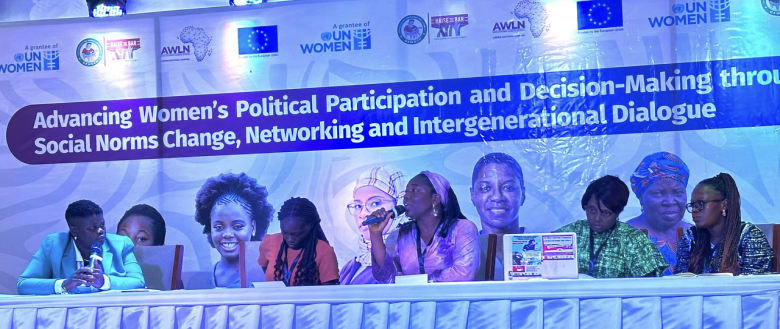
Advocates Say More Women in Office is the Key to Changing Systems That Exclude Women
Advocates said Sirleaf’s powerful rebuke shifted the pressure from women back where it belongs — onto lawmakers, political parties, election officials, civil society, and voters.
The test now is not whether leaders agree with Sirleaf. Many already claim to do so. The test is whether they will act — whether male leaders in parties will be willing to step aside to make room for women, and whether voters, especially women, will decide this issue is urgent.
This story was a collaboration with New Narratives as part of the Investigating Liberia project. Funding was provided by Susan and David Marcinek and the Swedish Embassy in Liberia. Funders had no say in the story’s content.