
By Tetee Gebro, New Narratives health correspondent
Summary :
- A 57-year-old grandmother says a 24-year-old security guard raped her at a mining site near Penson Town, rural Montserrado.
- The victim and community members say police and court officers demanded money at multiple stages of the case, including for medical referrals and transporting the suspect to prison.
- While judicial system procedures say rape survivors should not pay, advocates warn that rules are being ignored, leaving poor rural women to face steep barriers to justice.
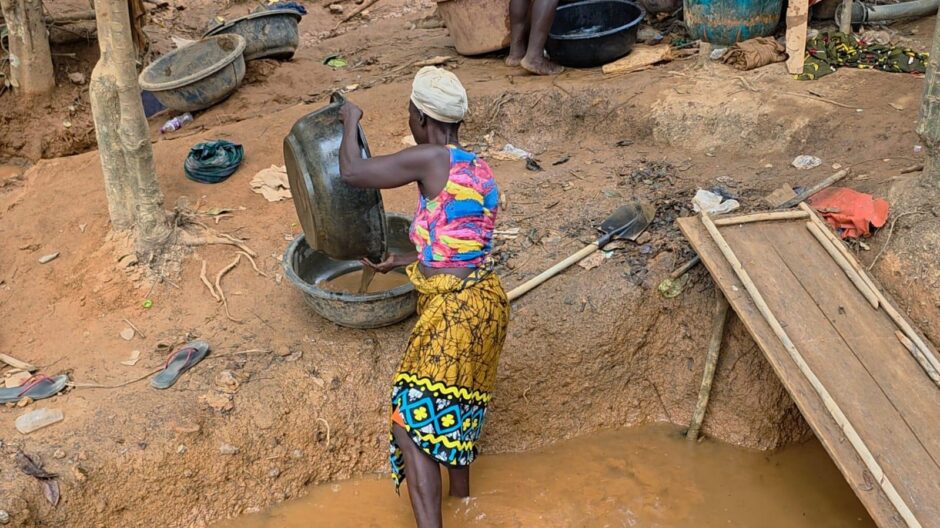
PENSON TOWN, Montserrado – It was the end of another long Sunday morning for this grandmother, panning through mud in a stream here trying to find enough specks of gold to feed her eight grandchildren. As she walked into the bush on her way to the site with her youngest grandson, aged three, her mind was on the $L1700 ($US9) she had made that day.
The woman—whom New Narratives is calling by her first initial “E.” to protect her identity, says she did not notice that a 24-year-old security guard from the mine site had followed her until he approached.
“He told me, ‘I want you,’” she recalls speaking in Liberian English, in an emotional interview. “I told him, ‘You and my grandchildren are equal. Don’t tell me that thing.’ He said, ‘Since I talking to you and you don’t want agree, I take it by force.’” He pushed her to the ground in front of her grandson knocking over the gold speckled sand she had collected. She fought, but the man was stronger.
E.’s grandson ran toward town crying for help. An elderly man arrived and shouted at the attacker. But it was only when a strong young motorcyclist approached, E says, that the man finally jumped off her.
E’s first ordeal was over but Liberia’s justice system was about to deal her another. In her quest to obtain justice E. has had to pay illegal fees to police and court officials, endured humiliation and confusion. Advocates say her case has been a window into the many obstacles it takes for a rape victim to obtain justice in rural Liberia.

The Gender Ministry has a SGBV Crimes Unit but it operates on a limited budget and survivors are frequently asked to cover basic costs themselves. Each request for money becomes another reason cases stall or are abandoned. For women like E., who live by small-scale mining justice often depends not on the law—but on who can afford to pursue it.
Liberia’s Sexual Offences Act Court (Court E) and the Sexual offenses division of the Circuit Courts state clearly that “no ministerial officer, or other personnel of the Sexual Offences Court and the Sexual

Offences Divisions shall charge or collect any fee from … any officer thereof acting in an official capacity,
for any services rendered in any criminal cases, nor for the filing, recording or indexing of any official
paper or other document, or for furnishing a transcript, certificate.”
But E. faced fee after fee. Her alleged attacker ran away but community members caught him and
turned him over to the police. Penson Town community wants to see E.’s attacker held to account.
Leaders here helped her as she hit roadblocks.
Samuel Towah, the interim town chief, says the case moved through several police stations and courts,
and at nearly every stage, officials asked for money—for hospital referrals, paperwork, and
transportation.
At the Careysburg court, Towah says, they were told they needed $L4,000 ($US30) to transport the
suspect to South Beach Central Prison in Monrovia. “They said if I don’t pay, the man will not go to
South Beach,” E. says. “I cried on them. They insisted.”
“The town people collected small-small—some 50, some 20 Liberian dollars—just to raise the money,”
Towah says. It took two days to raise the money to send the suspect to prison.
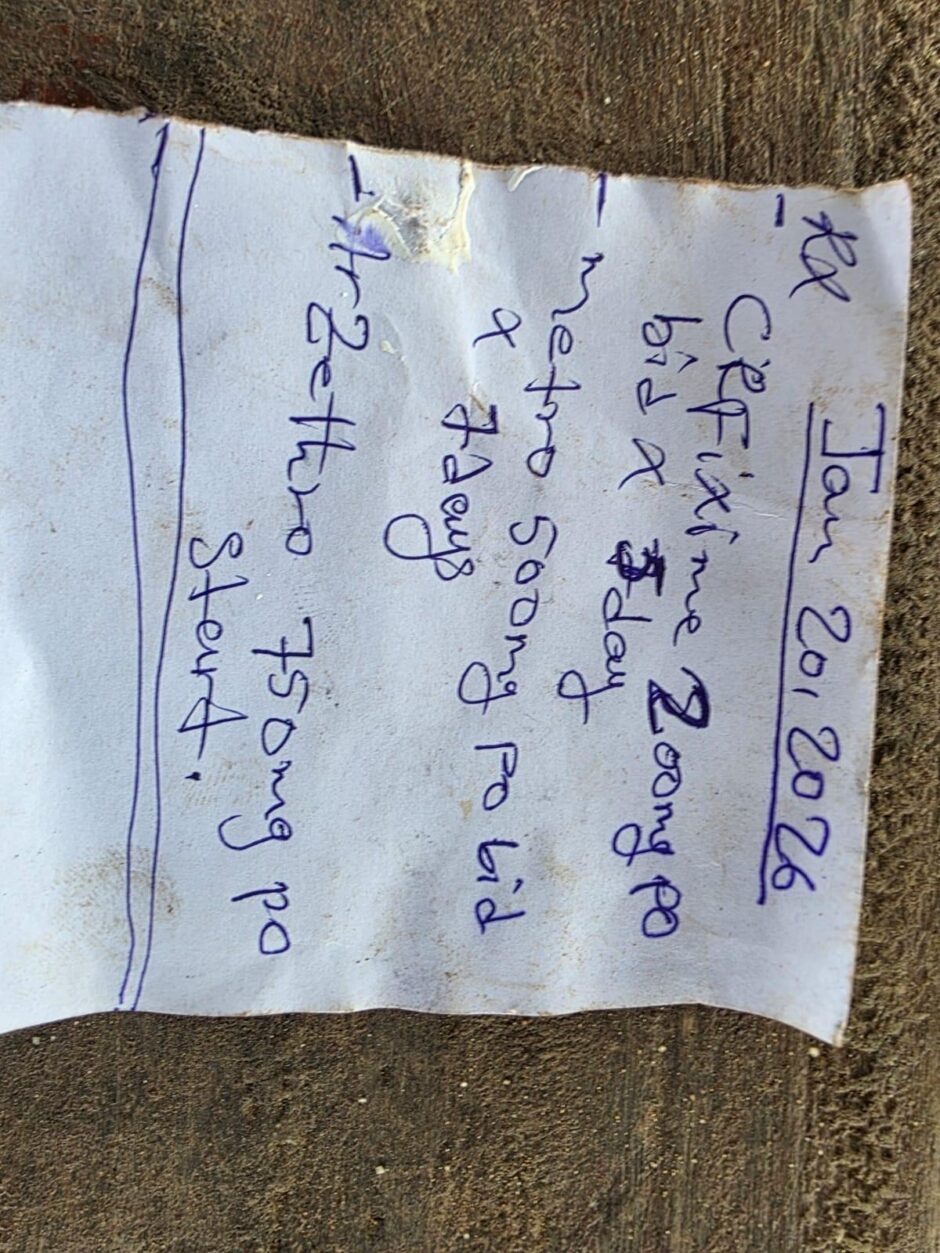
E. says she was asked to pay an additional $L500 Liberian dollars so the suspect could sleep overnight in
a police cell while they raised the money to send him to South Beach.
E. said a court officer named Edwar Gehson gave her this slip of paper with his number to send the
mobile money payment
An Under Resourced Gender Ministry Struggles to Apply The Law
“Procedurally, it is wrong,” said Isaac L. George Jr., director of the Justice Ministry’s Sexual and Gender-
Based Crimes Unit, in an interview of the fees E. faced. He promised an investigation and said any
money taken from the woman should be returned.
But he also described a system struggling with severe shortages, especially in rural areas. He said the
SGBV Crimes Unit receives about $US12,000 a year to handle cases across the entire country—an
amount he called far too small.
Victims’ advocates agree. They are demanding government devote more resources to the issue.
“The government has the primary responsibility,” said Williette Arthur, of the Organization for Women
and Children. “Civil society can support and advocate, but survivors should not suffer because funding is
low or attention is not there.”
“I don’t know how to read the paper”
E. faced other barriers. After the assault, she says police told her she needed a medical exam to show
she was attacked and treatment for her body. She was first sent to NIZO Hospital in Monrovia, and later
to Duport Road clinic’s one stop center, where rape victims are examined and treated after the crime.
E. says she underwent an examination and was give some pain killers. She was also given a list of
antibiotics to buy – a common mix prescribed for suspected or confirmed sexual transmitted disease
when a lab result is not available. She does not know if a report was sent to the police.
But like most women in rural Liberia she does not know what the papers say.
“I don’t know how to read and write,” she says quietly.
Victims’ advocate Williamette Arthur says Liberia’s police and the ministries of justice and gender have
failed E. at every step. She says survivors should receive a basic support package that includes medical
care, counseling, legal support, and safe housing.
“The government should have clear guidelines for survivor support,” she says. “Support must be
documented and transparent, so it does not look like hush money or influence the survivor’s decision in
court.”
“There is a provision in the Domestic Violence Act of 2019 that talks about compensation for survivors
by perpetrators,” Arthur said. “These laws must be enforced, not ignored.”
E. is still recovering and waiting to hear from the court about next steps. Three weeks ago the court told
her they would call her when they are ready. On Monday Isaac George of the gender ministry said he was yet to contact E. and did not know the status of the case.
This story was a collaboration with New Narratives as part of the Investigating Liberia project.