
By Anthony Stephens, senior justice correspondent and New Narratives editors
Summary:
- A grand jury in Monrovia has indicted 11 people accused of trafficking and stealing from 57 victims in Liberia’s largest human trafficking case to date.
- The indictment followed a FrontPage Africa/New Narratives investigation that exposed allegations that bribery had led police investigators to drop or reduce charges.
- The case brought international scrutiny on the government over its failure to combat human trafficking scams as more and more Liberians are caught up in them.
A grand jury in Monrovia has indicted 11 people accused of operating a sprawling human trafficking ring that prosecutors say lured dozens of Liberians with promises of jobs abroad before holding them captive, extorting money from their families and subjecting some victims to rape and torture.
The indictment comes two months after a FrontPage Africa/New Narratives investigation exposed victims’ allegations that lawyers and police investigators had taken bribe payments to undermine the case. Delays in prosecuting the case looked likely to give the perpetrators the right to apply for bail after which they were expected to vanish as accused trafficker Cephus Selebay did in a similar case in 2022. The case is the largest human trafficking prosecution in Liberia’s history.
The investigation shone a rare spotlight on the corruption that plagues Liberia’s justice system and undermines confidence in the rule of law. It gave credence to victims claims that justice is only available to those who can pay.
It also came as researchers at the U.S. State Department are finalizing their annual Trafficking in Persons Report. Liberia has spent the last two consecutive years on the Tier-2 watchlist. A third year could mean a cut in U.S. funding.
Leading human rights advocate Tiawan Gongloe condemned the government’s failures in the case.
“If the government really has a political will to act, it can,” said Tiawan Gongloe, a former solicitor general. “There are trained people in the law enforcement agencies of Liberia to actually do it if there’s a political will from the top, from the Ministry of Justice, from everywhere. In fact, if the president is involved, that makes it stronger, because when the president of the nation says ‘This is a serious matter that affects my citizens,’ everyone will take it seriously.”
After the investigation was published Oswald Tweh, the justice minister, and the spokeswoman for President Joseph Boakai did not respond to requests for comment. But victims said prosecutors had retaken statements under the supervision of Sumo C. Kutu Akoi, the lead anti-human trafficking prosecutor.
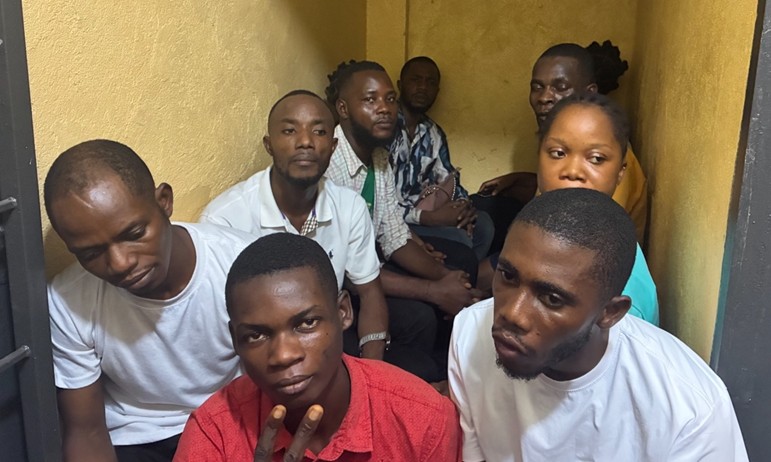
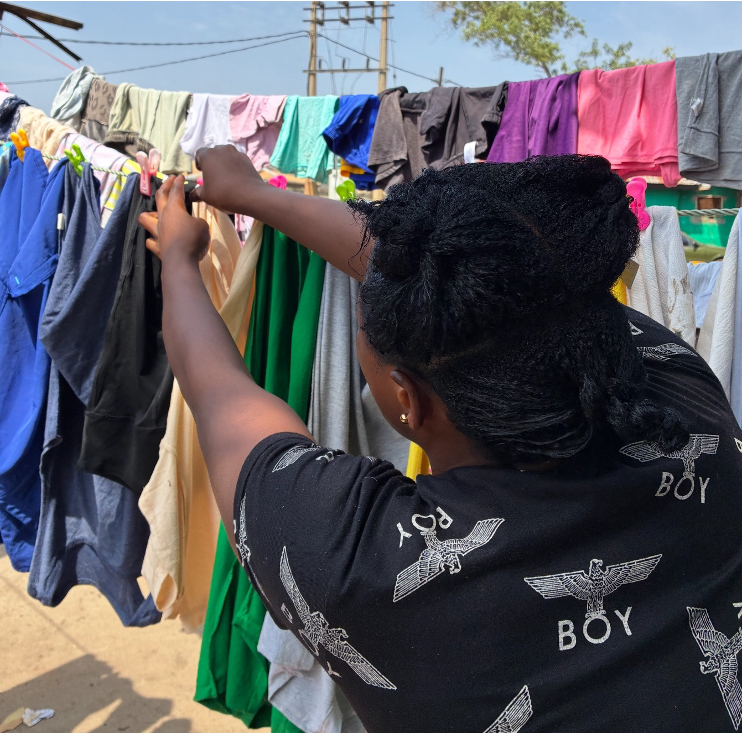
According to court documents, the victims — 22 women and 35 men recruited from seven of Liberia’s 15 counties — were promised jobs in Canada or Australia. Instead, prosecutors say, they were taken to a fenced compound in Gbankpa Town, near the residence of Vice President Jeremiah Koung along the Roberts International Airport highway, where they were allegedly detained for up to a year, beaten, starved, sexually assaulted, forced to call relatives to send money and in many cases, coerced to recruit their relatives and loved ones.
Most were financially devastated by the crimes. One woman from Nimba County told FrontPage Africa/New Narratives she had sold her farm and everything she owned to raise $US16,500 to give to traffickers. Another had been forced to lure her brother with false promises that she was happily in Canada. Now their mother was on death’s door hounded day and night by debt collectors seeking repayment for money loaned to send them abroad.
In their unanimous decision, the grand jurors concluded that it was “more probable than not” that the defendants had “committed the crime of trafficking in persons, a felony of the first degree.” The indictment alleged that the accused “willfully, knowingly, intentionally and purposely agreed, conspired and extorted a total of $US124,921” from the victims between 2024 and 2025.
“The victims were coerced by the defendants to call their relatives to pay additional money to the defendants,” the indictment said, describing the acts as “slavery-like practice/labor exploitation.”
The indictment also seeks nearly $US200,000 in restitution under Liberia’s revised anti-trafficking law, including compensation for ongoing medical and psychological treatment, rehabilitation expenses already incurred by victims and their families, and emotional distress and suffering that prosecutors said continued long after the victims escaped the compound.
All 11 defendants — Bill Plato, Wuo Zekarso Garteh, Preston Godfred, Maxson Wonlebaye, Jerome Genseh, Luther Flomo, Alexander Plato, Madthianline Tompia, Shalley Jonny, Blessing Favior Suah and Stanley Wonlebaye — were indicted on charges including trafficking in persons, theft of property and criminal conspiracy. Three – Plato, Garteh and Wonlebaye -were indicted on rape charges. An additional 11 suspects remain at large, according to the indictment.
FrontPage Africa/New Narratives reported that police initially charged only five of the 11 defendants with Trafficking in Persons – the most serious of the charges which carries a minimum 20-year sentence and does not allow bail. Just one defendant – Bill Plato – was charged with rape.
Three defendants —Marthaline Tompia, Shelley Jonny and Blessing Favor Suah — who had been accused of torture, trafficking and theft by multiple victims – did not appear on the original charge sheet at all.
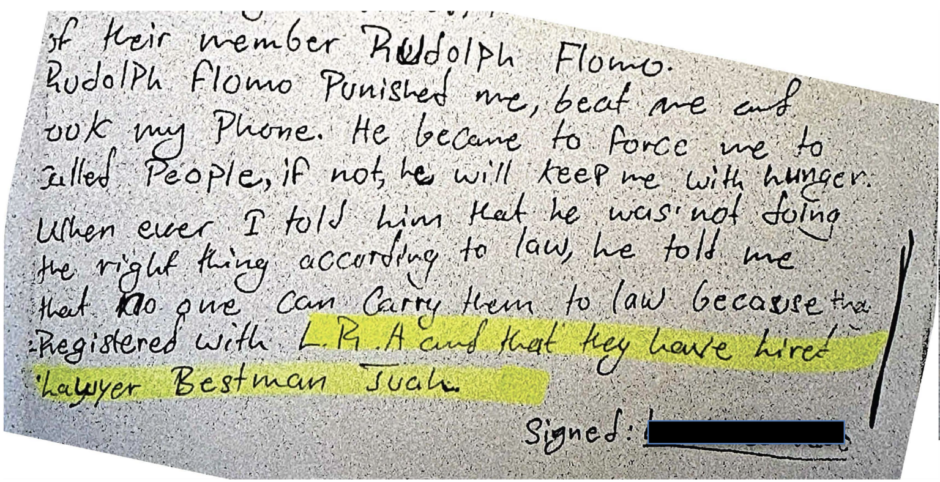
Victims said they believed they knew why charges had been dropped or reduced: Nine victims told police investigators and FrontPage Africa/New Narratives that their alleged captors had been openly contemptuous of the justice system. Police were “in the business,” they were told. Their captors “owned the government.” They said the alleged traffickers told them a public defender named Bestman Juah was taking $500 a week to keep them free. They said a prosecutor had told them that Juah had offered him a $7000 bribe to reduce the charges.
When he refused the bribe, victims suspected police had taken it. Enoch Dunbar, who leads the Liberia National Police Trafficking in Persons desk, and Emmanuel S. Walker, an investigator, took the victims’ statements but reduced and dropped the charges from the original charge sheet.
One of nine victims’ statements to police that name Bestman Juah as the lawyer for the traffickers. (The victim’s name is redacted for their security.)
In WhatsApp messages to New Narratives in March Juah, Dunbar and Walker strongly denied they had taken any payments.
In the grand jury indictment Trafficking in Persons, Theft of Property and Criminal Conspiracy charges were restored against all defendants. Garteh and Wonlebaye had rape charges restored.
For the victims, the indictment represented a rare sign of hope in a case they feared had stalled indefinitely.
“Right now, I am feeling a little better,” said L., a rape victim in the case whom FrontPage Africa/New Narratives is identifying by her initial to protect her from retaliation. “Since we started the case, we’ve been going to court again and again, and we weren’t hearing anything good. But at least this past Wednesday, we were able to reach the grand jury. I feel a little better because the case has taken long.”
Another victim said the indictment had changed his perspective about Liberia’s justice system, “especially for the poor,” though “from our point of view, we thought the case should have started long ago.”
“I am excited,” said a prosecutor involved in the original case, whom FrontPage Africa/New Narratives is identifying only by their middle initial, T because of a fear of retaliation. “Justice is not always conviction. But the voice of the victim must be heard before a court, and the court must make a fair determination.”
A statement to Liberia’s police by a victim that they were told by their alleged captors Bestman Juah is their lawyer. A sign in Liberia’s judicial complex warning against bribery.
A new court term began on May 11. T. said investigators had gathered extensive corroborating testimony and evidence.
“That story is corroborated by everyone we spoke to,” the prosecutor said. “I think we have a case we can prove, and these guys will be held accountable for their actions.”
Victims said they are ready for the case.
“We are willing 100 percent to testify,” Z. said. “That’s what we’ve been pushing for.”
Liberia has struggled for years to secure convictions in trafficking cases. Between 2023 and 2024, the government lost three trafficking prosecutions. Since 2020, only 22 trafficking cases have reached Liberian courts, and just six have ended in conviction. (Uganda, by contrast, recorded 130 convictions in 2023 and 109 in 2024.)
The scale of the problem dwarfs that record. With climate change and economic turmoil driving more and more young people from subsistence farming, the number of people vulnerable to these scams is growing. Paynesville prosecutors alone say they have received reports involving hundreds of victims in recent years. In January, Nigerian police and military raided two compounds in Lagos, where victims said there were hundreds of Liberians being held.
Compounds have been discovered in Freetown and others in Monrovia. There are almost certainly victims in captivity now.
Anti-trafficking advocates said they hoped the latest indictments would demonstrate stronger enforcement efforts as Liberia faces growing international scrutiny over failures to combat human trafficking.
This story was a collaboration with New Narratives as part of the Investigating Liberia project. Funding was provided by the Swedish International Cooperation Development Agency. The funder had no say in the story’s content.