
By Joyclyn Wea with New Narratives
Summary:
- An effort by the Liberian Anti-Corruption Commission to encourage citizens to report corruption by putting allegations in boxes at government agencies has failed, with fewer than three people using the boxes in the seven months since they were put out.
- Experts say fear is the main barrier – people don’t want to be seen near boxes because they fear retaliation for reporting corruption.
- Activists say the only solution is digital: a phone app allowing users to anonymously report corruption is ready to go but needs funding.
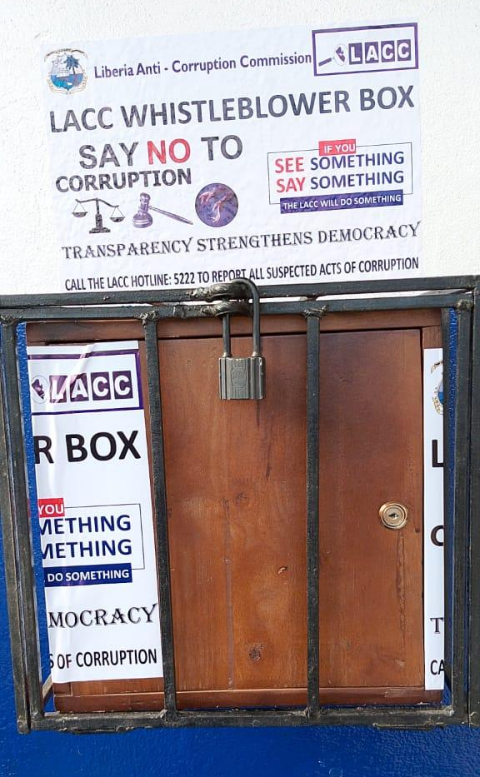
In August, the Liberia Anti-Corruption Commission, hoping to encourage Liberians to call out what experts say is rampant corruption at every level of government, began placing whistleblower boxes across key government ministries, agencies, and police stations. They hoped people, particularly officials of government, would quietly report corruption and other illegal acts by putting the allegations on slips of paper and depositing them anonymously in the boxes.
But months later, the Commission says, the approach is not working. It has opened the boxes twice and found just three complaints in total. Experts say people are too afraid to be seen to be blowing the whistle on corruption for fear of losing jobs, in a market where there are few jobs available.
“The boxes are exposed, and nobody wants to be seen walking toward those boxes,” says Alfred Karnley, compliance director at the Commission. “There is still this fear of repercussions.”
Experts say the outcome was not that surprising. The Commission placed the first six boxes as a low-cost test to see if the approach would work. Boxes were placed at the Civil Service Agency, the ministries of education and commerce, and at three police stations. But it has not expanded beyond that first phase.
Corruption is a serious problem in Liberia. The country ranked 136 out of 182 nations on Transparency International’s latest Corruption Perceptions Index — meaning most countries in the world are seen as less corrupt. During the Weah administration the United States went so far as to officially sanction numerous senior Liberian officials for corruption, a sign of how serious the problem is.
Corruption holds back the country’s development, locking it into a low-income status. It means public money meant for schools, hospitals, and roads ends up in private pockets instead — leaving ordinary people without the services they need. Government after government has promised to crack down on it. That’s why the Commission says it needs a reporting system that people will trust — and use.
Accountability advocates say the early results show that Liberia’s challenge is beyond building reporting tools — it is building trust and protection so people can report without risking their jobs or safety.
“Fighting corruption comes with serious risks,” says Harold Aidoo, executive director of Integrity Watch Liberia. “People worry about their jobs, their safety, and their families. “It is physical, psychological, and economic.”
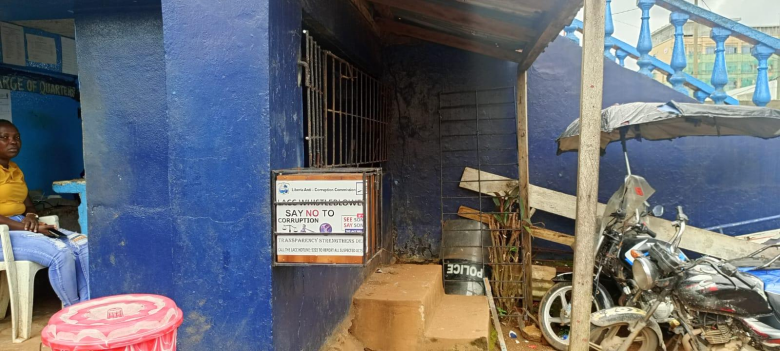
Aidoo says the boxes ran into a hard truth about how Liberians protect themselves in public spaces. “By nature of our culture, you’re not going to have people to use that. A box in a hallway does not feel private. It creates some sort of stigma for people who are reporting.”
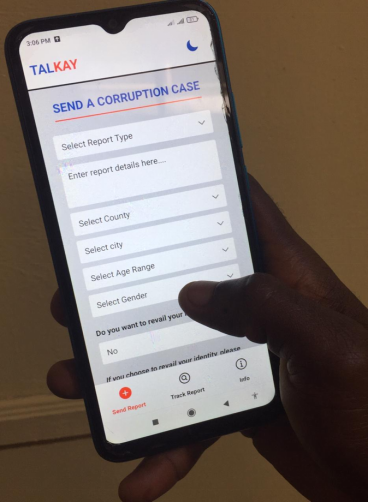
That is why Integrity Watch helped develop the Talkay App in 2022, he says, to give people a way to report without being seen. “Talkay” is a Liberian colloquial word meaning “ it gives one the free will to go ahead and report any happening.” It lets users choose complaint categories like bribery, extortion, molestation, misuse of government office, and upload photos, videos, and audio evidence. Aidoo says the public cannot fight corruption from the sidelines. “You cannot fight corruption in the absence of citizens.”
Karnley agrees and says the corruption commission’s next step is to move away from the boxes and back toward digital reporting, because it can protect a person’s identity better. “The best way we think this can happen is through the mobile platform,” he said. “You remain anonymous for as long as you want.”
But funding remains a key issue. Aidoo says building and maintaining the Talkay system has already cost about $60,000, and upkeep runs about $6,000 to $7,000 a year. Karnley says the redesigned Talkay App is ready, but payments are needed before it can be published for the public to download. “What is left is for this payment to be made so that the app can be placed for citizens to download and start using it.”
This year, the government allocated $US4.4 million for the Commission’s operations in the national budget. Even with that allocation, the Commission says it is still trying to find the safest, most trusted way for people to report corruption — and to prove to the public that speaking up will not put them in danger.
This story was a collaboration with New Narratives as part of the “Investigating Liberia” project. Funding was provided by a private donor and the Swedish Embassy in Liberia. The funders had no say in the content.