
By Aria Deemie, climate and environment reporter with New Narratives
Summary
• Rural women say Liberia’s climate policies are failing to reach the communities most affected, warning that technical language, planning meetings, and funding commitments have not translated into real support on farms and in villages.
• As heat intensifies and farming becomes less reliable, many women remain dependent on firewood and charcoal, while cleaner energy alternatives—efficient cookstoves and palm-kernel briquette – projects struggle due to high costs, broken equipment, and lack of market access.
• Rural women and civil society leaders say climate justice must prioritize inclusion, practical training, and accountability to close the gap between policy promises and lived reality.
When Ma Kebbeh Monger stood up to speak, she was direct and honest. The women she represented in the Rural Women Structure of Liberia had a simple message for government officials, and international agencies gathered at the EJS Ministerial Complex this week for Liberia’s second National People’s Climate Justice Summit: climate solutions are failing to reach the people bearing the brunt of the crisis.
“Before the action take, it should be there. No one should be left behind,” Monger said. “All the big big people talking climate change — the people in the rural community, they the ones suffering more.”
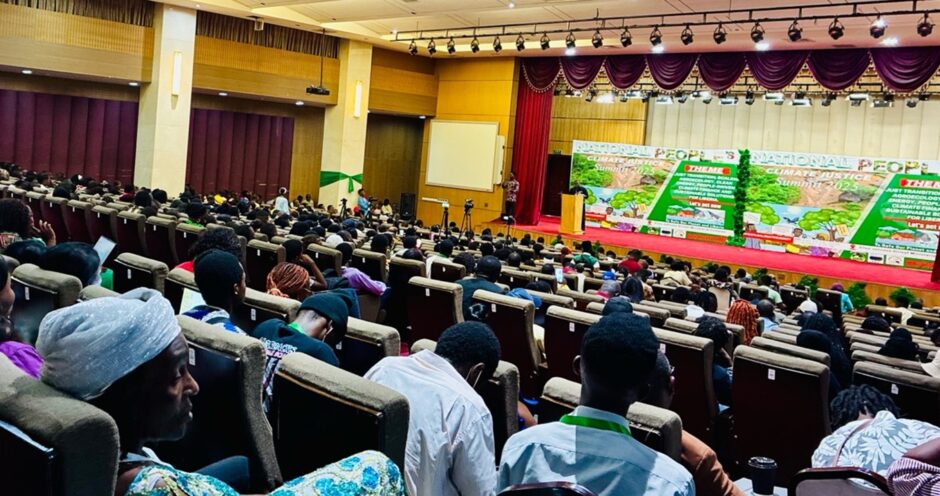
National People’s Climate Justice Summit in Monrovia, where participants debated how climate
policy can better reach vulnerable communities. Photo: Aria Deemie/New Narratives
Liberia’s climate justice debate is unfolding amid a worsening climate crisis that is already reshaping daily life for millions of people across the country. Although Liberia contributes just 0.04 percent of global greenhouse gas emissions, it remains among the countries most vulnerable to climate shocks.
A FrontPage Africa/New Narratives investigation found that Monrovia experienced its hottest dry season on record in 2024, while climate models project up to 118 additional extremely hot days each year by mid-century, increasing the risk of heat-related illness and reducing productivity for workers in both urban and rural areas. Separate reporting has shown that early-warning and disaster-response systems remain underfunded or non-operational, leaving farmers and other vulnerable communities without reliable forecasting or warnings as weather patterns become unpredictable.
Meanwhile, failed crops are driving farmers to charcoal production because of a lack of alternatives, putting a strain on Liberia’s forests which could eventually lead them to collapse with far reaching consequences for food security.
The two-day summit, convened under the theme “Just Transition: Scaling Agroecology, Clean Energy, People-Driven Climate Finance and Sustainable Solutions for Liberia,” was attended by more than 800 participants, including farmers, academics, renewable energy practitioners, government officials, civil society actors, women and youth leaders, and representatives of local and international nongovernmental organizations. Monger warned the gathering that inviting them to gatherings like this was not enough. She wants to see talk translated into impact on farms and in villages where people depend directly on forests and land for survival. Rural women, with fewer income making alternatives have been hardest hit.
Representing the Boakai administration Bill McGill Jones, deputy finance minister, told the gathering that the government understood the scale of the problem facing the country. He said the government had made the issue a priority, announcing the establishment of a Climate Integration and Financing Office within the finance ministry, aimed at mainstreaming climate considerations into national planning and budgeting.
Jones claimed Liberia has secured more than $US573 million for climate commitments to strengthen climate resilience, renewable energy and agroecology programs nationwide, with $US213 million disbursed as of December 2024 in ongoing partnerships with the World Bank, IMF, African Development Bank, United Nations agencies, the European Union and Sweden, though he did not provide details of those funds.
As US and European governments slash funding for aid and global funds to help vulnerable countries adapt to climate change, he warned the country would face significant challenges implementing its ambitious commitments on climate change without predictable and sustainable funding.
“Climate change is no longer an environmental concern,” Jones said. “It is a macro-fiscal, developmental, and social imperative.”
‘When They Said Carbon, I Thought It Was a Bomb’
Monger’s speech underscored the disconnect the rural communities feel from high level conversations about climate change at national and international meetings. She urged leaders to work harder to communicate in ways that communities can understand.
“When they talked about carbon, I thought it was la bomb they coming to send,” she said.
“I say, ‘Ah! Another war coming to Liberia?’”
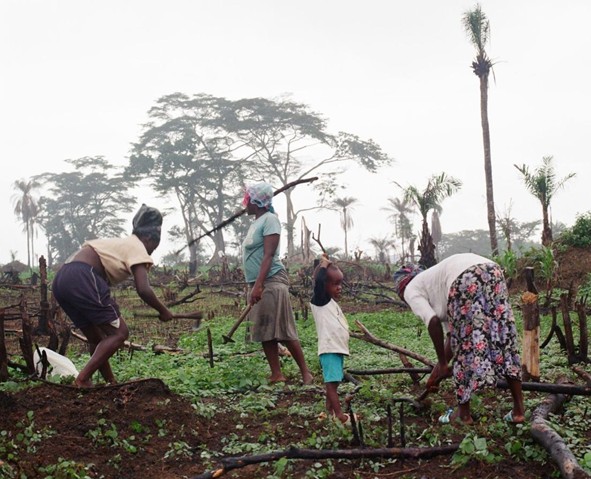
Only after the concept was explained in plain terms did she understand it as referring to the smoke from burning wood and bush clearing — common practices in rural Liberia. (Carbon dioxide, emitted when “fossil fuels” like trees, oil and gas are burned, is the main gas that is being trapped in the atmosphere and leading to global warming.) Monger said rural women rely heavily on firewood and charcoal and called for government to provide eco-stoves in every rural household, paired with training delivered in local languages.
She urged the government and NGOs to move away from technical manuals and toward practical demonstrations — drawing trees, explaining soil, and showing the consequences of over-burning land.
“When you clear bush, some bush must stay,” she said. “If you burn everything, when the rain fall, your farm will spoil. Trainer to trainer. When people understand it, they will own it.”
In an earlier FrontPage Africa/New Narratives investigation, Emmanuel Yarkpawolo, executive director of the Environmental Protection Agency, said the government is working to reduce charcoal’s toll by promoting cooking methods that use less or no charcoal. But he acknowledged that the US$20 cost per stove is out of reach for many.
“It’s hard at first, but over time, you save money,” he said. “Still, EPA can only provide guidelines and training. We can’t support everyone individually.”
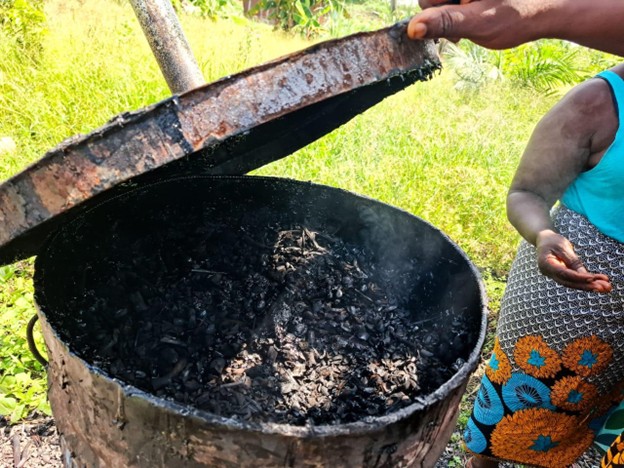
Photo: Aria Deemie
That gap between policy and reality is visible in Todee District, lower Montserrado County, where a group of women tried to pivot to a more sustainable model producing charcoal from palm kernel shells instead of trees. The project offered cleaner fuel and better income. But it collapsed before it could take off.
“The machine broke down before we finished training,” said Esther Sigbae, 51. “We were making dense black briquettes — cleaner and longer-burning than traditional charcoal — but now they sit unsold.”
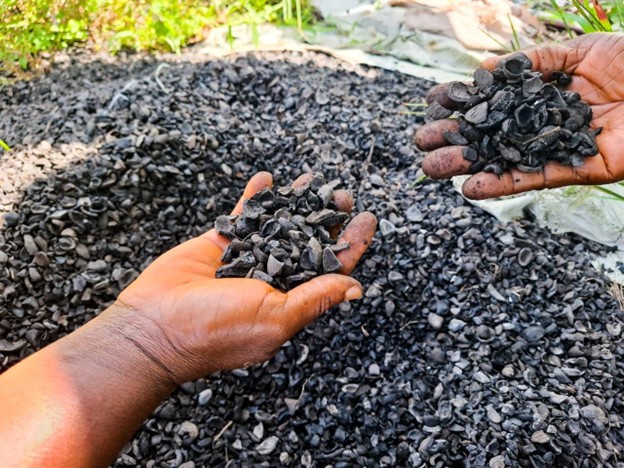
Without repairs or access to buyers, the women returned to cutting trees.
“Nobody’s buying,” Sigbae said. “So we built an oven again and started burning wood.”
She now supports eight children — four of her own and four left behind by her late sister. With no refrigeration, tools, or transport, most of her vegetables rot before they can reach Monrovia’s markets.
Each woman had contributed just $LD100 — less than 50 cents — mainly to buy food to stay strong after farming and charcoal work. But even that small amount sparked plawor, a fuss.
“If you give your share what will your children eat at home?” Sigbae asked. “We dig with our hands. No tools. We thought this could help us stand on our own.”
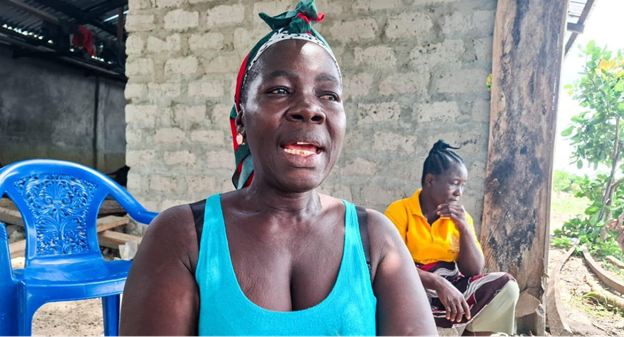
Photo: Aria Deemie
Now, the women say they want more than funding. They are asking for training, market access, and equipment repairs.
“We don’t want to just burn bush anymore,” Sigbae said. “We want to learn and then teach our friends. But right now, we’re just stuck.”
Closing the session, ElizabethGbahJohnson, Country Director of ActionAid Liberia, said climate justice cannot be separated from questions of power and accountability.
“Climate justice is also a social justice issue,” Johnson said. “It is about power, participation, and public accountability.”
She urged policymakers to pair data with lived experience, from farmers restoring soil through agroecology to youth cooperatives powering cassava mills with solar energy.
This story was a collaboration with New Narratives. Funding was provided by the American Jewish World Service. The donor had no say in the story’s content.