
By Nemenlah Cyrus Harmon, climate correspondent with New Narratives
Summary
- In the lead up to the launch of the latest Global Hunger Index Liberia remains among the world’s most food insecure countries, with one in three people undernourished and progress against hunger barely shifting despite decades of interventions.
- Experts say heavy reliance on imported rice and low local yields, continues to drive food insecurity, leaving the country vulnerable to global price shocks and supply disruptions.
- Data from an important new survey is informing a new push to boost domestic rice production by government, partners, and lessons from Nigeria.
Across rural communities in Liberia, rice paddies have fed families for generations and that have also, for generations, never quite been enough. Fields that yield barely a ton per hectare. Families that import nearly every grain they eat. A country, for more than two decades, has ranked among the hungriest on earth.
It is here, in Monrovia, the country’s capital, a bustling city, not farmland that Concern Worldwide, a humanitarian organization that supports vulnerable communities, and partners have chosen to launch its 2025 Global Hunger Index report in a high powered event this week.
The organization says the event underscores the message that Liberia’s illness has been long been diagnosed. Now it must be cured.
“Change in hunger indicators takes time. But what the data tells us clearly is that progress has been flat for far too long,” says Ciara Begley, country director of Concern Worldwide.
Boosting food production has been a major priority for President Joseph Boakai. Limited technology, inefficient farming practices, low investment, and terrible roads hamper production. The erratic rainfall and higher temperatures brought by climate change are making things worse.
But now the partners have fresh data from an important new national survey, full government buy-in and a successful game plan to learn from in Nigeria. The goals is to help farmers produce rice more efficiently and at scale—reducing imports, stabilizing prices, and easing pressure on households.
Twenty Years of the Global Hunger Index
The Global Hunger Index is published each year by Concern Worldwide, Welthungerhilfe, and the Institute for International Law of Peace and Armed Conflict, to measure and track hunger at the global, regional, and country levels. The aim of the Index is to trigger action to reduce hunger around the world.
On the Index’s 20th anniversary the coalition is spotlighting the fact that global hunger has seen little reduction since 2016, and stalled progress is pushing the UN Sustainable Development Goal 2030 target of Zero Hunger out of reach.
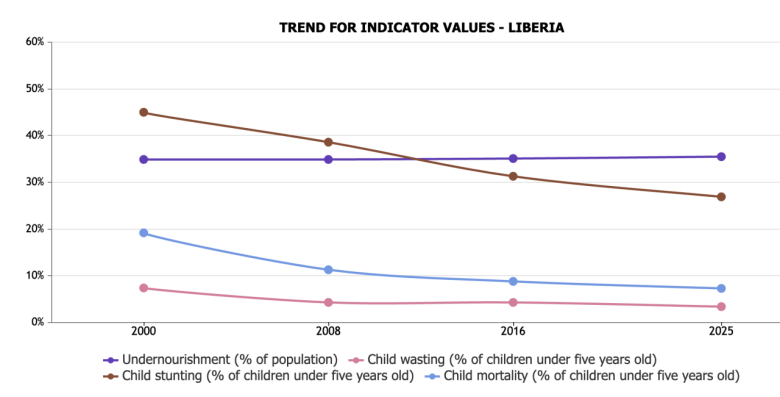
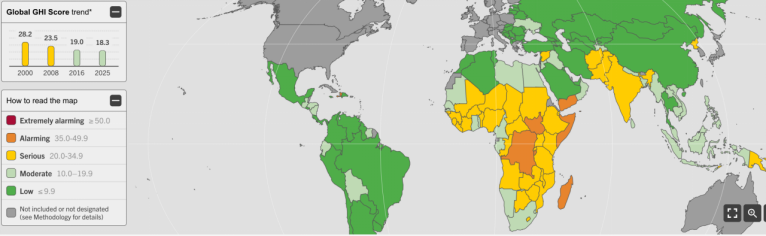
Liberia scored 30 on the Index, a rise of one point since last year, and ranked 112 out of 123 countries, putting it in the “serious” category. It is one of 10 countries in the serious category that have not moved in a decade. The Index found one in every three Liberians is undernourished. One in every four children under five is stunted.
In a recent Front Page Africa/New Narrative report, Francis Mulbah, assistant minister for planning and development at the Ministry of Agriculture, argued the country is making better progress than the Index shows.
“The Global Hunger Index is not false,” says Mulbah. “But it does not represent the current reality, because it relies on data collected between 2022 and 2024.”
Mulbah claims government assessments show national food insecurity has dropped from 47 percent in 2022 to 20.7 percent in 2025. More than 33,000 Liberians have transitioned from food insecurity to food security since the 2022 baseline. The government will also release the data at the launch and FrontPage Africa/New Narratives has been unable to verify it.
The ministry says the administration expanded cultivated land from 244,000 hectares in 2024 to 250,000 hectares in 2025; increased local rice output slightly to 273,852 metric tons in 2024, and is targeting an additional 50,000 hectares for production. Farmers have received improved seeds, fertilizer, and up to $US1,000 per hectare under the Emergency Rice Production Offensive project, alongside expanded extension services and mechanized farming.
It has also deployed more district agricultural officers and crop technicians, introduced mechanized farming to boost efficiency, and improved road access to reduce transport costs and enhance food distribution.
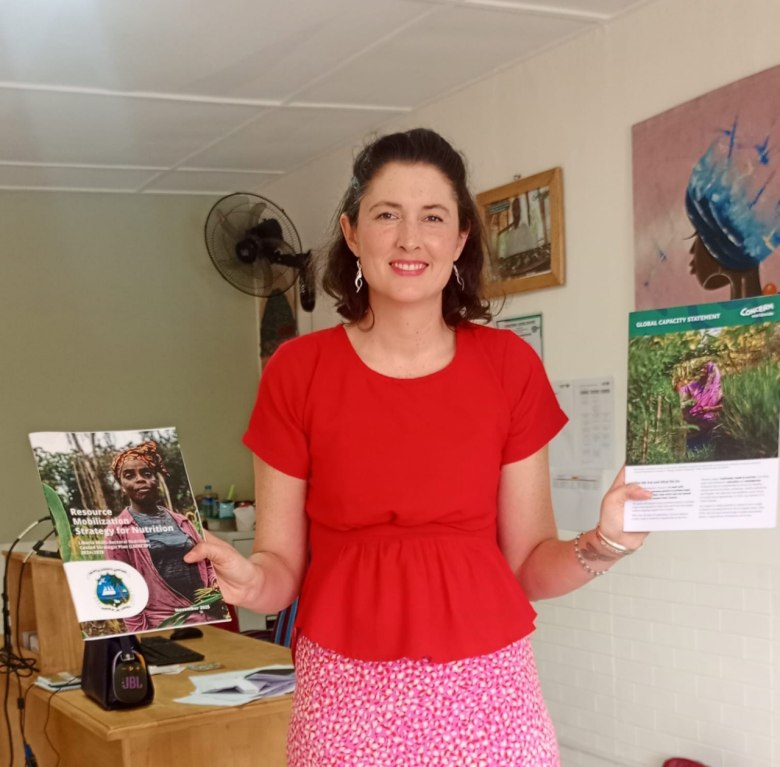
Begley has seen another key step forward. The Irish national says, for the first time in her five years in Liberia, there is something new to work with: a comprehensive, multi-sectoral food and nutrition security assessment, jointly led by the ministries of agriculture and health with support from partners. It is the first honest nationwide picture of hunger in Liberia in years. Among the key findings: nearly half of households spend more than 65 percent of total income on food alone.
“That assessment changes the conversation,” Begley says. “It gives Liberia an evidence base to shape policy, prioritize investments, and measure accountability. It takes bravery to go and check what the reality of the situation is on such a hot political topic. But the government of Liberia has made agriculture the ‘A’ in ARREST — they’ve gone and got the data.”
The Global Hunger Index is released globally every October, but for Concern, the real work begins after the report drops. In-country launches — are held months later, deliberately, after the dust of global headlines has settled and where dialogue becomes action.
“The report itself is just aggregated data,” said Begley, “the in-country launch is about driving change.”
Rice Production Is at the Heart of Liberia’s Food Challenge
Rice sits at the center of Liberia’s hunger crisis. According to the World Bank, rice makes up over 20 percent of what Liberians eat, nearly half of adult caloric intake and takes up 15 percent of average household spending. When the price of rice rises — as it does whenever global shipping costs spike, or India restricts exports – the poorest Liberians eat less. Political tensions rise.
Liberia produces less than a third of the 650,000 tons Liberians eat each year. The gap, over 400,000 tons — is filled by imports, mostly from India. Average yields hover around one ton per hectare, barely enough to make rice farming worth the labor.
Learning From Nigeria’s Jigawa State Agriculture Boom
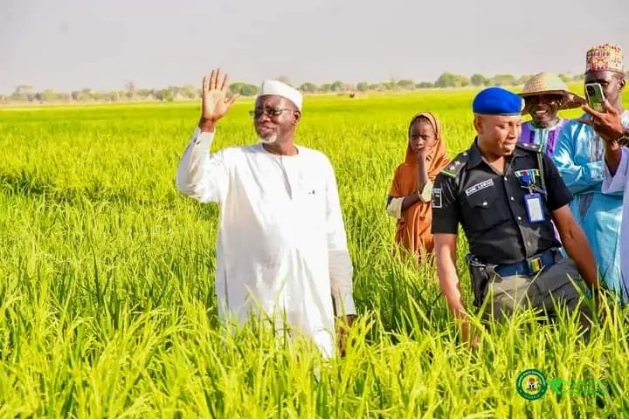
As part of this year’s launch Umar Namadi, the Governor of Jigawa State in Nigeria, will lead a delegation to talk about how his government helped turn 23,000 rice farmers into a national food security success story.
The Jigawa government embraced a system of rice intensification, a method that helps rice farmers grow more with less, not as a donor project but as economic policy that, importantly, engaged private business. Nigeria leads Africa in rice production, accounting for 9.1 million tons (approximately 20 percent of the total) in 2024 according to Intelpoint.
“We went to those states, and we spoke with the government but also the private sector,” Begley says. “Because the way they did it was not the government doing all. That is not affordable. It is the private sector being enabled to run things at a profit — and that requires an enabling environment.”
That enabling environment is what Liberia is now trying to build. And the governor of Jigawa has agreed to come and show how it was done.

The Ganta launch will bring together leaders, scientists, and private-sector actors to advance rice production and nutrition. Key speakers will include Umar Namadi, governor of Jigawa State, Nigeria, J. Alexander Nuetah, Minister of Agriculture, Liberia and Dr. Louis Maplah Kpoto, Minister of Health, Liberia, while a panel of rice scientists and climate experts discuss Liberia’s “pathway to rice sovereignty and nutrition gains.”
Over the following two days will take delegates to the field in Lofa County: local rice processors, rice intensification demonstration plots, and a 500-hectare pilot with the Armed Forces of Liberia. Farmers will share testimonies, yield data, and practical demonstrations of improved seed varieties, water management techniques, soil spacing, transplanting methods.
“This is not just a talk shop,” Begley said plainly. “It’s about deliverables.”
Organizers say the visit and launch will be an intense few days but they hope it will be a decisive boost in Liberia’s quest to move to get the arrow moving lower again on hunger.
This story was a collaboration with New Narratives as part of the Investigating Liberia Project. Funding was provided by the American Jewish World Service and Swedish International Development Cooperation Agency. The funders had no say in the story’s content.