

By Nemenlah Cyrus Harmon with New Narratives
- Hunger in Liberia is “serious” according to the latest Global Hunger Index
- The number of malnourished people has risen to two in every five
- Child “stunting”, death and wasting has not improved in eight years
- Government rejects findings and commits to increasing food production
ELWA QUARRY, Monrovia — Fatu Moore pounds rocks hour after hour in this quarry on the outskirts of the capital. Her weathered hands tell a story of survival. For 35 years she has crushed rocks here under the hot sun, transforming boulders into gravel for income to feed her seven children.
But lately customer numbers have dropped, and this backbreaking doesn’t put enough food on the table.
“Sometimes when they buy one pickup load of rocks, it will take two to three weeks before another customer comes,” said the 42-year-old Madam Moore whose husband died in a motorcycle accident six years ago. “Before that time, what will we be eating?”
Madam Moore represents a growing crisis in Liberia. In recent years climate change and global economic shocks have combined to increase what experts call “food insecurity” – growing numbers of Liberians are finding it hard to get enough to eat. As with so many areas, women and children like her are most vulnerable.
According to the 2024 Global Hunger Index, launched today in Liberia by international NGOs Welthungerhilfe and Concern Worldwide, the country ranks 120th out of 127th countries, showing a “serious” level of hunger. The Index uses data from national governments and various UN and other multilateral agencies to “assess the state of hunger and malnutrition globally, regionally, and nationally,” according to a press release. This year’s Index found nearly two in every five Liberians are malnourished – a 5-percentage point increase from 2016.
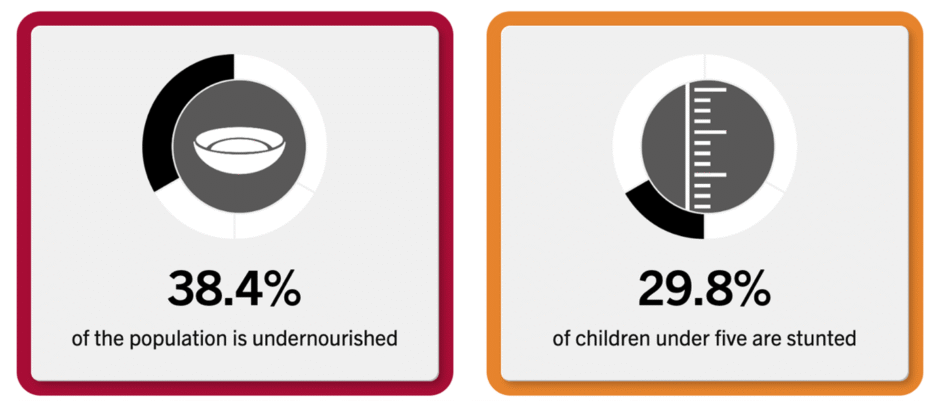
Three in every five children under five are “stunted” meaning they have impaired growth and development resulting from chronic malnutrition, repeated infections, and inadequate psychosocial stimulation. It is characterized by a child being significantly shorter than the average for their age leading to physical and cognitive impairments that can persist throughout their life. Numbers for stunting, child wasting and under 5 mortality have number have barely budged since 2016.
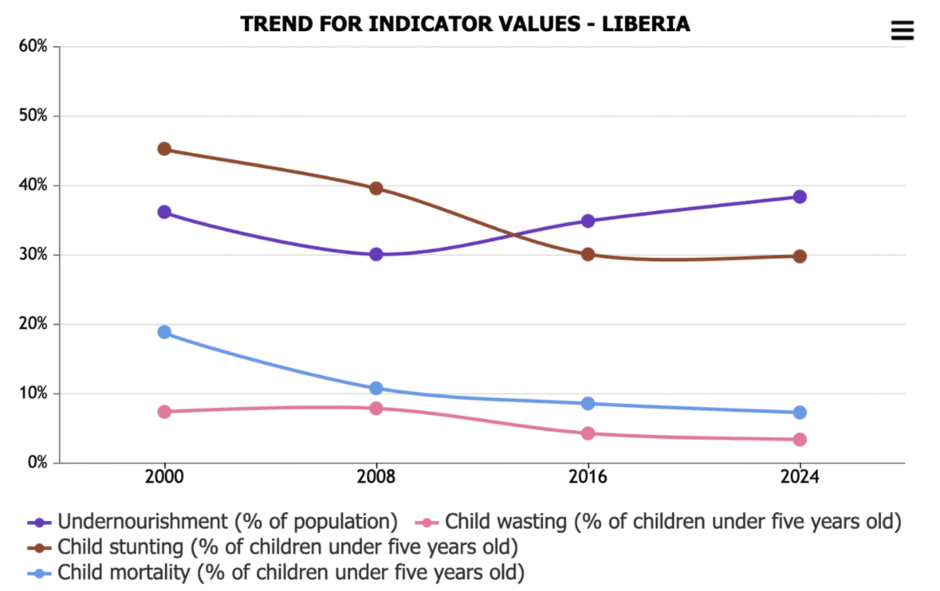
The Index flagged that “little progress has been made on reducing hunger since 2016”, and the prospects for achieving the United Nations’ Sustainable Development Goal Target of Zero Hunger by the target date of 2030 “are grim”. Liberia is among 42 countries still experiencing alarming or serious hunger.
The Liberian government rejected the findings.
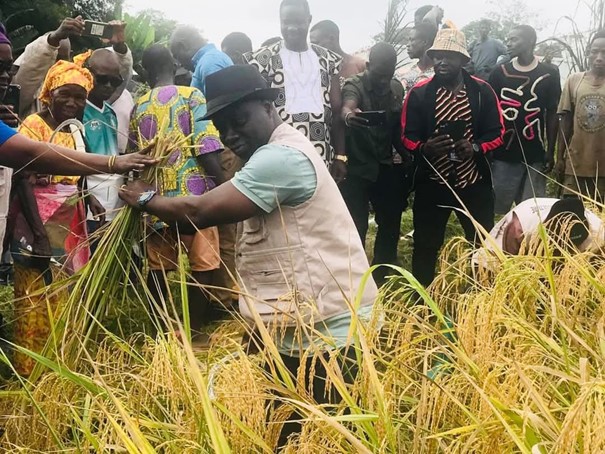
“There could be hunger at certain time, but the idea that Liberia is experiencing severe hunger, I don’t want to agree with that,” said Dr. J. Alexander Nuetah, Minister of Agriculture, in an interview. He blamed any increase in hunger on the high global prices of rice, Liberia’s staple food, from which Liberians derive more than half their calories. As much as 70 percent of the rice is imported. Increasing the amount of rice grown in Liberia has been a stated priority of the Boakai administration which took office a year ago. Minister Nuetah said the government had taken measures to increase food production, launching the national agriculture development plan in which $US4 million in the 2025 budget will support domestic food production. He said it will come from the $8 million allocated under the budget line “Agriculture Value Chain Project”.
“By 2030, our target is to reverse the data, instead of importing 70 percent, we should be producing a minimum 70 percent of rice,” said Minister Nuetah.
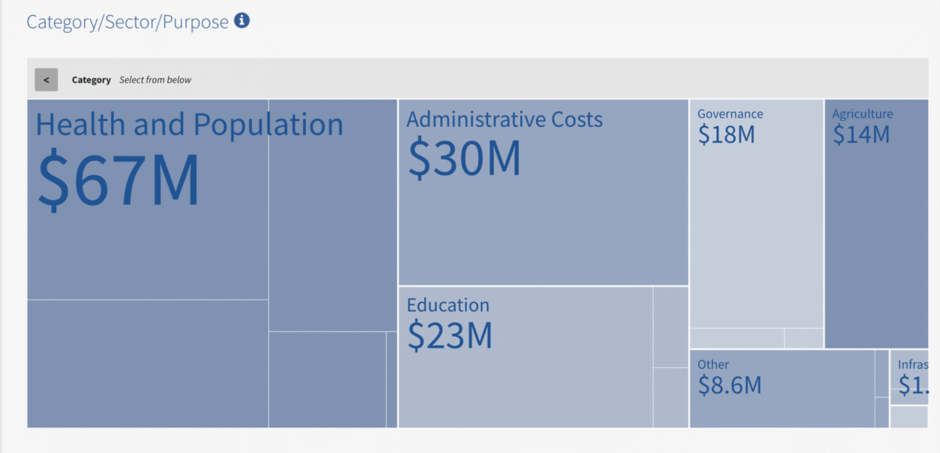
Experts worry that effort may be hampered by cuts to United States aid. The US government spent more than $14 million on agriculture projects in 2024 according to the US government site foreignassistance.gov including large projects devoted to food security. Others were funding roads, electricity and other infrastructure that support the growing, transportation, and storing of food.
A Crisis Deepens
The Global Hunger Index statistics become painfully human in the stories of mothers forced to make impossible choices.
“I have seven children. Only three are going to school because there’s no money,” Madam Moore said. “When they (customers) buy small rock, we buy one cup of rice and eat it. What else can we do? Sometimes we can use $LD500 (US50 cents) or 400 for food per day for all eight of us. We just manage it for us to eat.”
In the same quarry community, Garmai Bakarro, 63, cares for four grandchildren, none of whom attend school. After her husband’s death three years ago, she joined her daughter in crushing rocks—a last resort for survival.
“Sometimes we can sleep with hunger,” Madam Bakarro said. “When the day breaks, I tell my friends or go to my daughter for help. Sometimes when the children are sick, I can go to my friends and ask them for $LD 100 or 200 to buy medicines.”
The crisis has ripple effects beyond immediate hunger. Dr. Toga Gayewea McIntosh, a leading economist, said it leads to a devastating cycle: hunger undermines so-called “human capital” – the productivity of individuals in an economy – which in turn hobbles economic recovery.
“If you have an eight-hour job to do, you won’t have the stamina if you are hungry,” Dr. Gayewea McIntosh said. “This deficit, combined with widespread unemployment and hunger, means our productivity is going downhill.”

The economic pressures on women here have intensified in recent years. A Front Page Africa/New Narratives survey in 2024 found that as climate change has changed weather patterns, traditional farmers with no access to irrigation or weather forecasts, are growing less food. More and more have turned to other livelihoods like charcoal production and rock crushing. That has driven down prices.
Madam Moore said that the price for a pickup load of crushed rocks has dropped by half, from $LD6,000 ($US30) to just $LD 3,000.
“We are forced to sell it because we have nothing else,” she said. She struggles to pay her monthly rent of $US15.
Madam Bakarro said the situation has led to thoughts of returning to her rural home. “Sometimes when I sit down and think on it, I want to go back to the bush,” she said. “But if I go over there, who will help me? That’s why I said let me be here, maybe God will provide.”
Community Response
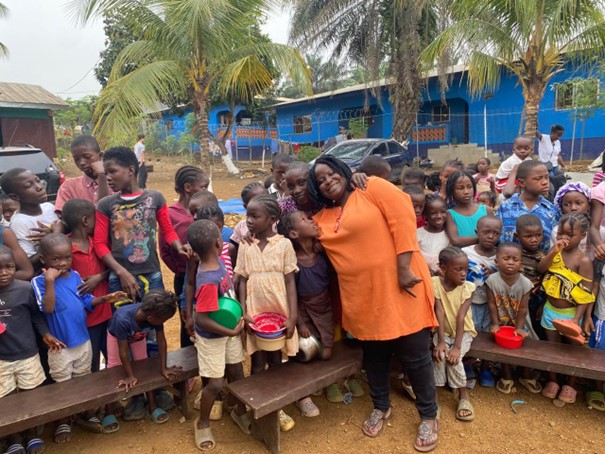
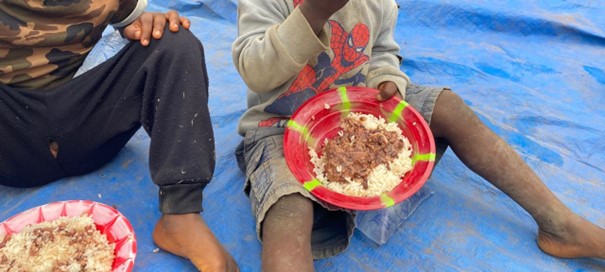
As the crisis grows some Liberians have taken it upon themselves to address the problem. On a recent morning children from one Monrovia neighborhood took their place on benches in a community hall to receive a small bowl of rice and meat soup.
The meal was provided by local community leader Ne-Suah Beyan-Livingston who raises funds for the food on her Facebook page. What began as feeding a few children who had lost parents to the Ebola crisis in 2014-2015 has expanded to provide meals to over 400 kids, twice weekly.
“I even want to stop, but, every time I want to, like I am tired, the faces of these children remind me that we are looking up to you.”
It has been a lifeline for many here.
“Most of the inhabitants in this area survive on backyard gardens and ‘gbobachop’ (a petty trade) women,” said Madam Livingston. Many have come to the city from rural areas where farms are failing and other options are limited.
Many of the children come with containers to take some of the meager serving home to share with family.
“I’m going to eat it all,” said one little boy to his seatmate. “I’m not going to take any to my ma.”
But even these community-led efforts face mounting challenges. “It’s overwhelming,” Madam Livingston admitted. “I pray for the day when the number will start to drop drastically at this feeding station.”
Solutions Must Be Multifaceted According to Experts
Experts point to multiple factors driving the crisis. According to Dr. McIntosh, Liberia’s economy remains dangerously undiversified with 80 percent of food imported. The dependence on imports makes the country vulnerable to global price fluctuations and supply chain disruptions.
“We can’t keep on doing what we’re doing,” he said. “We have to diversify our economy, focusing on about three or four things. For example, agriculture—we’ve got to focus on it, and I mean moving it from this traditional approach, non-mechanized approach. When you release labor from the agricultural lands because you’re mechanizing, you then create the capabilities of that released labor into manufacturing. We can start producing goods domestically instead of importing practically everything.”
Dr. McIntosh also advocates for investment in education and health systems to build Liberians’ productivity. And he wants to see the building of industries that will create a lot of jobs. Key among those is tourism.
“Liberia has so many opportunities to exploit the tourist industry. If we were to focus on serious tourist industry development, as is done elsewhere, all the unemployed people who are poor and suffering and hungry can feed their children, can feed themselves.”
But the key fix will be corruption.
“Governance determines the action that takes place between the people, the resources, and the outcome,” said Dr. McIntosh. “If it is weak, then what we get from the activities is weak, and so our productivity, our innovation, our motivation—all these things suffer. Corruption sets in seriously and erodes what we should have gotten to minimize or eradicate poverty.”
For women like Moore and Bakarro, such long-term solutions offer little immediate relief. For now the situation is particularly dire for women headed households who must navigate both economic hardship and social vulnerabilities. With limited access to credit, land, and education, many women find themselves trapped in a cycle of poverty that threatens to extend to the next generation.
As the sun sets over the rock quarry, Madam Moore continues her work, hoping to earn enough for tomorrow’s meal.
“It’s only this rock business we can use to send our children to school,” she said. “We don’t have anything else.”
This story was a collaboration with New Narratives as part of the Investigating Liberia Project. Funding was provided by the Swedish Embassy in Liberia. The funder had no say in the story’s content.