
By Joyclyn Wea with New Narratives
Summary:
- Young Liberians are marching on Thursday to tell lawmakers that sexual and domestic violence can no longer be treated as normal.
- President George Weah declared rape a national emergency in 2020, but the number of cases is still growing. Protesters said they want proof that government promises lead to real protection and justice.
- Advocates said the deeper issue is whether the state can show results: more investigations, faster, fairer prosecutions, stronger survivor services, and safer communities.
Six years ago, former president George Weah won praise for declaring rape a national emergency. He promised a tougher response to sexual and gender-based violence.
But little real change was evident, and the numbers kept rising. In 2024, the number of cases of rape, domestic violence, and other forms of sexual and gender-based violence increased by 17 percent over the year before to 3500. Activists said intimidation and fear of reporting cases mean the true number is far higher.
Today, Young people are taking Weah’s promise to the streets. Activists said large numbers of young Liberians will march on the Capitol and petition lawmakers with a question that goes beyond one day of protest: if rape was treated as a national emergency in 2020, why do so many Liberians still feel the crisis has not changed?
The protest comes with a direct challenge to the government. Organizers are not only asking leaders to condemn abuse. They want proof that official action has made survivors safer, improved investigations, and delivered justice more fairly.
“Our disappointment is that the system is still not impartial,” said Titus Pakalah, one of the campaign’s lead organizers. Pakalah said poor defendants accused in gender-based violence cases often go straight to prison and can wait there for years without trial, while powerful suspects can access resources and protections faster. “The system tends to exclude the most powerful people from accessing fair justice.”
In 2020, Weah declared rape and all forms of sexual and gender-based violence a national emergency. The government announced steps that included a special prosecutor, a sex offenders registry, and stronger national action against abuse. None or most of those did not happen. The task force and roadmap clearly moved forward, and the funding was officially announced, but the public record suggests the prosecutor’s office and sex offenders registry were implemented unevenly and remained difficult to verify in full.
The government also announced an initial $US2 million contribution to a special fund for sexual and gender based violence, but a report by the Feminist Alliance found that $US1.2 million approved in 2020/21 for the fight against rape was disbursed instead to a project called the “Safe Home for Girls.” No project with this name was found by FrontPage Africa/New Narratives. The report also found that allocations for sexual and gender-based violence in 2022 and 2023 could not be verified as having been disbursed.
Pakalah said the campaign is meant to turn anger into pressure on lawmakers. He said organizers want the government to reopen space for youth voices in policy, improve confidentiality for survivors, and strengthen psychosocial and legal support. He said the march is also meant to push President Joseph Bokai to re-declare rape a national emergency and to create a pathway for young people to work with the government in responding to gender-based violence.

Liberia passed the Rape Act in 2005, which amended the Penal Code to increase penalties for rape and create the offense of gang rape. The Domestic Violence Act, signed in 2019, made domestic violence a crime and broadened legal protection to cover abuse in the home, including physical, sexual, emotional, psychological, and economic abuse.
Specialized mechanisms were also created to improve the response. But experts said passing laws is easier than making institutions work. Survivors and advocates flag weak enforcement, uneven investigations, delays in court, social pressure on victims, and poor access to services outside major urban areas.
Recent stories by FrontPage Africa/New Narratives have documented the challenges faced by poor women. In December 2025, a Monrovia-based woman who reported the rape of her 8-year-old child to police was asked for fees repeatedly in order to see the perpetrator jailed and tried. It was only after the story was published that Isaac George of the GBV unit intervened to put her and the child in a safehouse and launch an investigation. He promised to refund the fees.
A 57-year-old grandmother from rural Montserrado was also asked repeatedly to pay fees to incarcerate her attacker and have her case proceed through the justice system. As of publication, the case is lost in the system.
Hawa Wilson, program coordinator at Paramo Young Women Initiative, said addressing the issue should be a national priority. The cost of sexual and gender-based violence goes beyond the immediate harm to survivors.
“When violence becomes normal, and redress is weak, women and girls feel unsafe in school, at work, and in public life,” she said. “That fear pushes them back and limits their full participation in society.”
No countries that limit the engagement of women in politics and the economy has thrived economically. Wilson also said the state’s response has often been reactive and underfunded, and that survivor services remain weak outside urban areas. She pointed to gaps in psychosocial support, shelters, medical care, and coordination across institutions.
While the Ministry of Health and Gender reports the number of sexual and gender-based cases in the country each quarter, activists want to see it go further: If cases are going up, what other progress can the government show? How many reported rape cases lead to arrest? How many are prosecuted? How many end in conviction? How long do survivors wait for cases to move through court? How many counties have functioning shelters, medical care, trained investigators, and psychosocial support? And how much money has been committed to making the anti-rape response work?
Pakalah said that is why the march matters. “Young people are also demanding systemic change because things don’t seem to be changing in areas of access to justice for survivors of GBV or rape,” he said.
Liberia’s civil wars left a deep legacy of violence, trauma, and weak trust in institutions. Women and girls carried much of that burden. In the years since the war, the country has built laws, plans, and programs meant to protect survivors. But many Liberians still see the same pattern: violence, outrage, promises, and too little visible change.
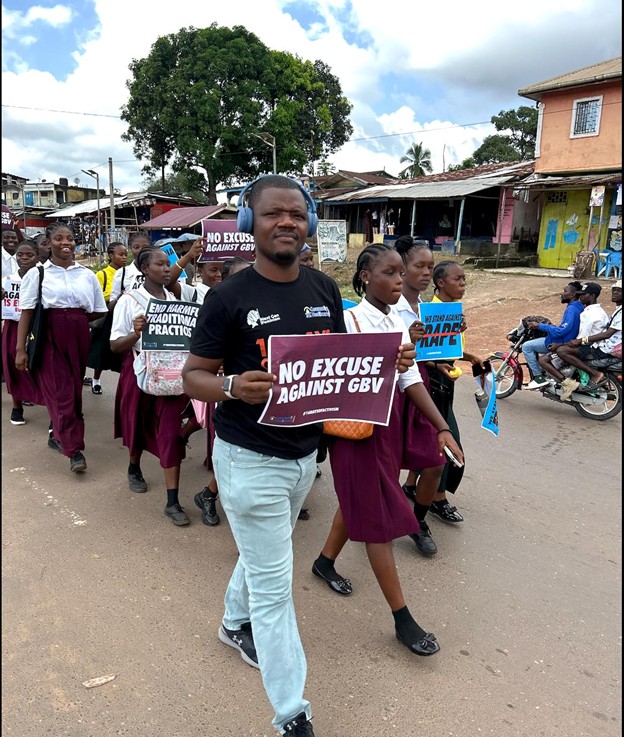
Activists said they plan to place their demands directly before lawmakers and warned that if the government fails to act, young people will keep marching until the promises made to survivors are matched by results.
This story was a collaboration with New Narratives as part of the “Investigating Liberia” project. Funding was provided by Susan and David Marcinek and the Swedish Embassy in Liberia. The funders had no say in the content.