
By Anthony Stephens, senior reporter with New Narratives
Summary:
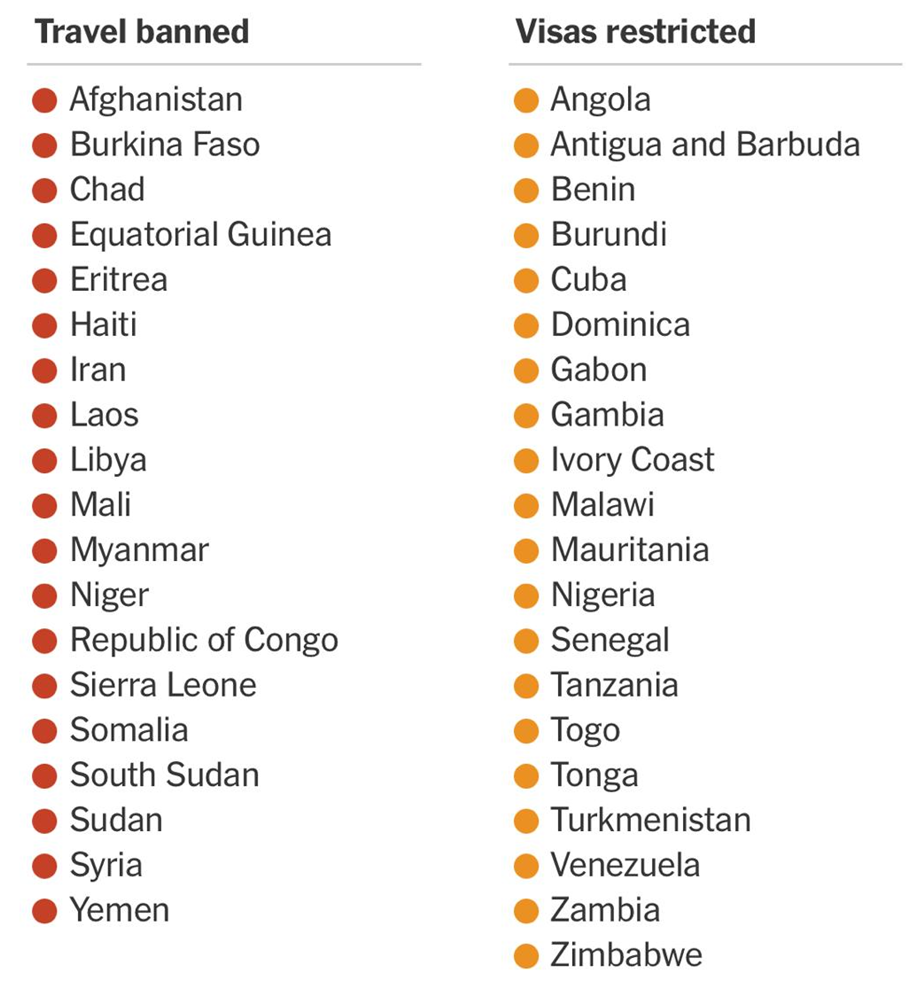
- Liberia was excluded from the Trump administration’s latest travel ban and visa restrictions, which affect nearly 40 countries worldwide, including several major West African economies including Ivory Coast, Nigeria and Senegal
- Analysts say the decision reflects improving diplomatic engagement between Monrovia and Washington and Trump administration interest in Liberians minerals.
- Liberian government officials did not respond to requests for comment, but President Joseph Boakai recently praised the U.S. visa decision as a sign of “growing confidence in Liberia’s progress and global engagement.”
Liberia’s exclusion from the Trump administration’s latest travel ban has drawn a mix of praise and caution from foreign policy experts, who say it reflects warming relations with Washington as the Trump administration shift its focus from aid to U.S. national interests.
The revised policy, announced last month by the White House, took the number of countries facing visa restrictions to nearly 40 countries worldwide, most of them in Africa. Most of the major economies in West Africa are on the list including Côte d’Ivoire, Nigeria, Senegal and Mali. Citizens of other countries — including Sierra Leone, Burkina Faso, Togo, Gabon, Tanzania, Zambia, Niger, the Democratic Republic of Congo and Somalia — face broad travel bans. Liberia and Ghana are two of just a handful of countries in the region that are not facing a ban.
The administration said the policy was aimed at protecting the United States from “terrorist attacks and other national security and public safety threats.” High numbers of people overstaying their visas have also been cited.
The move followed the arrest of an Afghan national in Washington State in connection with the shooting of two U.S. National Guard members, one of whom later died. President Donald Trump pledged to expand travel restrictions after the incident.
According to The New York Times, Kristi Noem, the secretary of homeland security, urged President Trump to impose “a full travel ban” on countries she said were contributing to crime and instability in the United States.
Liberia’s absence from the list has drawn particular attention. Earlier in the year the Trump administration placed Liberia among 36 countries whose citizens could potentially face travel restrictions, triggering anxiety in Monrovia and among Liberians in the diaspora. Liberia had one of the highest rates of visa overstays in the world. In response, President Joseph Boakai appointed the foreign minister, Sara Beysolow Nyanti, to lead a special committee to engage U.S. officials and address Washington’s concerns.
Since then, relations between the two countries have shown signs of warming. Last month, Liberia and the United States signed a $US124 million memorandum of understanding focused on“strengthening Liberia’s health system, disease surveillance, outbreak response capacity, and frontline health workforce,”— a move widely welcomed in Liberia.
Washington has also extended the validity of multiple-entry visas for Liberians from 12 months to 36 months — a decision celebrated by Liberians at home and abroad. President Boakai said it “reflects growing confidence in Liberia’s progress and global engagement,” and that “it opens new doors for our citizens to explore educational, cultural, and economic opportunities while strengthening our bilateral cooperation with the United States.”
Experts said Liberia’s willingness to accept third country nationals being deported from the United States as part of Trump’s push to deport millions of immigrants in the country illegally, was a key factor in the decision. In October Liberia announced that it had “voluntarily” agreed to take one of the most high-profile cases in the Trump administration’s crackdown – Kilmar Abrego Garcia, a Salvadoran national, who the United States sought to deport after a U.S. judge ruled he could not be returned to his homeland. Ghana has also taken deportees in recent weeks. The legality of the deportations has been widely challenged in the U.S. and has been opposed by human rights groups.
“I think Liberia’s willingness to accept the Ecuadorian man played a role here,” said William Gyude Moore, a former Liberian minister of public works and now a senior policy fellow at the Center for Global Development in Washington.
Last month, a federal judge ordered García’s release, ruling that he had been unlawfully detained.
The Trump administration has also been a strong backer of the supported the so-called Liberty Corridor – a 25-year Concession between the Government of Liberia and U.S.–linked miner Ivanhoe Atlantic signed in July 2025. The deal grants Ivanhoe rights to use and develop Liberia’s rail and port infrastructure — notably the 243 km Yekepa–Buchanan railway and Liberia’s Atlantic port facilities — to transport iron ore from its neighboring Guinea deposits to global market.
The prospect of travel restrictions had caused widespread concern among Liberians, many of whom rely on close family, educational and economic ties to the United States. The Liberian executive recently said that Presidents Boakai and Trump had spoken by phone, saying “the conversation focused on matters of mutual interest, including areas of regional peace and stability, and cooperation in key areas such as governance, economic development, and security.”
Tennen B. Dalieh Tehoungue, an international justice expert, cautioned against overreliance on Washington.
“We must not be just fixated on having a relationship with America,” said Tennen B. Dalieh Tehoungue, a former gender officer with the Swedish embassy in Liberia, in a WhatsApp audio message. “We need to expand our horizon based on policies with different countries.”
Pointing to Sweden’s planned withdrawal later in 2026, she added: “You cannot be having a good rapport with America and your Swedish counterparts are closing down on you. Sweden is a very, very strategic partner within the European Union.”
Tehoungue said Liberia must also position itself regionally, as instability spreads across the region.
“We see the instability within the Sahel,” she said. “How is Liberia situating itself to be of political significance, economic significance, in the midst of the turmoil?”
Neither Saywhar Gbaa, the assistant minister of foreign affairs for public affairs, nor Daniel Sando, the deputy minister of information for public affairs, responded to requests from FrontPage Africa/New Narratives seeking comment on Liberia’s exclusion from the U.S. travel ban.
This story is a collaboration with New Narratives as part of the “Investigating Liberia” project. Funding was provided by the Swedish Embassy in Liberia. The funder had no say in the story’s content.