
By Gloria Wleh with New Narratives

Summary:
• Many Liberians are misusing antibiotics, antiparasitic, antifungal and antiviral drugs without prescriptions, creating what experts call “superbugs” – infections that are resistant to commonly available drugs.
• Families are spending hundreds of U.S. dollars on ineffective treatments as superbugs lead to prolonged illnesses and hospital stays, with a 2021 study linking over 4,000 deaths in Liberia to drug resistance.
• Limited government regulation, poor surveillance, and lack of trust in healthcare are worsening the crisis, as experts call for stronger enforcement, public awareness, and national investment to combat anti-microbial misuse.
POLICE ACADEMY, Montserrado County —– When Paul was just 14-months-old, he was diagnosed with whooping cough, a severe cough that can lead to pneumonia. His drug store owner mother started giving him antibiotics like erythromycin without consulting a doctor or getting a laboratory analysis of his infection.
When the boy improved his mother stopped giving him the drugs. But a month later his cough came back worse. Violent coughing spells made it hard for Paul to breathe. His 29-year-old mother, who asked not to be named for fear of stigma, tried another antibiotic and then another. The boy would improve for a while only to get worse again. For months the cycle continued until she finally took him to a doctor.
“All of the medicines that the doctor prescribed, these are medicines I have been giving him all the time, but they are still not working,” she says.
Experts say Paul is one of a growing number of people in Liberia, who are no longer responding to common drugs. Across the country people do exactly as his mother did – trying drugs until they work and then stopping. Then trying another when the illness comes back. But doctors warn this is not how antimicrobial drugs work and this type of misuse is leading to what’s called “anti-microbial resistance” – a crisis that is claiming thousands of lives and threatening to leave Liberians defenseless against dangerous infectious diseases.
“Antimicrobial resistance is a global crisis and in Liberia, it is threatening the treatment of diseases,” says Dr. Saybah Manyango, focal person for antimicrobial resistance at the Ministry of Health. “We see it all over the country. Because of that, we say, it is a threat.”
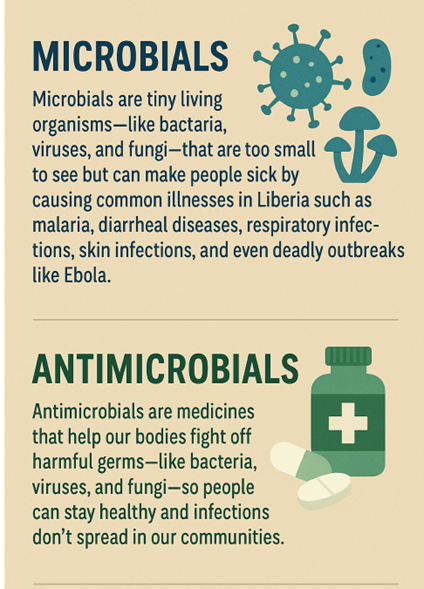
Antimicrobials are medicines that help our bodies fight off these microbials—so people can stay healthy and infections don’t spread in the communities. The Ministry of Health says there is no national data to show the number of Liberians who are being affected by this but says that common infections like pneumonia, urinary tract infections, and diarrhea are among the top five infections that have become harder to cure in the country.
A 2021 study by the Washington University found that the number of premature deaths associated with antimicrobial resistance that year was more than 4,000, making it the fifth largest killer of Liberians that year.
Children under five saw the highest number of deaths from anti-microbial resistance. The World Health Organization says it is among the top ten health threats in the world and estimates that by 2050, it could kill 4.1 million people across Africa.
Dr. Manyango says people must seek medical help before taking drugs to help fight against antimicrobial resistance in the country.
“You are not a doctor. You do not know what is happening to you,” Dr. Manyango says. “So that is why it is good to go to the hospital, be checked properly, before you take any medicines.”
The problem is not just that people are taking a drug that may not treat the illness they have. It’s also the way they are using them according to Dr. Plenseh McClain, chairperson of Medicinal Chemistry at the University of Liberia. Antimicrobials are not like pain killers to be taken until a patient feels better.
“Take it at the right dose. Do not keep some,” Dr. McClain says. “Even though they told you to take it for seven days, five days you feel well, complete it. Do not give it to another person who is sick. Let the person go to the hospital and get a diagnosis.”
Experts warn the dangers go even further. Antibiotic resistance can spread superbugs to animals, plants and surfaces spreading the dangers even further.

But Paul’s mother says the misuse of antimicrobial drugs is a culture in Liberia. Noone had ever told her to do anything else. Most Liberians purchase and take medicines without firstly seeing a doctor. Many cannot afford doctors’ visits and laboratory tests. Others say they do not trust the health care system.
“In Liberia, I can say it is normal,” she says. “We just walk in the pharmacy without prescriptions and just get antibiotics and other drugs.”
Dr. McClain, who co-authored a 2022 study on antimicrobial resistance in Liberia, agrees. Her research found that people are taking drugs anyhow because they are not educated about the repercussions.
“People taking this anyhow because of the poor knowledge, because of the poor awareness,” she says.
Cash-Strapped Government Faces Major Obstacles to Curbing Antimicrobial Misuse
The former administration of President George Weah unveiled a national action plan on antimicrobial resistance in 2018-2022. One key element was to improve the knowledge gap among Liberians and strengthen its evidence base by keeping track of people showing signs of resistance. About US$29 million was needed to execute the plan. Dr. Manyango, who was appointed under the administration of Joseph Boakai in 2024, says she did not receive any reports from her predecessor, Dr. Diana Smith, about that money or how it was spent.
Dr. Manyango says the health system is poorly equipped to respond to the challenge. It currently does not have the equipment to carry out testing for antimicrobial resistance. Only three hospitals in three of the four counties she refers to as hotspots have testing machines.
In countries with more developed health systems it is not legal or possible to buy anti-microbials – or a wide range of medicines – without a medical prescription.
Even with a prescription from a doctor, Liberians may struggle to find safe drugs. Liberia’s monitoring of imported medicines is limited and under-resourced, leaving gaps that allow expired, poor-quality, or even fake drugs to enter the country. The Authority has basic inspection and reporting systems in place, with weak border controls, limited laboratory capacity, slow reporting of side effects, and little use of digital tracking tools.
In September Liberia’s Medicines and Health Products Regulatory Authority hosted its first big conference on medicine safety to help protect people from dangerous or fake drugs. Health experts, government officials, and international partners met in Monrovia to discuss better ways to track medicines, monitor side effects. Authority leaders announced plans for a new “track and trace” system that can help stop expired, tainted, or poor-quality medicines from entering Liberia. Speakers from groups like the WHO and West African Health Organization explained that stronger cooperation and modern tools—including digital systems and real-world reporting — can help keep patients safe.
Dr. Luke Bawo of the Liberia Medicines and Health Products Regulatory Authority concedes the authority has a presence in only four of the 15 counties, making it difficult for them to carry out surveillance and monitor the importation, sales and consumption of drugs but he says new plans will change that.
“That has been a big battle because it has not been practiced before,” Dr. Bawo says. “We are combating it. We are trying to ensure that we reverse that and enforce the already laid down rules.”
Dr. Manyango says Liberia has taken some significant steps in the fight against antimicrobial resistance compared with neighboring countries. She points to the development of a national plan as a sign of the government’s commitment to the issue. But she says there must be a separate line in the national budget for antimicrobial resistance, saying that will boost the country’s efforts.
Patient advocates say the government needs to do more.
“If I am sick, I’m going across the road to the pharmacy that is open and I will buy from there,” says Martin Forkpah, of the nonprofit Consummate Health. “Because I believe the person in that pharmacy is a specialist. If that person is not, it is the responsibility of the government to shut them down.”
The Economic Burden of Antimicrobial Resistance
Paul ended up spending a week in hospital. That cost, on top of the money his mother had spent for endless courses of medicines, hit the family’s finances badly.
“When I got to the hospital, I thought it was something I could solve with $US50 dollars,” she says. “But before I left from there, I spent almost a thousand dollars.”
Mercy Swen also spent a huge chunk of money she didn’t have on medical bills when she became sick with severe stomach pain in 2022. Surprisingly, Mercy is a student of public health at the University of Liberia. Even she did not understand the dangers of what she was doing.
Mercy took a range of anti-microbial drugs without medical advice including amoxicillin, mycobacterium avium complex known as lady mac, as well as paracetamol for eight months but the pain did not go away. She eventually moved between two clinics and three hospitals over four years but no medication worked.
She is now left with ongoing pain. Mercy makes just L$1000 (US$5) a day selling sour milk to take care of herself and her younger sibling. She says she constantly has to go to some members of her family for financial assistance in order to pay her medical bills.
In a country where more than half of the population lives in poverty and most people struggle to afford basic needs, Mercy says many sick people will choose buying food over medicines.
“If you burning with fever, imagine you thinking what you will eat and then taking money to go buy medicine,” she says. “So you will calculate. You will say, ‘Let me just go buy food, I will eat it, I will get well.’”
Rising Drug Resistance Further Undermining Trust in Health Care System
Mercy’s experience has left her questioning if many health practitioners in the country know their jobs. It was not until the last facility she visited she someone told her that she was misusing the medicines and that the diseases in her body were resisting the drugs from curing her.
“I don’t think they have knowledge,” she says. “There are so many health care workers that don’t have knowledge on antimicrobials. They are not helping at all.”
Dr. Manyango of the health ministry agrees that the issue is undermining public trust but says they are working to address it.
“People go to the hospital and say “I’m taking the treatment, it’s not doing anything’. The doctor ain’t know his work,” Dr. Manyango says. “At the end of the day, they criticize the health system but these are some of the challenges.”
Dr. Luke Bawo of the regulatory authority says it has to take the effort of everyone, Including lawmakers and funders to fight this.
“Combating antimicrobials, it is not a vertical fight,” Dr. Bawo says. “It has to take the effort of everyone. Including lawmakers, including decision makers, including the funders to fund the strategies as well.”
Mercy now lives on herbal medicines and chemical drugs to reduce her pain each time it shows up. She takes moringa and guava leaves, alongside the pain relief, hoping that she will get a positive result when next she visits the hospital.
“I just decide on my own to take the herbs,” she says. ”Since the civilized side was not working, let me just try the country side.”
Paul’s mother is now an antimicrobial resistance advocate regrets giving her son drugs without going for a laboratory test. She now gives him vitamin C to help stop the cough but she has nothing else.
The pharmacist no longer sells certain drugs at her pharmacy without prescriptions. She says she is making plans to take her son outside of the country for further medical examinations.
“If I knew from the first start, I couldn’t have just given random antibiotics like that,” she says. “I could have just wait for doctor to prescribe those antibiotics before administering it to my child.”
This report is a collaboration with New Narratives as part of the “Investigating Liberia” project. Funding was provided by the Swedish embassy in Liberia which had no say in the story’s content.