
By Anthony Stephens, senior justice correspondent with New Narratives
Summary:
- A Liberian civil war survivor says the deportation of former LURD commander Mayama Sesay, also known as “Black Diamond,” has left him fearing for his safety.
- He alleges Sesay ordered the killing of his sister in 2003 and later oversaw his assault, and says he has received death threats linked to another ex-rebel commander, Laye Sekou Camara.
- Human rights advocates warn that returning accused war crimes suspects without a war crimes court in place risks intimidating witnesses.
- Liberia’s Witness Protection Agency says the government is treating witness safety as a priority and is working to assess threats and provide support.
In July 2003, N. says he watched armed fighters kill his sister during Liberia’s civil war—an attack he says was ordered by former rebel commander Mayama Sesay, known as “Black Diamond.” More than two decades on, he says the memory of the gunfire, the panic, and the loss has never faded.
So the news that Sesay had been deported from the United States in September after she had been found to have violated immigration procedures there by lying about her wartime record, has left him and other survivors living in fear. (N. is his first initial. FrontPage Africa/New Narratives is hiding his identity to protect him from retaliation.) N. testified via video-link to prosecutors in the investigation against Sesay.
Although deportees are traditionally received by family members upon arrival, officials have provided few details about who took custody of Sesay. Laurie Massaquoi Page, spokeswoman for the Liberia Immigration Service, told FPA/NN that Sesay was “signed for by a family member,” but provided no details. Nothing has been heard publicly about Sesay’s whereabouts since her return.
“Her being in the country is a threat to all of us,” says N. “We are afraid. When I am sleeping, I watch over everything I do. When I am going home, I am afraid of going home.”
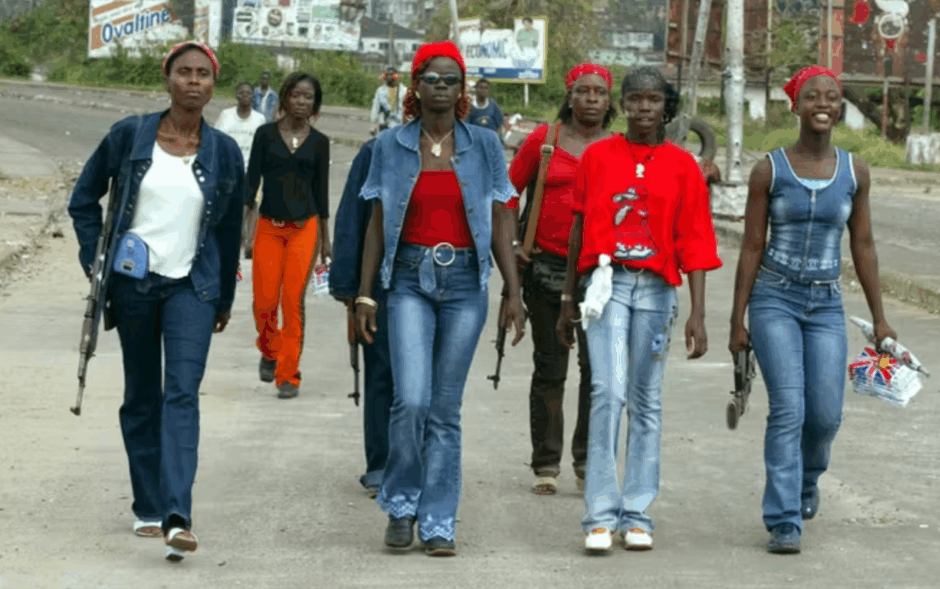
Sesay, who led a feared all-female fighting unit known as the “Women’s Artillery Commandos” during the war, according to U.S. Immigration and Customs Enforcement, fought with the rebel group Liberians United for Reconciliation and Democracy, or Lurd, which the Truth and Reconciliation Commission later found was responsible for the second-highest number of reported wartime violations — 18,797 abuses, or 12 percent of all violations the commission documented.
N. says he and his sister had left their home in Caldwell, on the outskirts of Monrovia, searching for food at the Freeport of Monrovia, the country’s largest seaport. Fighters on the ground had allowed civilians to take rice from a shipping container.
Then, he says, Sesay arrived, furious.
“‘Who gave these dogs the rice?’” N. recalls Sesay asking her fighters. Moments later her troops opened fire into the container where unarmed civilians were taking rice from.
“The bulk of them that died in the container were women because only few men were there,” says Sackie. “Roughly about 6-10 persons were there, including my sister.”
N. says the killing of his sister was not the only abuse he suffered. Weeks later, he says, he was assaulted by Sesay’s bodyguards while she looked on. He recalls fetching water from a community well when armed men stopped him.
“They said ‘put the water down,’” he says. “When I put the water down, they said ‘open your mouth.’ I opened my mouth; they put rock inside. They knocked me with the gun butt. That what took out the three teeth from my mouth. She (Sesay) was there. She did not talk.”
The commission’s final report, released in 2009, does not name Sesay. But analysts note that the absence of her name does not amount to exoneration. The commission itself acknowledged that it documented only a fraction of crimes committed during the war.
N. says his fear is well founded. He says he has previously received death threats from Laye Sekou Camara, known as “K-1,” another former rebel commander, and was forced to relocate multiple times.
Last year, N. was among 17 Liberians who traveled to Philadelphia to testify against Camara in a U.S. federal case. Camara ultimately pleaded guilty to criminal immigration fraud and was sentenced to nearly five years in prison. (Prosecutors had asked for a 40-year sentence.) The judge credited witness testimony for his finding that Camara was guilty of killings during the second Liberian civil war, including the murder of N’s brother.
Despite the threats N. says he has no regrets.
“I felt relieved that at least justice has been served,” says N. “I do not regret. I wanted justice for my brother.”
But he says the threats have not stopped and he is concerned that Camara will be returned to Liberia as early as 2029.
“My life is not safe,” he says. “My life is in danger. The man knows me personally. Some of his bodyguard know me personally.”
Human rights advocates say the fear voiced by witnesses like N underscores the urgency of establishing Liberia’s long-promised war crimes court. Hassan Bility, director of the Global Justice and Research Project, says seven witnesses in U.S. and European cases involving alleged Liberian war crimes, including N. have been relocated in the past six months because of security threats. Bility says the witnesses now fear for their lives. His organization conducts the investigations with Civitas Maxima, a Switzerland-based partner, in cooperation with national investigators and prosecutors.
“When the witness is located and they look at the individual who was deported to Liberia, and some of the things they did during the war, they begin to feel that individual is still capable of doing that, either directly or indirectly,” Bility says. “What this does is that it discourages the victims and witnesses to come forward again. It certainly is a grave reason to be worried. It is very, very, troubling. Of course, it’s causing chaos among witnesses.”
Bility urges the government to act swiftly to protect witnesses and signal that intimidation will not be tolerated.
“The government should make sure that they have the message for the public, ‘if you intimidate witness, if you threaten a witness, if you attack the witness and all victims, we will get you,’” he says. “That is very important. The government remaining silent on these issues is somewhat, in my view, discouraging.”
In a phone interview, Maxwell Grigbsy, director of the Witness Protection Agency of Liberia, said the government “sees the issue as a priority.”
“The government is prepared to work with this witness to evaluate the threat level,” says Grigsby. “And as much as we can, the government will provide support to ensure that the level of threat is minimized or elimenated.”
Sesay is the second accused Liberian warlord deported from the United States, following the removal of George Boley, a former rebel leader with the Liberia Peace Council, in 2012. Two others have been found guilty. Mohammed Jabbateh of the Ulimo rebel group is serving a 30-year sentence after being convicted in the same federal court in 2017. He will be deported at the end of his sentence. Tom Woewiyu, second in command to Charles Taylor of the National Patriotic Front of Liberia, was convicted in 2018 and was awaiting sentencing when he died of Covid in 2021.
Camara will return to Liberia two years after the anticipated war and economic crimes court is set to become operational. He would be eligible to face prosecution in that court because his U.S. conviction was for immigration fraud, not war crimes.
The Office of the War and Economic Crimes Court of Liberia, which is overseeing the establishment of both the war crimes court and a national anti-corruption court, recently submitted its long-delayed bills to Oswald Tweh, Liberia’s justice minister, and Bushuben Keita, President Boakai’s legal adviser. The bills will be reviewed by Tweh, the Cabinet and Boakai before being sent to the Legislature for approval — a process that could take weeks, or even months.
N. says he is willing to testify when the court is formed.
“Not only justice for my sister, but everybody that was in that container that died,” says N. “Because some of the people that were in the container, their parents were not around. So, we will tell the law that she did it. And those people that died, at least when they are in their graves, they got justice.”
This story is a collaboration with New Narratives as part of the “Investigating Liberia” project. Funding was provided by the Swedish Embassy in Liberia. The funder had no say in the story’s content.