
By Joyclyn Wea and Tetee Gebro with New Narratives
Summary
- Liberia’s national digital identity system is still stalled because the Registry says it cannot fully access the biometric database until the government pays a US$1.7 million debt to the company that built it.
- Millions of people are still outside the system, while many cards have expired, and even earlier registrants were locked out of the ID system, which is the key to many public services.
- A committee set up to restart the rollout has one more month to report. Civil society groups say the longer the delay continues, the more public trust will drop.
Seven months after President Joseph Boakai halted Liberia’s national digital identity card rollout to “fix the system,” the National Identification Registry says Liberia still cannot run the system because it is locked by the Kenyan company that built it. The Registry says the company will only release access after the government clears a $US1.7 million debt owed to it.
Millions of Liberians are still not enrolled, and expired ID cards are piling up. Even the 640,000 Liberians who were signed up under a previous version of the digital database, which electronically stores “biometric data” – meaning photographs and fingerprints, cannot access it. A $2 million tranche of World Bank funding for the expansion of the centers is on hold.
“This is a security risk. Liberia cannot sacrifice its national identification card,” Eddie Jarwolo, executive director of Naymote Partners for Democratic Development, a leading accountability group in Liberia.
The program was part of component one of the $US30 million World Bank-funded Governance Reform and Accountability Transformation Project, designed to “enhance access to selected digitally provided public services, raise tax revenues, and improve the openness of accountability institutions.” A national digital identity card was meant to store digital information of all Liberians, linked to SIM cards, to allow easy and transparent access to the electoral system, taxation, banking, and other public services.
Such systems have been rolled out in countries across Africa as an important way to modernize public services and ensure no one is left out. The government had committed to registering another two million Liberian adults on the system before 2030. But that has ground to a halt.
Last April, President Boakai unveiled the expanded rollout and gave all Liberians until August to register. But it soon became clear that the government had not put enough staff and offices in place to process all citizens.
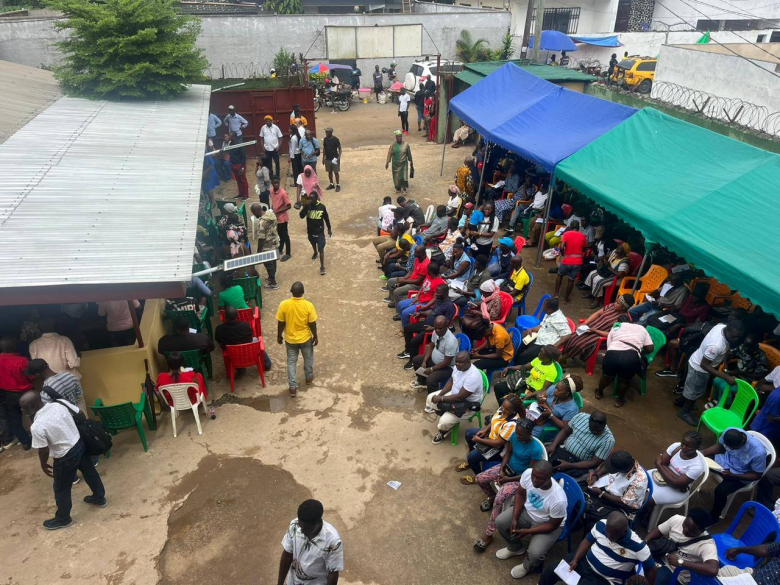
By June, thousands of citizens were angry at being forced to wait in long lines only to be rejected from service for days on end. FrontPage Africa/New Narratives reported that, with 15 centers in Monrovia processing about 85 people a day, it would have taken more than three years to process Monrovia’s population of more than a million adults. And six years to process the two million people the government had committed to enroll.
In the meantime, many people, including elderly and other vulnerable citizens, were being locked out of banking, government, and communications services, which were now mandated to demand ID cards from customers. President Boakai suspended the rollout a week later.
New Narratives/FrontPage Africa found that the rollout chaos came because the Registry did not have access to the new system and did not have the World Bank funds to expand the number of centers, because it owed $1.7 million to Techno Brand, the Nairobi-based firm that built the Registry’s system for $5.9 million.
Seven months later, that debt has still not been paid. Nyema said the $1.7 million is not in the 2026 approved budget for the Registry by the Legislature. A committee put in place by President Boakai was drawn from the key agencies tied to identity, elections, banking, and telecoms, including Internal Affairs, Foreign Affairs, Post and Telecommunications, the Central Bank, the National Elections Committee, the senior economic advisor, and the President’s Delivery Unit. The committee was told to deliver a new rollout plan by April 13, 2026, just a month away.
Samuel Kofi Woods, national security adviser to President Boakai, put in charge of the committee, declined a request for comment, referring reporters to the Registry.
Andrew Peters, the registry’s executive director, declined to be interviewed and referred reporters to Sylvester Nyema, deputy director, who took the job in September, after the suspension. Nyema said Woods’ committee has not shared any report with the Registry management, and he could not say when it would report to the president.
Nyema said the Registry has been pushing for a solution and is in talks to raise money, including potentially borrowing it. He also said that anyone who was registered before the halt can go to the Registry headquarters in Congo Town and receive their card.
There is no information campaign to notify the public of that fact. Liberians are being forced to use passports or election cards as identity cards to do banking or other government services.
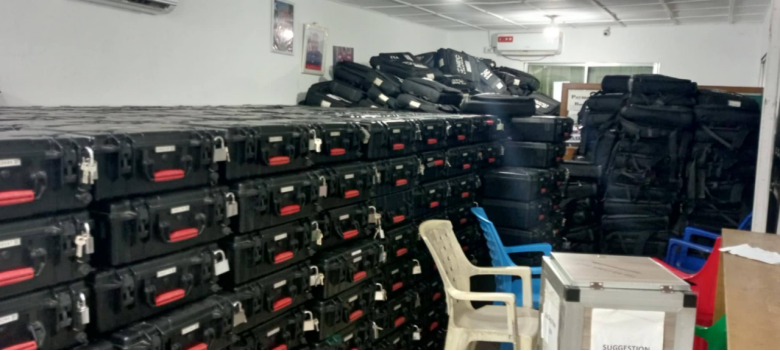
500 biometric voter kits turned over to the Registry by the National Elections Commission. Credit: Registry Facebook page.
Meanwhile, civil society and transparency warned the long delay in restarting the process is causing distrust among the public. Jarwolo said he visited the Registry in December to see what had changed. He said some issues had been addressed, including steps meant to improve the quality of the card.
The Registry has also pointed to support from the National Elections Commission. In a July 2025 Facebook post, the Registry said Commission turned over 500 enrollment kits that could help expand enrollment sites nationwide.
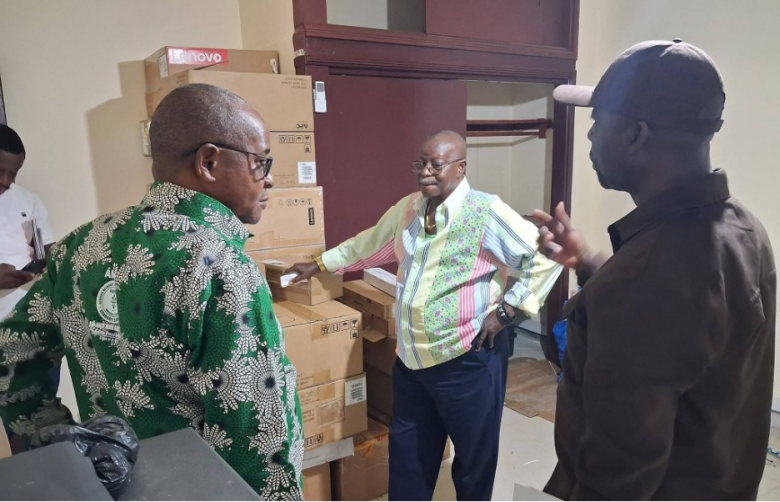
Jarwolo said low enrollment is a national risk. He warned that weak identity systems can expose Liberia to fraud and political manipulation. He also criticized what he described as a push for private actors to carry costs upfront in a country where repayment is uncertain.
Jarwolo questioned how serious the steering committee process has been.
“The political will is lacking,” he said. “At the moment, they are compromising the security of the country.”
He warned that the longer the system stays stalled, the worse public doubt will grow. “The more they don’t work, the more the mischief will get out there,” he said.
This story was a collaboration with New Narratives as part of the Investigating Liberia project. Funding was provided by Susan and David Marcinek and the Swedish Embassy in Liberia. The funders had no say in the story’s content.